 by Madison Dental Art Review Board
More than 40 million Americans are missing all of their teeth in at least one arch, and tens of millions more are missing several teeth, yet a large share of them never pursue tooth replacement because they fear rigid, bulky, or uncomfortable appliances. Flexible dentures have quietly changed that conversation. If you have been asking yourself what are flexible dentures and whether they might be the right solution for your smile, this guide gives you a thorough, plain-language answer based on the most current clinical evidence available in 2026.
Table of Contents
Key Takeaways
- Flexible dentures are made from a soft thermoplastic nylon resin rather than the hard acrylic plastic used in traditional dentures.
- They are most commonly used as partial dentures, replacing a few missing teeth while the remaining natural teeth stay in place.
- Their advantages include a lighter weight, a more natural appearance, and the elimination of metal clasps.
- Flexible dentures are not ideal for every patient; certain clinical situations call for traditional acrylic, cast-metal, or implant-supported options instead.
- A prosthodontic evaluation at a full-service dental practice is the best way to determine which type of denture is right for your specific needs.
Comprehending What Flexible Dentures Are and How They Work
So, what are flexible dentures, exactly? At their core, flexible dentures are removable dental prostheses fabricated from a thermoplastic nylon resin, most commonly a material marketed under names such as Valplast or TCS. Unlike conventional acrylic dentures, which are rigid and rely on metal wire clasps to grip neighboring teeth, flexible dentures are designed to bend slightly under pressure, conforming to the natural contours of the gum tissue and remaining teeth.
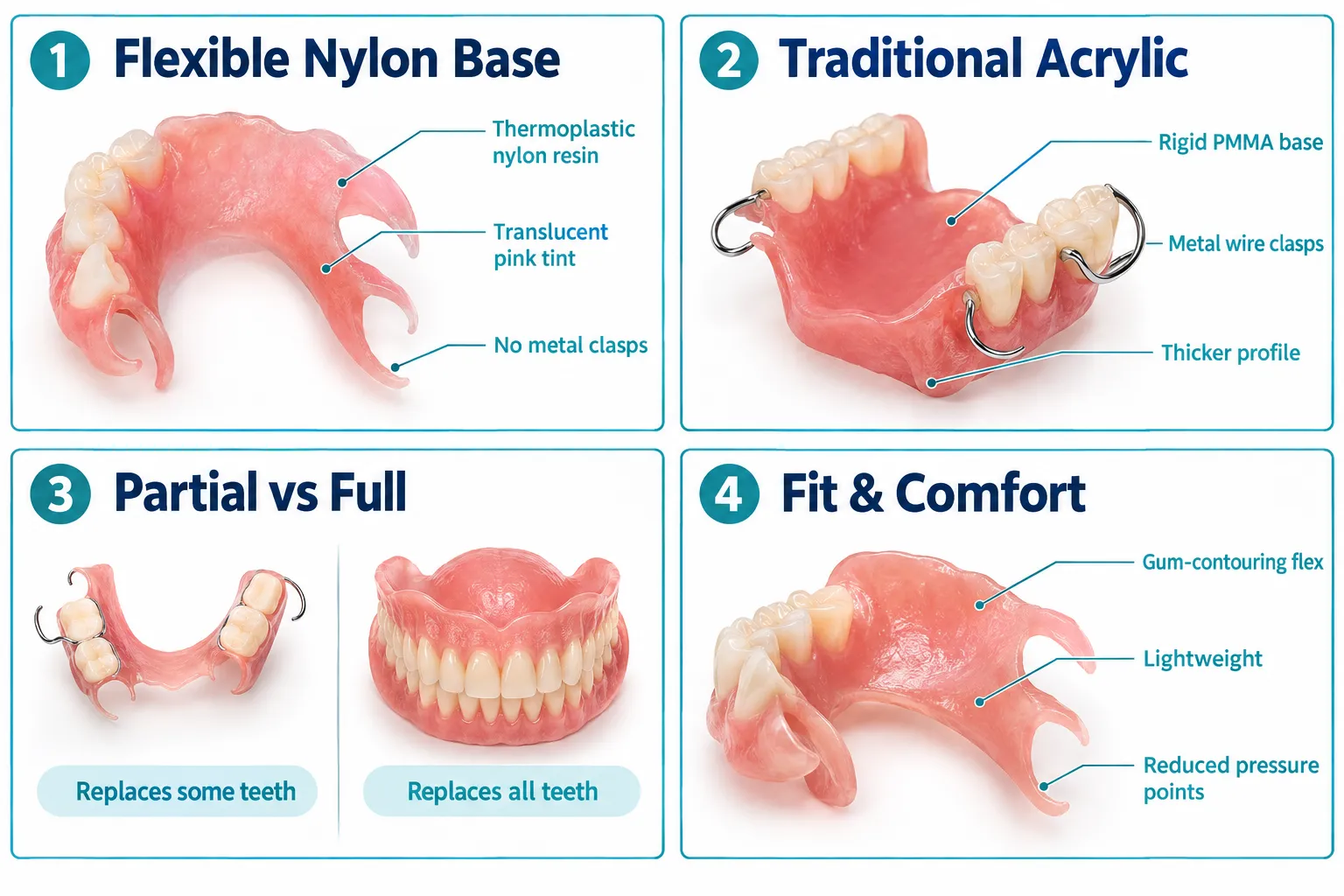
The base of a flexible denture is typically translucent or tooth-colored pink, which means the clasps that anchor the prosthesis blend into the gum tissue rather than showing as silver metal. This single design feature is one of the most frequently cited reasons patients choose flexible partial dentures over conventional alternatives, especially when the missing teeth are toward the front of the mouth where aesthetics matter most.
How the material works: Thermoplastic nylon is processed at high temperatures in a dental laboratory. The softened material is injected into a custom mold taken from precise impressions of your mouth. Once cooled, the nylon hardens into a strong yet slightly pliable appliance. The controlled flexibility allows the denture to distribute chewing forces across a wider surface area, which many patients report feels more comfortable than the concentrated pressure of a rigid base.
Flexible Partial Dentures vs. Full Flexible Dentures
The most common application is the flexible partial denture, used when a patient still has some healthy natural teeth remaining. These partials use tooth-colored clasps that wrap around adjacent teeth, holding the prosthesis securely without the visual intrusion of metal.
Full flexible dentures, replacing an entire arch of missing teeth, are less common. Because a full denture relies heavily on suction and close contact with the gum ridge for retention, the slight flexibility of the base can sometimes work against stability. Most clinicians reserve the flexible design for partial applications and evaluate full-arch cases individually.
For patients weighing all their tooth-replacement options, it helps to understand how flexible partials compare to other solutions. Our overview of dental implants vs dentures covers the broader landscape of choices available today.
The Benefits, Limitations, and Clinical Considerations of Flexible Dentures
Comprehending what flexible dentures can and cannot do is essential before making any treatment decision. The research picture in 2026 is more nuanced than early marketing suggested, and an honest look at both sides helps patients set realistic expectations.
Main Benefits
1. Aesthetics The translucent pink clasps mimic gum tissue so closely that most people cannot tell a flexible partial is in place. For patients who are self-conscious about their smile, this is a meaningful advantage over metal-clasp partials.
2. Comfort and Lightweight Feel Thermoplastic nylon is significantly lighter than acrylic resin or cast metal. Patients who have transitioned from traditional acrylic partials to flexible dentures frequently report a reduction in gum soreness and a more natural feel during everyday activities.
3. No Metal Components For patients with metal sensitivities or allergies, flexible dentures offer a metal-free alternative. There are no wire clasps that can irritate soft tissue or cause pressure sores.
4. Durability Against Fracture Because the base flexes rather than resisting stress rigidly, flexible dentures are less prone to cracking or shattering if accidentally dropped, a practical advantage for daily wear.
5. Faster Adjustment Period Many patients report adapting to flexible partial dentures more quickly than to traditional rigid partials. If you are curious about what that adjustment process looks like in general, our article on whether dentures are comfortable and how to adjust to them offers helpful context.
Limitations to Know
Clinical Note:Flexible dentures are not universally suitable. Your dentist or prosthodontist must evaluate your bone density, remaining teeth, bite alignment, and overall oral health before recommending any prosthetic option.
- Not easily relined or repaired. Unlike acrylic dentures, which can be relined as the gum ridge changes shape over time, thermoplastic nylon is difficult to adjust chairside. If your jaw ridge resorbs significantly, a new prosthesis may be needed sooner.
- Limited suitability for large spans. When many consecutive teeth are missing, a flexible partial may lack the rigidity needed for stable chewing. Cast-metal frameworks or implant-supported options often perform better in these cases.
- Cannot support dental implants directly. Flexible nylon is not compatible with implant attachments in the same way that rigid frameworks are. Patients interested in implant-retained solutions should discuss cast-metal or milled options with their provider.
- Potential for staining over time. The nylon material can absorb pigments from coffee, tea, and certain foods more readily than polished acrylic, requiring diligent cleaning habits.
For patients who are still deciding whether to pursue dentures at all, our guide on whether to save your teeth or get dentures walks through that decision in detail.
Who Is a Good Candidate?
Flexible partial dentures tend to work best for patients who:
- Are missing one to several teeth with healthy adjacent teeth remaining
- Have mild to moderate bone support in the jaw
- Prioritize aesthetics and comfort over maximum chewing force
- Have a metal sensitivity or allergy
- Need a transitional prosthesis while planning for dental implants
If you are missing back teeth specifically, our article on partial dentures with no back teeth addresses that unique situation in depth.
What Happens If You Delay Tooth Replacement?
Leaving a gap from a missing tooth is never a neutral decision. Neighboring teeth drift, the jawbone beneath the empty space begins to resorb, and bite alignment can shift over time. Our resource on what happens if you don’t replace a missing tooth explains the long-term consequences clearly.
The Process of Getting Flexible Dentures at Madison Dental Art
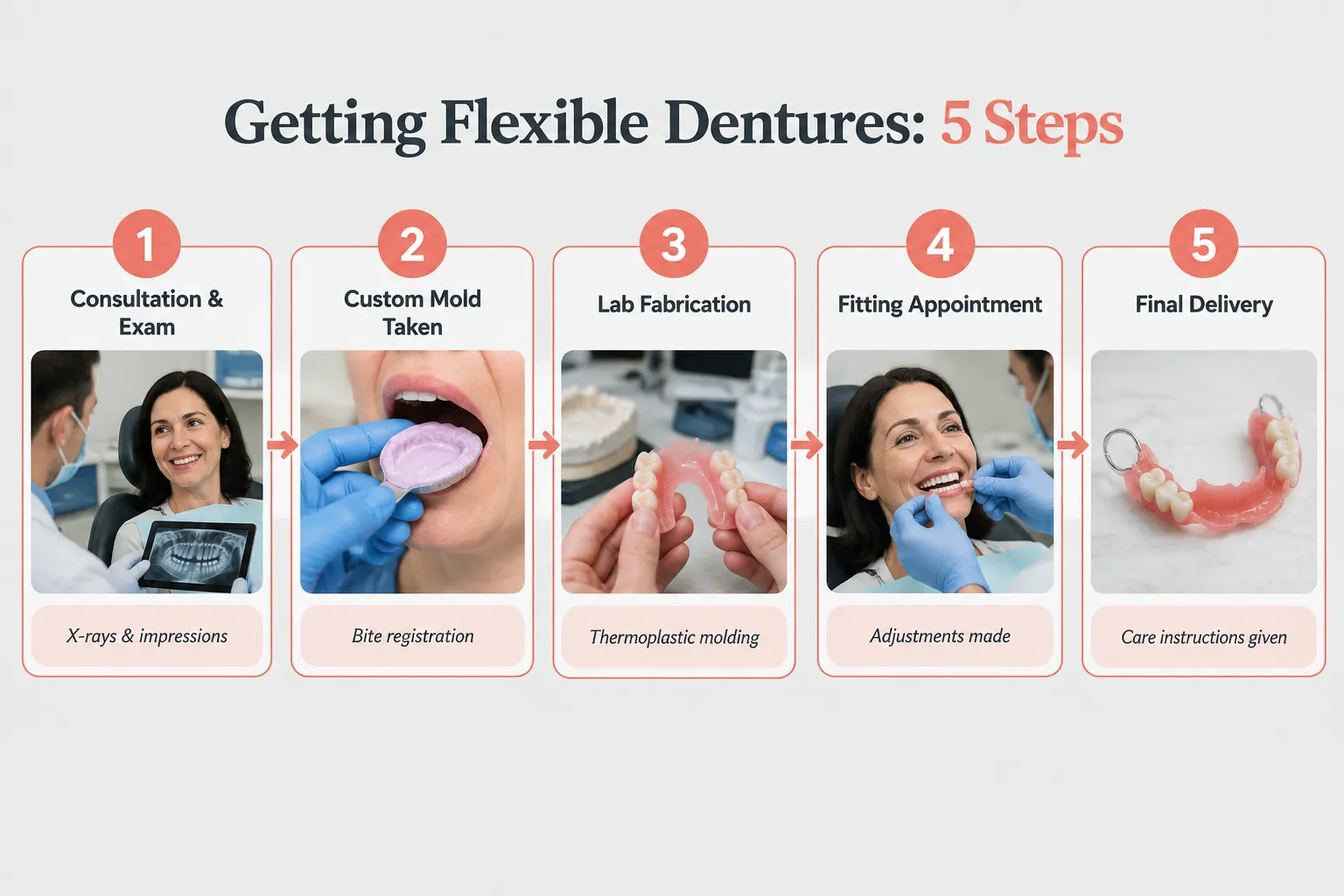
At Madison Dental Art, serving Forest Hills, Queens, and the greater New York City area since 1994, the process of obtaining flexible dentures follows a careful, patient-centered path.
- Comprehensive Evaluation, Your dentist will review your medical and dental history, take digital X-rays, and assess the health of your remaining teeth and gum tissue.
- Impressions and Bite Registration, Precise impressions of your upper and lower arches are taken to create an accurate model for the dental laboratory.
- Laboratory Fabrication, A skilled dental lab technician injects thermoplastic nylon into your custom mold. This process typically takes one to two weeks.
- Fitting Appointment, Your dentist seats the denture, checks your bite, and makes any necessary adjustments for comfort and function.
- Follow-Up Care, A follow-up visit ensures the prosthesis is performing well and that your gum tissue is responding normally.
Our prosthodontics page provides a full overview of the denture and bridge services available at our practice. For patients who want to understand the full spectrum of permanent options alongside removable prostheses, our guide on what permanent dentures are and how they work is a valuable companion read.
Cost and Insurance
The cost of flexible partial dentures varies depending on the number of teeth being replaced, the complexity of the case, and the laboratory used. In 2026, flexible partials generally fall in a mid-range price tier, typically more affordable than implant-supported solutions but sometimes higher than basic acrylic partials due to the specialized materials involved. For a broader look at denture pricing, our article on how much a set of dentures costs provides helpful benchmarks.
Many dental insurance plans include partial denture coverage, though the extent of coverage varies by plan. Madison Dental Art accepts multiple insurance plans, visit our insurance page for details, or call us at (718) 268-8228 to speak with a team member.
FAQs:
How long do flexible dentures typically last?
With proper care, flexible partial dentures generally last between five and eight years. However, because the jaw ridge changes shape over time due to natural bone resorption, some patients find they need a replacement or a new prosthesis sooner. Regular dental checkups help monitor fit and catch any issues early.
Can I eat normally with flexible dentures?
Most patients can eat a wide variety of foods comfortably with flexible partial dentures. Sticky, very hard, or extremely chewy foods should be approached with caution, particularly during the initial adjustment period. Our article on whether you can eat with dentures covers practical eating tips in detail.
Are flexible dentures better than traditional acrylic dentures?
Neither type is universally superior, the best choice depends on your individual clinical situation. Flexible dentures offer aesthetic and comfort advantages for many patients, while traditional acrylic dentures are easier to reline, repair, and adjust over time. A prosthodontic consultation is the most reliable way to determine which option suits your specific needs.
Can flexible dentures eventually be replaced with dental implants?
Yes, in many cases. Wearing a flexible partial denture does not permanently prevent you from pursuing dental implants later. Nevertheless, the health of your jawbone at the time of implant placement matters significantly. Our article on getting dental implants after dentures explains what that transition involves.
References
- American College of Prosthodontists. (2023). Removable partial dentures: Patient information. https://www.prosthodontics.org/patient-education/removable-partial-dentures/
- American Dental Association. (2022). Dentures. https://www.ada.org/resources/research/science-and-research-institute/oral-health-topics/dentures
- National Institute of Dental and Craniofacial Research. (2021). Tooth loss in adults (age 20 to 64). https://www.nidcr.nih.gov/research/data-statistics/tooth-loss/adults
- MedlinePlus / U.S. National Library of Medicine. (2023). Dentures. https://medlineplus.gov/ency/article/001910.htm
- University of Michigan School of Dentistry. (2022). Flexible partial dentures: Clinical considerations and patient selection. https://dent.umich.edu/
Madison Dental Art
Content written and reviewed by
Madison Dental Art Review Board
Madison Dental Art : Experienced dentists and specialists dedicated to providing accurate, trusted, and patient-focused oral health information.
Important information
The content of this article is for strictly educational and informational purposes. It does not replace in-person professional medical diagnosis, advice, or treatment.


