 by Madison Dental Art Review Board
More than 36 million Americans have no remaining natural teeth, yet millions more are facing the exact crossroads you may be standing at right now, wondering whether to fight to keep what they have or start fresh with dentures. The question of should I save my teeth or get dentures is one of the most consequential decisions in dental health, and the answer is rarely one-size-fits-all.
Your natural teeth are living structures anchored in bone, connected to nerves, and designed to last a lifetime with proper care. Dentures, on the other hand, are a proven, time-tested solution when natural teeth can no longer be saved or when keeping them causes more harm than good. Deciding between these two paths requires an honest look at your current oral health, your budget, your lifestyle, and your long-term goals.
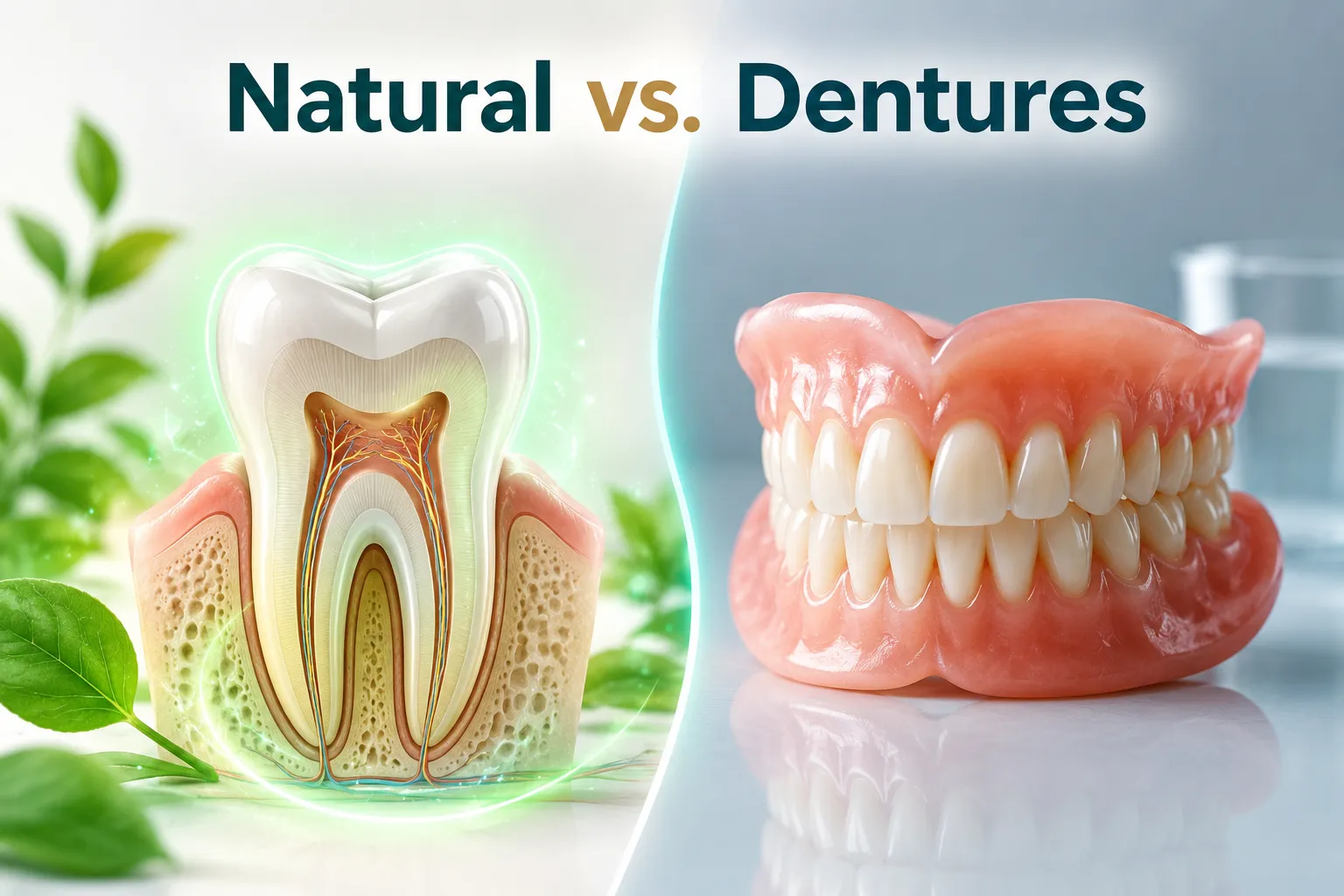
Table of Contents
Key Takeaways
- Saving natural teeth is almost always the preferred option when the tooth structure, bone support, and surrounding gum tissue are still viable.
- Several clinical factors, including bone loss, infection severity, and financial cost, can tip the decision toward dentures.
- Modern denture options, including implant-supported dentures, offer significantly better function and comfort than older generations of removable appliances.
- A thorough evaluation by a qualified dental team is the only reliable way to know which path is right for your specific situation.
- Patients in Forest Hills and greater NYC have access to full-spectrum restorative care under one roof at Madison Dental Art.
Why Saving Your Natural Teeth Is Usually the First Priority
Dentists operate under a foundational principle: preserve natural tooth structure whenever clinically possible. Your natural teeth do far more than chew food. They stimulate the jawbone, maintain facial structure, support neighboring teeth, and contribute to clear speech. When a tooth is lost, the bone beneath it begins to shrink, a process called resorption, which can alter your facial appearance over time.
When saving a tooth makes clear sense:
- The tooth has a cavity or decay that has not yet reached the root tip
- The tooth is cracked but the fracture does not extend below the gumline
- Gum disease is present but in its early to moderate stages, where dental teeth scaling and periodontal treatment can stabilize the situation
- The tooth has an infected pulp that can be resolved with a root canal
- The tooth is loose but the underlying cause, such as gum disease, can still be treated effectively
If you are dealing with a tooth infection or persistent pain, that does not automatically mean extraction is the answer. Many infected teeth respond well to endodontic treatment followed by a crown.
“The goal is always to keep what nature gave you, but only when keeping it serves your health, not just your sentiment.”
At Madison Dental Art, our team evaluates every tooth on its own merits. Dr. Alexander Chao, who graduated in the top 3% of his class at NYU College of Dentistry, leads a practice built on the principle that preservation comes first. When gum disease threatens tooth retention, our periodontology specialist Dr. Robert Weber, a Diplomate of the American Board of Periodontology, provides advanced interventions including osseous surgery and scaling to give your natural teeth the best possible chance.
If you are concerned about how long teeth can realistically survive with gum disease, our article on how long you can keep your teeth with periodontal disease offers a detailed breakdown.
When the Answer to “Should I Save My Teeth or Get Dentures” Shifts Toward Dentures
There are situations where extraction and dentures become the more responsible clinical recommendation. Holding onto teeth that cannot be saved delays necessary treatment, increases costs, and can cause ongoing pain, infection, and bone loss.
Clinical signs that dentures may be the better path:
- Severe bone loss: When more than 50% of the supporting bone around a tooth is gone, long-term retention becomes unlikely even with aggressive treatment.
- Teeth that are non-restorable: A tooth broken at or below the gumline typically cannot support a crown and must be extracted.
- Advanced, uncontrolled periodontal disease: If multiple teeth are severely mobile and the infection has spread widely, comprehensive extraction followed by dentures may be more effective than trying to save each tooth individually.
- Repeated treatment failures: If a tooth has had multiple root canals, failed crowns, or recurring infections, continued investment may not be justified.
- Financial and quality-of-life considerations: Saving a tooth can sometimes cost more than the tooth is functionally worth, particularly when several teeth require simultaneous, complex treatment.
If you are already facing the possibility of full or partial tooth loss, knowing your denture options is essential. Our guide to what permanent dentures are and how they work is a helpful starting point, as is our comparison of implant dentures vs. traditional dentures for patients weighing stability and long-term function.
The Middle Ground: Partial Dentures and Implants
Not every case is all-or-nothing. Many patients benefit from keeping some healthy natural teeth while replacing others with partial dentures or dental implants. Implant-supported restorations, in particular, address the bone resorption problem that standard dentures cannot solve. If you have already had dentures and are now considering implants, our article on getting dental implants after dentures explains what that transition involves.
A Side-by-Side Look at Essential Factors
| Factor | Saving Natural Teeth | Getting Dentures |
|---|---|---|
| Bone preservation | Maintained naturally | Bone resorption continues over time |
| Chewing efficiency | Near-normal | Reduced, especially with removable dentures |
| Treatment timeline | Can be lengthy | Faster path to a complete smile |
| Maintenance | Brushing, flossing, checkups | Daily cleaning, periodic relining |
| Long-term cost | Higher upfront, lower over time | Lower upfront, ongoing adjustments |
What the Evaluation Process Looks Like
Answering the question of should I save my teeth or get dentures requires a thorough clinical assessment, not a guess based on symptoms alone. At Madison Dental Art, that process typically includes:
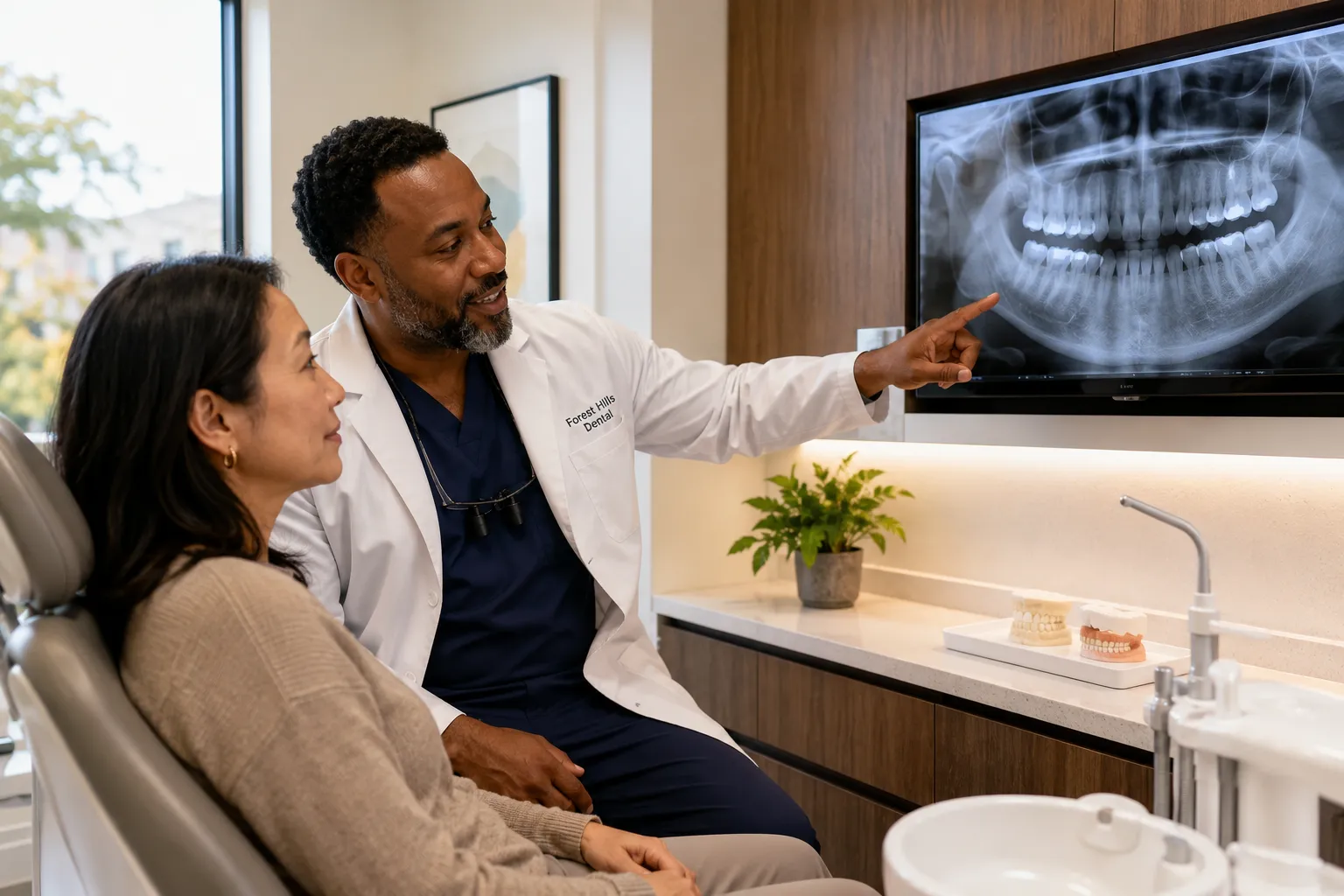
- Digital X-rays and 3D panoramic scanning to assess bone levels, root integrity, and the full jaw structure
- Periodontal probing to measure gum pocket depths and bone attachment
- Pulp vitality testing to determine whether nerve tissue is still healthy
- A full medical and dental history review, since conditions like diabetes and osteoporosis affect healing and treatment outcomes
If you are wondering how often you should be getting these evaluations to catch problems early, our resource on how often you should get a dental checkup provides clear guidance.
For patients who ultimately choose dentures, our prosthodontics team in Forest Hills provides custom-fitted appliances designed for comfort, function, and natural appearance. And if you are in the transition period between extraction and your final denture fitting, our article on what to eat with no teeth while waiting for dentures offers practical day-to-day guidance.
FAQs
Can a loose tooth be saved, or does it always need to come out?
A loose tooth does not automatically require extraction. The outcome depends on the cause. Looseness from gum disease may be reversible with periodontal treatment, scaling, and improved home care, especially if caught early. Nevertheless, a tooth that is severely mobile due to advanced bone loss, trauma, or a root fracture is often not salvageable. A clinical exam with X-rays is the only way to determine which situation applies to you.
Are dentures comfortable to wear every day?
Modern dentures are far more refined than they were even a decade ago. Most patients adapt within a few weeks, though there is an adjustment period. Fit is the single most important factor in comfort, poorly fitted dentures cause sore spots, difficulty chewing, and speech changes. Custom-fitted dentures made by a skilled prosthodontist minimize these issues significantly.
How does saving or extracting teeth affect jawbone health long-term?
Natural tooth roots stimulate the jawbone every time you bite and chew, which signals the body to maintain bone density in that area. When a tooth is extracted and not replaced with an implant, the bone beneath it gradually shrinks. Over years, this can change your facial profile and make denture fitting more challenging. Implant-supported dentures are the only denture option that partially addresses bone stimulation, which is one reason they are often recommended for younger patients or those with significant remaining bone volume.
What does it cost to get dentures compared to saving teeth?
Costs vary widely depending on the number of teeth involved, the type of restoration chosen, and your insurance coverage. Saving a single tooth through a root canal, post, and crown can range from several hundred to over a thousand dollars per tooth. A complete set of dentures involves different cost considerations. For a detailed breakdown, visit our article on how much a complete set of dentures costs.
References
- Petersen, P. E., & Ogawa, H. (2023). Prevention of dental caries through the use of fluoride, the WHO approach. Community Dentistry and Oral Epidemiology, 51(1), 3-10. https://doi.org/10.1111/cdoe.12839
- American Academy of Periodontology. (2022). Gum disease information: Periodontitis. https://www.perio.org/consumer/gum-disease.htm
- National Institute of Dental and Craniofacial Research. (2021). Dental caries (tooth decay). U.S. Department of Health and Human Services. https://www.nidcr.nih.gov/research/data-statistics/dental-caries
- American College of Prosthodontists. (2022). Facts and figures about edentulism. https://www.prosthodontics.org/assets/1/7/ACP_Facts_and_Figures_for_Edentulism.pdf
- Tonetti, M. S., Chapple, I. L. C., Jepsen, S., & Sanz, M. (2023). Primary and secondary prevention of periodontal and peri-implant diseases: Introduction to, and objectives of the 11th European Workshop on Periodontology consensus conference. Journal of Clinical Periodontology, 50(S26), 1-4. https://doi.org/10.1111/jcpe.13783
- Centers for Disease Control and Prevention. (2021). Oral health data: Adults with all teeth lost. https://www.cdc.gov/oralhealth/data_statistics/adult.htm
Madison Dental Art
Content written and reviewed by
Madison Dental Art Review Board
Madison Dental Art : Experienced dentists and specialists dedicated to providing accurate, trusted, and patient-focused oral health information.
Important information
The content of this article is for strictly educational and informational purposes. It does not replace in-person professional medical diagnosis, advice, or treatment.


