 by Madison Dental Art Review Board
Nearly 40 million Americans are missing all of their teeth in one or both jaws, and tens of millions more are missing at least one back tooth, yet many of them never seek treatment because they assume the gap “doesn’t show.” That silence comes at a steep cost. If you are wondering can you get partial dentures with no back teeth, the honest answer is: yes, but the situation is more complex than replacing a missing front tooth, and the solution requires careful planning with a qualified dental professional.
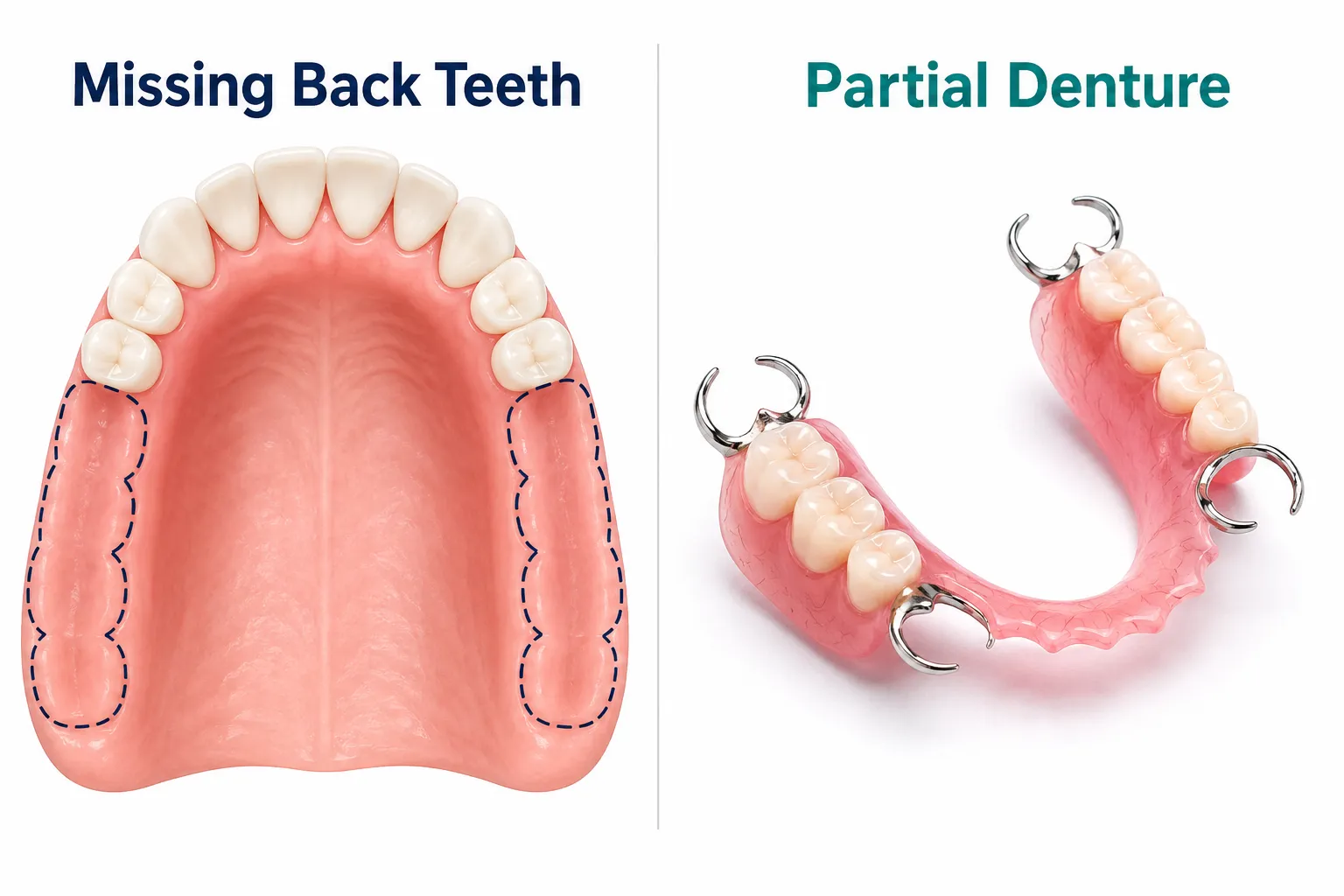
Table of Contents
Key Takeaways
- You can get partial dentures with no back teeth, but missing posterior teeth create a specific clinical challenge called a “distal extension” case that requires special design considerations.
- Without back teeth, remaining front teeth bear abnormal chewing forces, which accelerates wear, shifting, and bone loss over time.
- Removable partial dentures, implant-supported options, and dental bridges are all potential solutions, the right choice depends on your bone health, remaining teeth, and overall oral condition.
- Delaying treatment after losing back teeth causes jawbone shrinkage that can make future restorations more difficult and costly.
- A specialist evaluation at a full-service practice is the most important first step before committing to any restoration plan.
Why Missing Back Teeth Is a Bigger Problem Than It Looks
Most patients who lose back molars or premolars think, “No one can see them, I’ll deal with it later.” Dentists hear this reasoning constantly, and it is understandable. But the back teeth do the heavy lifting of chewing. When they are gone, several things happen quickly:
Bone loss begins almost immediately. The jawbone needs the stimulation of tooth roots to maintain its density. Without that stimulation, the bone resorbs, it literally shrinks. Studies show measurable bone loss can begin within the first year after extraction.
Remaining teeth start to shift. Teeth are held in position partly by the pressure of neighboring teeth. When back teeth disappear, front teeth drift backward and opposing teeth over-erupt into the empty space. If you have noticed your bite feeling different, this may already be happening. Our article on why your teeth may be shifting explains this process in more detail.
Chewing function drops significantly. The molars and premolars handle roughly 90% of the grinding and crushing work during chewing. Losing them forces the front teeth, which are designed for biting, not grinding, to absorb forces they were never built for. This leads to accelerated enamel wear and cracking.
Facial structure changes. Over time, bone loss in the posterior jaw causes the lower third of the face to collapse slightly, making patients look older than they are.
The good news: all of these consequences are either preventable or reversible when treatment begins promptly.
Can You Get Partial Dentures With No Back Teeth? Comprehending the Clinical Challenge
When all posterior teeth are missing but some front teeth remain, the clinical situation is classified in dentistry as a Kennedy Class I or Class II distal extension case. This terminology matters because it directly affects how a partial denture must be designed.
In a standard partial denture case, the prosthesis can anchor on teeth on both sides of the gap. In a distal extension case, there are no back teeth to anchor onto, the denture “floats” off the end of the remaining teeth. This creates greater movement and pressure on the supporting gum tissue and bone underneath.
How a Distal Extension Partial Denture Works
A removable partial denture for a no-back-teeth situation typically includes:
- A metal or flexible framework that distributes chewing forces across the remaining front teeth and the gum ridge
- Precision clasps that grip the last remaining natural teeth without damaging them
- Acrylic or composite teeth set into a gum-colored base that rests on the posterior ridge
Because the denture rests partly on soft tissue rather than entirely on natural teeth, the fit must be extremely precise. Even small inaccuracies cause rocking, sore spots, and accelerated bone loss under the base. This is why the expertise of the dentist and the quality of the laboratory work matter enormously.
To understand what the adjustment process feels like day-to-day, our guide on what to expect with denture comfort and daily living walks through the realistic experience.
What About Eating With a Posterior Partial Denture?
Patients frequently ask whether they will be able to eat normally. The honest answer is: better than with no teeth at all, but with some limitations. Hard, crunchy foods and very sticky foods require caution. Our detailed resource on eating comfortably with dentures covers practical food strategies that make daily life much easier during the adjustment period.
Alternatives to Removable Partial Dentures for Missing Back Teeth
A removable partial denture is not the only answer when posterior teeth are missing. Depending on your bone density, gum health, and budget, other options may serve you better.
Dental Implants
Dental implants are titanium posts surgically placed into the jawbone to act as artificial tooth roots. They are widely considered the gold standard for replacing missing teeth because they stimulate the bone directly, preventing the resorption that occurs under removable appliances.
For patients missing multiple back teeth, implants can support individual crowns or serve as anchors for an implant-supported partial denture, a hybrid solution that combines the stability of implants with the coverage of a partial. If you are considering this path, our article on getting dental implants after dentures addresses the sequencing and planning involved.
One important consideration: patients who have already experienced significant bone loss after tooth extraction may require a bone graft before implants can be placed. Our resource on whether bone grafts are necessary before dentures or implants explains when this step is needed and what it involves.
At Madison Dental Art, our periodontology specialist Dr. Robert Weber, a Diplomate of the American Board of Periodontology, performs implant placement and bone grafting procedures with a level of precision that comes from decades of specialized training. Learn more about our periodontics services.
Fixed Dental Bridges
If only one or two back teeth are missing and the adjacent teeth are healthy and strong, a fixed bridge may be an option. A bridge is cemented permanently in place and does not require removal. Nevertheless, it requires shaping the neighboring teeth to serve as anchor crowns, and it does not address bone loss beneath the missing tooth space.
Implant Dentures vs. Traditional Dentures
For patients missing all back teeth on both sides, a comparison between implant dentures and traditional dentures is worthwhile. Implant-supported solutions offer significantly greater stability and long-term bone preservation, though they involve a surgical phase and a higher initial investment.
What Affects Your Candidacy for Partial Dentures With No Back Teeth?
Not every patient is an ideal candidate for every restoration type. A thorough evaluation considers:
| Factor | Why It Matters |
|---|---|
| Remaining bone volume | Thin or resorbed ridges reduce denture stability and implant candidacy |
| Gum health | Active gum disease must be treated before any restoration |
| Condition of remaining teeth | Clasps place stress on anchor teeth; those teeth must be healthy |
| Overall bite alignment | Misaligned bite affects how forces are distributed across the denture |
| Medical history | Certain conditions affect healing and implant success rates |
If gum disease is present, it must be addressed first. Untreated periodontal disease accelerates bone loss and will undermine any restoration placed on top of it. Our article on how long you can keep your teeth with periodontal disease provides important context on why this step cannot be skipped.
The Cost of Waiting vs. The Cost of Acting
One of the most common reasons patients delay treatment is cost. It is a legitimate concern. Nonetheless, delaying treatment consistently increases the total cost of care because:
- Bone loss requires grafting before implants can be placed
- Shifting teeth may require orthodontic correction before restoration
- Damaged anchor teeth may need crowns or root canals before a partial can be fitted
Comprehending how much a removable partial denture costs upfront, and comparing it against the compounding costs of delayed treatment, almost always makes early intervention the more economical choice. Madison Dental Art also accepts multiple insurance plans; visit our insurance page to check your coverage options.
Getting Evaluated at Madison Dental Art in Forest Hills
Madison Dental Art has served patients in Forest Hills, Queens, and greater New York City since 1994. Founded by Dr. Alexander Chao, who graduated in the top 3% of his class at NYU College of Dentistry, the practice brings together general dentists, a board-certified periodontist, and prosthodontic expertise under one roof at 112-03 Queens Boulevard, Suite 211.
Our prosthodontics team specializes in designing partial and complete dentures that fit precisely and function reliably. We use 3D panoramic scanning and digital X-rays to assess bone volume and plan restorations with accuracy that traditional imaging simply cannot match.
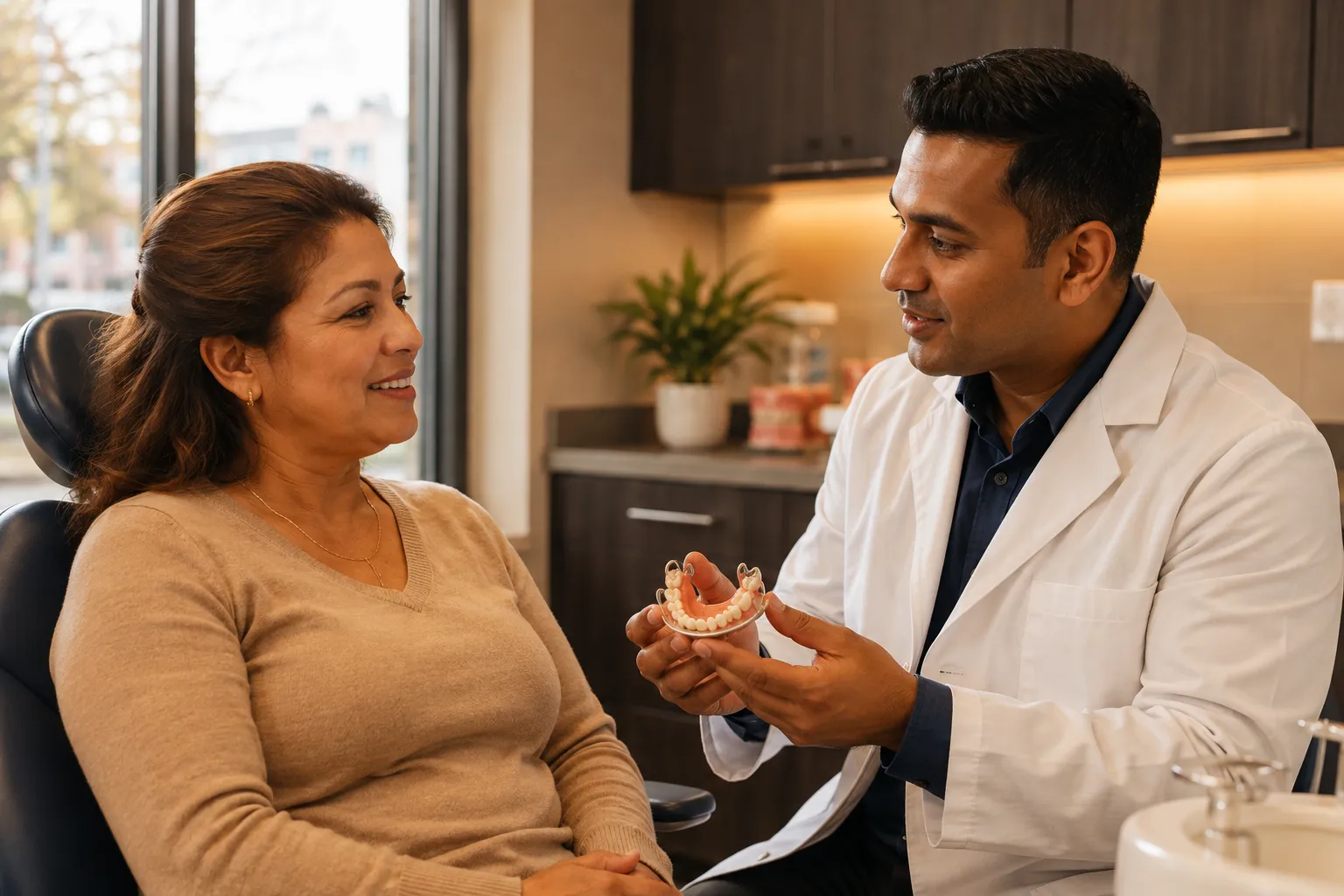
If you have lost your back teeth and are unsure where to start, the right first step is a comprehensive evaluation, not a guess based on online research. Every patient’s situation is unique, and the only way to know which solution is right for you is to have a qualified professional examine your specific bone structure, gum health, and remaining teeth.
FAQs
Can you get partial dentures with no back teeth if you have bone loss?
Yes, but the extent of bone loss affects your options. Moderate bone loss may still allow a well-fitted removable partial denture or implant-supported restoration. Severe bone loss often requires a bone graft procedure before implants can be placed. A 3D panoramic scan at your evaluation appointment gives the dentist the precise data needed to recommend the right path.
How long does it take to get used to a partial denture for missing back teeth?
Most patients adapt within four to eight weeks. The first two weeks typically involve the most noticeable discomfort and adjustment in speech and eating. Follow-up appointments for adjustments are a normal part of the process and should not be skipped, small fit corrections make a significant difference in long-term comfort.
Will a partial denture stop bone loss after losing back teeth?
A removable partial denture reduces but does not fully prevent bone loss beneath the denture base, because it rests on the gum rather than stimulating the bone directly. Dental implants are the only current restoration that actively stimulates the jawbone and halts resorption in the way a natural tooth root would.
How do I know if I need a partial denture or a full denture?
If you still have healthy natural teeth, even just a few front teeth, a partial denture is typically the preferred option because it preserves those remaining teeth and maintains more natural bite function. A full denture is indicated when all teeth in an arch are missing or must be extracted. Your dentist will assess the health and long-term prognosis of your remaining teeth to make this determination.
References
- American College of Prosthodontists. (2023). Facts and figures about prosthodontics. https://www.prosthodontics.org/about-acp/facts-and-figures/
- National Institute of Dental and Craniofacial Research. (2022). Tooth loss in adults (age 20 to 64). U.S. Department of Health and Human Services. https://www.nidcr.nih.gov/research/data-statistics/tooth-loss/adults
- American Dental Association. (2023). Removable partial dentures. ADA MouthHealthy. https://www.mouthhealthy.org/all-topics-a-z/dentures
- Centers for Disease Control and Prevention. (2021). Oral health surveillance report: Trends in dental caries and sealants, tooth retention, and edentulism, United States, 1999-2004 to 2011-2016. https://www.cdc.gov/oralhealth/publications/OHSR-2019-index.html
- Felton, D. A. (2022). Edentulism and comorbid factors. Journal of Prosthodontics, 31(S1), 7-18. https://doi.org/10.1111/jopr.13509
Madison Dental Art
Content written and reviewed by
Madison Dental Art Review Board
Madison Dental Art : Experienced dentists and specialists dedicated to providing accurate, trusted, and patient-focused oral health information.
Important information
The content of this article is for strictly educational and informational purposes. It does not replace in-person professional medical diagnosis, advice, or treatment.


