 by Madison Dental Art Review Board
Nearly 90% of adults in the United States have experienced tooth decay at some point in their lives, yet many people are surprised to learn that a simple filling is not always enough to save a badly damaged tooth. When decay reaches a certain threshold, dental crowns for decayed teeth become the most reliable path to preserving your natural smile and restoring full function. Comprehending when, why, and how crowns are used can help you make confident, informed decisions about your oral health.
At Madison Dental Art in Forest Hills, Queens, our team has been helping patients across New York City restore damaged teeth since 1994. This guide covers everything you need to know, from the clinical criteria that make a crown necessary, to the materials available, the procedure itself, and how to keep your crowned tooth healthy for years to come.
Table of Contents
Key Takeaways
- Dental crowns are recommended when decay destroys more than roughly half of a tooth’s structure, making a filling structurally insufficient.
- Crowns are also standard after root canal therapy, which leaves the tooth hollow and prone to fracture.
- Modern crown materials, especially monolithic zirconia, offer exceptional durability, with survival rates exceeding 86% over ten years.
- Decay can still develop under an existing crown if oral hygiene is poor or the crown margin breaks down; regular checkups are essential.
- Early intervention with a crown is almost always less costly and less complex than extraction followed by an implant or bridge.
When Does a Decayed Tooth Actually Need a Crown?
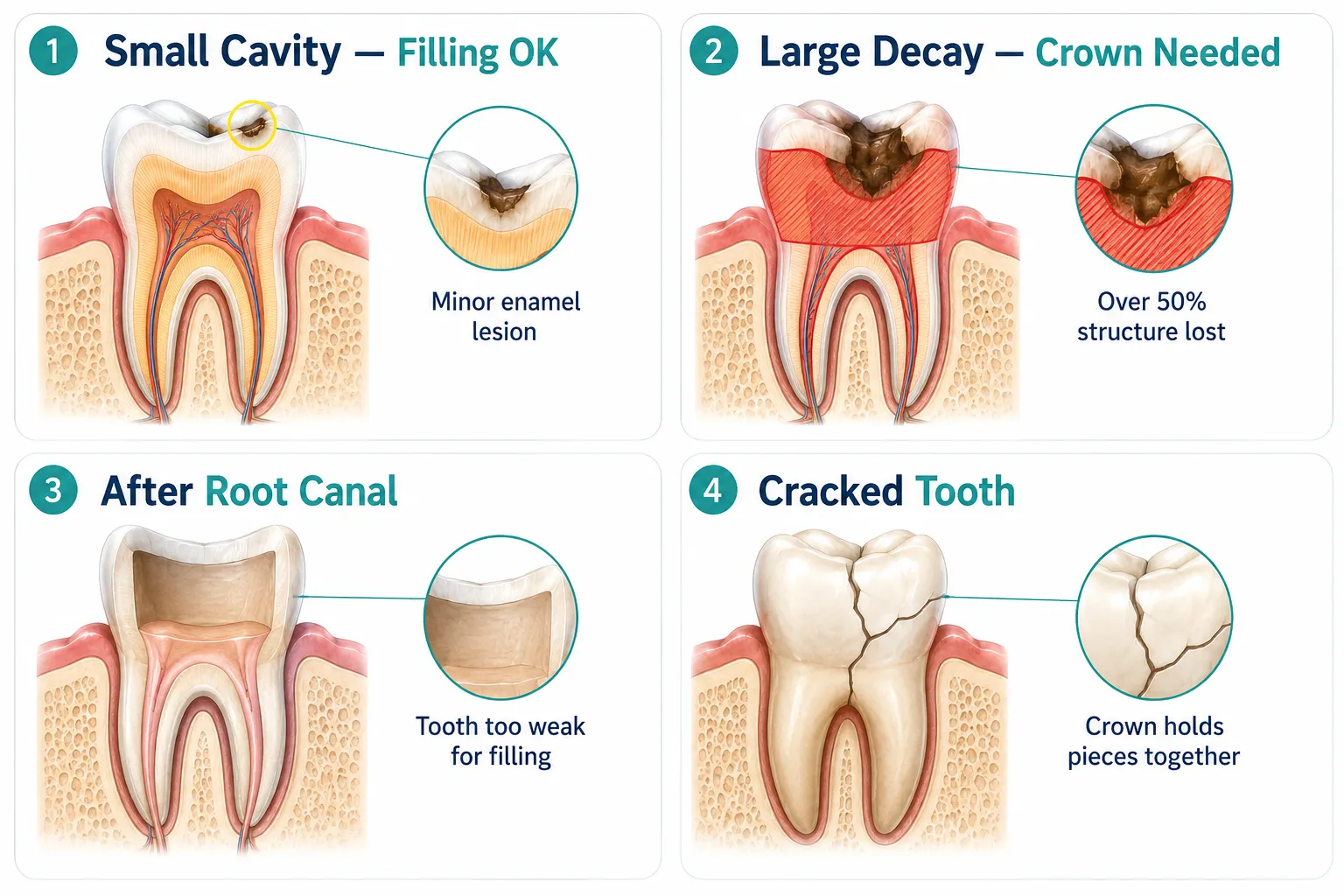
Not every cavity calls for a crown. The decision hinges on how much healthy tooth structure remains after decay is removed. Clinical guidelines from major U.S. dental insurers and professional associations generally indicate that a full-coverage crown is appropriate when:
- More than 50% of the tooth’s structure has been lost to decay or fracture
- A large existing filling has extensive recurrent (new) decay forming around or beneath it
- The tooth has undergone root canal treatment and is now structurally weakened
- The tooth is cracked and the crown is needed to hold the pieces together and prevent further splitting
A filling works by filling a void. A crown works by encasing the entire visible portion of the tooth, distributing bite forces evenly and preventing the remaining walls from cracking under pressure. When those walls are thin or compromised by deep decay, a filling simply cannot provide adequate protection.
“A crown is not a last resort, it is often the most conservative long-term option for a tooth that has lost significant structure to decay.”
It is worth noting that teeth with a poor overall prognosis, such as those with advanced gum disease, a crown-to-root ratio below 50%, or decay extending below the bone level, may not be good candidates for crowning. In those cases, extraction followed by an implant or bridge may be the more appropriate path. If you are wondering whether a dental crown is truly necessary for your situation, a thorough clinical evaluation is the only reliable way to find out.
Decay Under an Existing Crown
A common misconception is that a crowned tooth is immune to decay. In reality, bacteria can gain access at the crown margin, the thin line where the crown meets the tooth, if the cement breaks down, the gum recedes, or oral hygiene around that area is inadequate. This type of recurrent decay often progresses silently. Warning signs include:
- New sensitivity to hot or cold
- A dull, persistent ache
- A dark line or discoloration at the gum line
- A loose crown or an unpleasant taste
When decay is caught early under an existing crown, the tooth can often be re-treated and re-crowned. If decay is deep, root canal therapy may be needed first. In severe cases, extraction becomes unavoidable. This is why regular checkups and professional dental teeth scaling to remove plaque buildup at crown margins are so important.
Dental Crowns for Decayed Teeth: Materials, Procedure, and What to Expect
Choosing the Right Crown Material
Not all crowns are created equal. The material your dentist recommends will depend on the tooth’s location, how much structure remains, your bite forces, and your aesthetic goals. Here is a practical overview:
| Material | Best For | Main Advantage | Consideration |
|---|---|---|---|
| Monolithic Zirconia | Back teeth, heavy biters | Exceptional strength; 86%+ survival at 10 years | Less translucent than porcelain |
| Porcelain-Fused-to-Zirconia | Front and back teeth | Natural appearance | Porcelain layer can chip over time |
| All-Ceramic / E.max | Front teeth, cosmetic cases | Highest esthetic quality | Not ideal for very high bite forces |
| Metal (Gold/PFM) | Back teeth, bruxism patients | Extremely durable; minimal tooth removal | Visible metal color |
Research on monolithic zirconia is particularly encouraging. A ten-year study reported a cumulative survival rate of 86% for monolithic zirconia crowns on posterior teeth, meaningfully higher than the 71% seen with porcelain-fused-to-zirconia over the same period. A five-year prospective trial in a fully digital workflow found 100% survival for monolithic zirconia crowns, with no biological complications. These numbers make zirconia the material of choice for most heavily decayed back teeth in 2026.
For patients who need a crown on a front tooth, the aesthetic nuances of material selection become especially important. Our article on dental crowns for front teeth: cost, procedure, and aesthetics explores this in detail.
If you want a deeper comparison of all available options, see our comprehensive guide to types of dental crowns: zirconia, gold, porcelain, and more.
The Crown Procedure: Step by Step
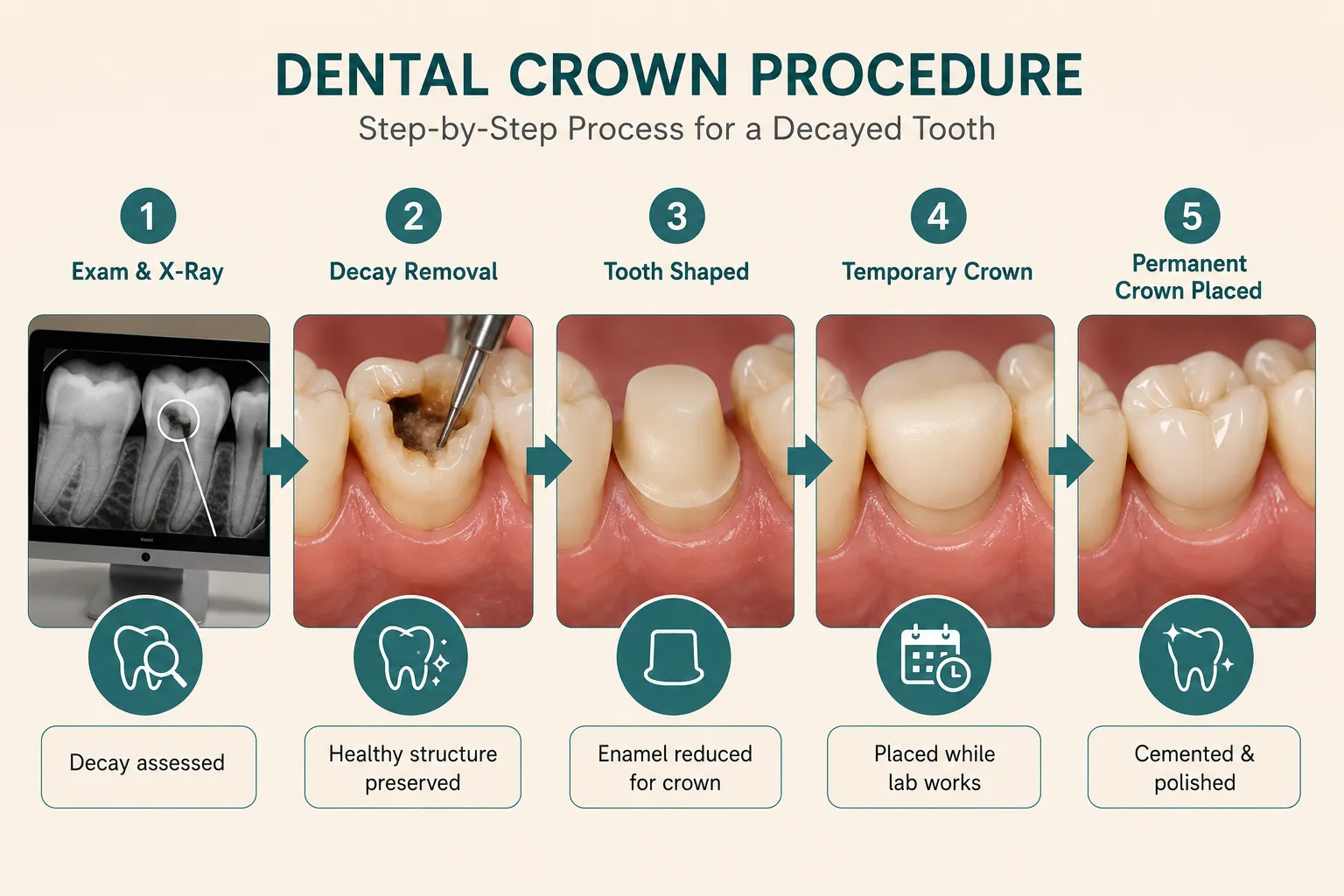
Knowing what to expect can significantly reduce dental anxiety. Here is how the process typically unfolds at Madison Dental Art:
Comprehensive exam and imaging, Digital X-rays and, when needed, a 3D panoramic scan allow our team to assess the full extent of decay, check root health, and confirm that the tooth is a viable candidate for a crown.
Decay removal and tooth preparation, All decayed tissue is removed. The tooth is then shaped to create a stable foundation for the crown. If decay has reached the pulp, root canal treatment is completed first.
Impressions or digital scan, A precise record of your prepared tooth and surrounding teeth is taken. Modern digital scanning eliminates the discomfort of traditional impression trays.
Temporary crown placement, A provisional crown protects the prepared tooth while your permanent restoration is being fabricated.
Permanent crown placement, At your second appointment, the temporary is removed, the fit and color are verified, and the permanent crown is cemented into place using a high-quality luting cement. Research shows that resin-modified glass ionomer cement provides superior long-term retention and helps guard against secondary decay at the margin.
For a more detailed walkthrough, visit our complete guide to dental crown procedure steps.
Will it hurt? Most patients are surprised by how comfortable the process is. Local anesthesia is used throughout preparation, and nitrous oxide sedation is available for anxious patients. Our article on what to expect before and after a dental crown addresses pain and recovery in full.
How Long Do Crowns on Decayed Teeth Last?
With proper care, a well-placed crown on a decayed tooth can last 10 to 15 years or longer. A 15-year prospective study of zirconia crowns confirmed their long-term reliability, though it also noted that complications do accumulate over time, underscoring the importance of ongoing maintenance. Factors that affect longevity include:
- The quality of the remaining tooth structure at placement
- The crown material chosen
- Your bite habits (grinding significantly shortens crown life)
- How consistently you maintain hygiene at the crown margin
For more on this topic, see are dental crowns permanent or do they need replacement?
Caring for a Crown on a Decayed Tooth, and Preventing Future Problems
Receiving a crown does not end your responsibility to that tooth. Consistent care is what determines whether your investment lasts a decade or a lifetime.
Daily habits that protect crowned teeth:
- Brush twice daily with a soft-bristled toothbrush, paying close attention to the gum line around the crown
- Floss daily, use a floss threader or water flosser if standard floss is difficult to maneuver around the crown margin
- Avoid biting hard objects (ice, pen caps, hard candy) that can fracture the crown
- If you grind your teeth at night, ask about a custom night guard; bruxism is one of the leading causes of premature crown failure
- Schedule professional cleanings every six months so your dentist can monitor the crown margin for early signs of recurrent decay
If you notice sensitivity, a loose feeling, or any discomfort around a crowned tooth, do not wait. Early intervention is almost always simpler and less costly than managing a problem that has been allowed to progress. Our team at Madison Dental Art is available Monday through Friday from 9:00 AM to 6:00 PM and Saturdays from 8:00 AM to 3:00 PM.
Comprehending the Cost and Insurance Picture
The cost of dental crowns for decayed teeth varies based on material, tooth location, and whether additional treatment (such as a root canal or build-up) is needed beforehand. Most dental insurance plans classify crowns as a major restorative procedure and cover a portion of the cost, typically 50% after your deductible, when there is documented clinical necessity. For a clear breakdown of what to expect financially, visit our guide on does dental insurance cover crowns?
Madison Dental Art accepts multiple insurance plans. Visit our insurance page for details, or call us at (718) 268-8228 to discuss your coverage before your appointment.
FAQs:
Can a tooth that is severely decayed always be saved with a crown?
Not always. A crown is an excellent solution when enough healthy tooth structure remains above the gum line to support it and when the root is sound. Nevertheless, if decay has extended below the bone crest, the root is fractured, or the tooth has severe periodontal bone loss, extraction may be the more appropriate choice. Your dentist will evaluate crown-to-root ratio, bone levels, and the overall prognosis before recommending a crown.
What happens if I delay getting a crown on a badly decayed tooth?
Delay allows decay to advance deeper into the tooth. What begins as a case requiring only a crown can progress to a situation requiring root canal therapy before the crown can be placed, or, in the worst case, extraction. Once a tooth is extracted, replacing it typically involves a dental implant, bridge, or partial denture, all of which are more complex and costly than a crown placed in time. Early treatment is almost always the simpler path.
Is there any alternative to a crown for a heavily decayed tooth?
For moderate decay, a large composite filling or an inlay/onlay may be sufficient. An onlay covers one or more cusps and provides more protection than a standard filling but less than a full crown, it is a reasonable middle ground when decay is significant but not yet extensive enough to warrant full coverage. For teeth that have had root canal treatment, nonetheless, a full crown is strongly recommended because the tooth becomes brittle and highly susceptible to fracture without the protection a crown provides. Your dentist can discuss all options during your evaluation.
How do I know if I have decay under an existing crown?
Decay under a crown often has no obvious symptoms in its early stages, which is why routine checkups and X-rays are so important. When symptoms do appear, they may include new sensitivity to temperature, a dull ache, a bad taste, visible darkening at the gum margin, or a crown that feels loose. AI-assisted radiograph analysis, now used in many modern practices, has demonstrated high sensitivity for detecting open crown margins and early caries on X-rays, helping clinicians catch problems before they become emergencies. If you suspect an issue with an existing crown, schedule an appointment promptly.
References
- American Dental Association. (2023). Caries management guideline series: Restorative management of dental caries in primary and permanent teeth. ADA Center for Evidence-Based Dentistry. https://www.ada.org/resources/research/science-and-research-institute/evidence-based-dental-research/caries-management
- American Dental Association. (2022). Oral health topics: Tooth decay. https://www.ada.org/resources/research/science-and-research-institute/oral-health-topics/tooth-decay
- National Institute of Dental and Craniofacial Research. (2023). Tooth decay. U.S. Department of Health and Human Services, National Institutes of Health. https://www.nidcr.nih.gov/health-info/tooth-decay
- Lawson, N. C., & Burgess, J. O. (2022). Dental ceramics: A current review. Operative Dentistry, 47(4), 345-360. https://doi.org/10.2341/21-048-L
- Sulaiman, T. A. (2020). Materials in digital dentistry, A review. Journal of Esthetic and Restorative Dentistry, 32(2), 171-181. https://doi.org/10.1111/jerd.12566
- American College of Prosthodontists. (2023). Prosthodontic care and dental crowns: Patient education resources. https://www.prosthodontics.org/patient-education/
Madison Dental Art
Content written and reviewed by
Madison Dental Art Review Board
Madison Dental Art : Experienced dentists and specialists dedicated to providing accurate, trusted, and patient-focused oral health information.
Important information
The content of this article is for strictly educational and informational purposes. It does not replace in-person professional medical diagnosis, advice, or treatment.


