 by Madison Dental Art Review Board
Nearly 15 million dental crowns are placed in the United States every year, yet the fear of pain stops countless patients from getting a procedure that could save their tooth. If you have been putting off a crown because you are worried it will hurt, this guide is for you. The short answer to “do dental crowns hurt” is: most patients feel little to no pain during the procedure itself, and any post-treatment sensitivity is typically mild and short-lived.

Learn more about dental crowns at our Forest Hills office.
Table of Contents
Key Takeaways
- Local anesthesia means the crown procedure itself is rarely painful, most patients feel only pressure or vibration.
- Mild sensitivity and gum soreness for 3 to 5 days after placement are completely normal.
- Discomfort that worsens or lasts beyond 1 to 2 weeks is a warning sign that needs professional attention.
- Common causes of abnormal crown pain include a high bite, nerve inflammation, decay, or infection.
- Modern techniques and sedation options make the crown experience far more comfortable than most patients expect.
What Happens Before the Crown: Anesthesia and Preparation
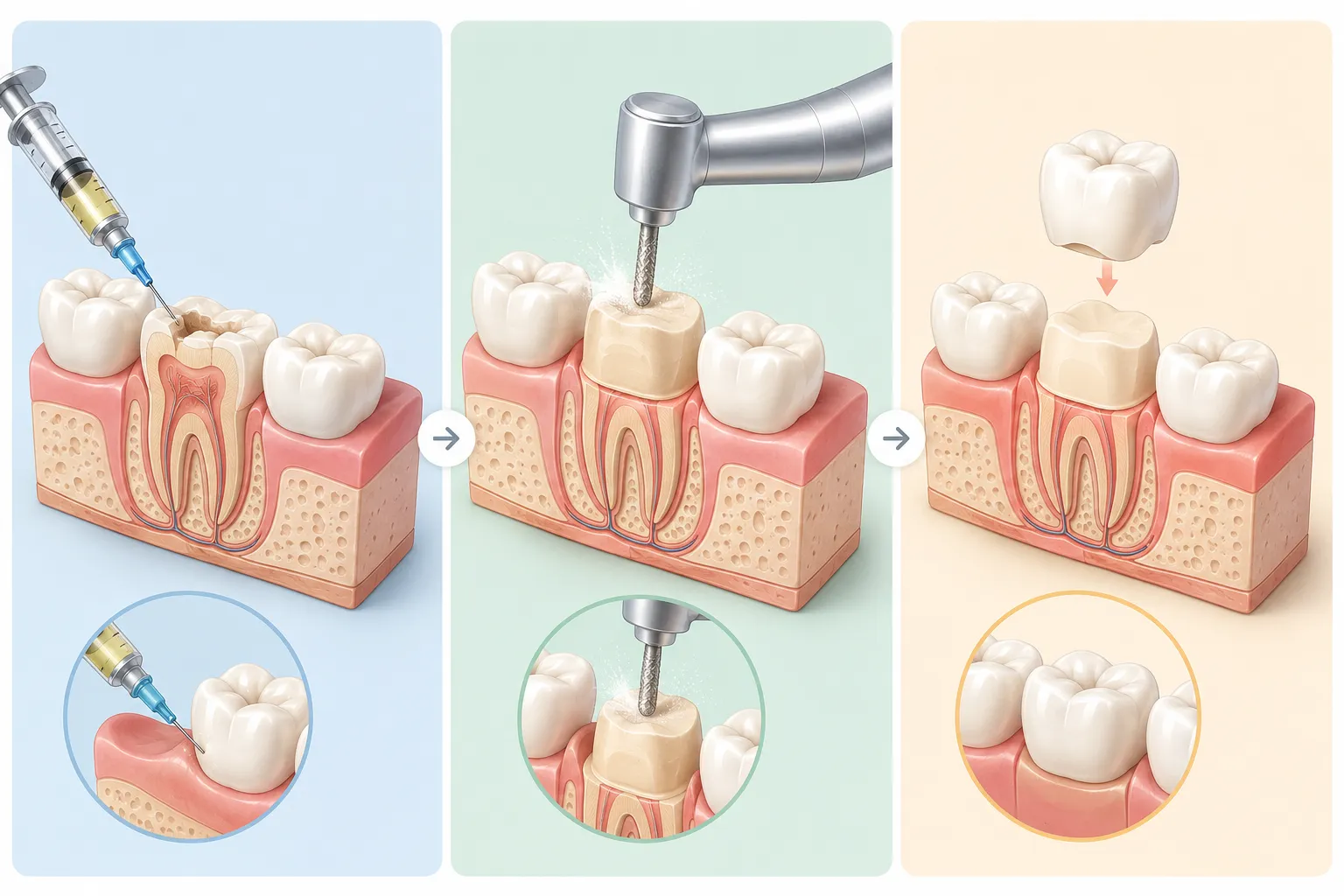
The most important thing to know before your appointment is that your dentist will thoroughly numb the area before touching the tooth. At Madison Dental Art in Forest Hills, Queens, every crown procedure begins with a careful injection of local anesthetic. You may feel a brief pinch from the needle, comparable to a small bee sting, but within a few minutes the entire area is numb.
What anesthesia actually blocks:
- Sharp pain signals from the tooth and surrounding gum tissue
- Sensitivity to temperature during the procedure
- Discomfort from the dental drill and shaping instruments
For patients with significant dental anxiety, nitrous oxide (laughing gas) is available at our practice to layer an additional layer of calm on top of the local anesthetic. Dr. Linda Lee, one of our general dentists, specializes specifically in anxiety-free care and takes extra time to ensure patients feel settled before any work begins.
Once the area is numb, the dentist reshapes the tooth to create space for the crown. This involves removing a thin layer of enamel from the outer surface. You will likely feel pressure and vibration, but not pain. An impression or digital scan is then taken so the permanent crown can be fabricated to fit your bite precisely. A temporary crown protects the tooth while the permanent one is being made.
“The numbing injection is usually the most uncomfortable moment of the entire crown procedure, and even that is brief.”
If the crown is being placed over a tooth that already had a root canal, the nerve has already been removed, which means the tooth itself cannot transmit pain signals at all. To learn more about the full sequence of steps, see our complete guide to dental crown procedure steps.
Do Dental Crowns Hurt During the Procedure?
The direct answer: no, the crown procedure should not be painful when proper anesthesia is administered. What patients commonly describe during the appointment includes:
| Sensation | Normal? |
|---|---|
| Pressure when the tooth is being shaped | Yes |
| Vibration from the dental drill | Yes |
| Mild jaw ache from keeping mouth open | Yes |
| Sharp or shooting pain | No, tell your dentist immediately |
| Burning or stinging sensation | No, more anesthetic may be needed |
If at any point during the procedure you feel sharp pain, raise your hand to signal your dentist. It simply means the anesthetic needs to be topped up, a common and easy fix. You should never feel you have to endure pain in silence.
It is also worth noting that the type of crown material can influence how the procedure feels. For a detailed breakdown of your options, our guide on types of dental crowns and their role in modern treatment explains the differences between porcelain, zirconia, and other materials.
After the Crown: Normal Sensitivity vs. Warning Signs
This is where most patient questions arise. Once the anesthesia wears off, usually 2 to 4 hours after your appointment, you may notice some discomfort. Here is what is considered normal and what is not.
Normal Post-Crown Symptoms (Days 1-5)
- Thermal sensitivity: The tooth may feel more sensitive to hot and cold drinks. This happens because the tooth structure was recently shaped and the nerve inside can be temporarily irritated.
- Pressure sensitivity: A mild ache when biting down, especially in the first 24 to 48 hours.
- Gum soreness: The gum tissue around the tooth was worked on and may feel tender or slightly swollen.
- Dull background ache: A low-grade discomfort that comes and goes is common in the first few days.
These symptoms typically improve on their own within 3 to 5 days and should be fully resolved within 1 to 2 weeks. Over-the-counter pain relievers such as ibuprofen or acetaminophen, taken as directed, are usually sufficient to manage this level of discomfort. Rinsing gently with warm salt water can also soothe gum irritation.
Red-Flag Symptoms That Need Attention
Ongoing pain is never normal. If you experience any of the following, contact your dentist promptly:
- Pain or sensitivity that worsens rather than improves after the first week
- Discomfort that lasts beyond 2 weeks
- Swelling in the gum or jaw
- A sharp pain specifically when biting down hard
- Visible pus or a bad taste near the crowned tooth
These symptoms may indicate a bite alignment problem, nerve inflammation, decay beneath the crown, a cracked tooth, or an infection. Our detailed resource on dental crown issues including pain, cracks, and sensitivity walks through each of these causes in depth.
The Most Common Causes of Crown Pain, and How They Are Fixed
Comprehending why a crown might hurt helps you recognize when to act.
1. High Bite If the crown sits even slightly too high, every time your teeth come together the crowned tooth takes more force than it should. This is one of the most common causes of post-crown pain and is easily corrected by your dentist adjusting the crown’s surface, a quick, painless appointment.
2. Nerve Inflammation (Pulpitis) The nerve inside the tooth can become temporarily inflamed after the prep work. Reversible pulpitis usually resolves on its own. Irreversible pulpitis, where the nerve is significantly damaged, may require a root canal. If you are wondering whether that scenario applies to you, our article on symptoms and need for a root canal is a helpful starting point.
3. Decay or Infection Under the Crown If decay was not fully removed before the crown was placed, or if bacteria find their way under the crown over time, an infection can develop. This typically presents as persistent throbbing pain, swelling, or sensitivity to heat.
4. Cracked Tooth A crack in the underlying tooth can cause sharp pain when biting at certain angles. This is a more complex situation that requires prompt evaluation.
5. Gum Recession or Gum Disease If the gum tissue around the crown recedes, the root surface below the crown margin can become exposed and sensitive. Maintaining good oral hygiene and attending regular checkups helps prevent this.
Evidence-Based Tips to Reduce Post-Crown Discomfort
These practical steps can make your recovery smoother:
- Eat soft foods for the first 48 hours, avoid hard, crunchy, or sticky items.
- Avoid extreme temperatures in food and drink for the first few days.
- Take anti-inflammatory medication (such as ibuprofen) proactively if your dentist recommends it.
- Brush gently around the crowned tooth and use a soft-bristled toothbrush.
- Avoid chewing on that side of your mouth until sensitivity settles.
- Call your dentist if pain does not follow the expected improvement curve.
Do Dental Crowns Hurt Long-Term?
A well-made, properly fitted crown should cause no pain whatsoever once fully healed. Many patients report that a crowned tooth feels completely natural within a few weeks. If new or late-onset pain develops months or years after a crown was placed, it almost always points to an underlying issue, such as a new cavity, gum disease, or a crack, rather than the crown itself.
This is one of the strongest reasons to keep up with regular dental checkups even after restorative work is complete. Early detection of any problem around a crown is far easier and less costly to address than waiting until symptoms become severe.
If you are also weighing the financial side of getting a crown, our guides on how much a dental crown costs without insurance and whether dental insurance covers crowns provide clear, up-to-date information for 2026.
FAQs
Is it normal to have pain the day after getting a dental crown?
Yes, mild discomfort the day after crown placement is completely normal. The anesthesia has worn off and the tooth and surrounding gum tissue are still recovering from the preparation work. A dull ache, gum tenderness, and sensitivity to temperature are all expected. Over-the-counter pain relievers taken as directed are usually sufficient.
How long does sensitivity last after a dental crown?
Most patients experience sensitivity for 3 to 5 days, with full resolution typically occurring within 1 to 2 weeks. Sensitivity that persists beyond two weeks, or that worsens over time, is not considered normal and should be evaluated by a dentist. The underlying cause, such as a high bite or nerve irritation, can usually be identified and corrected quickly.
Can a dental crown cause nerve pain?
Yes, in some cases. The process of shaping the tooth for a crown can temporarily irritate the nerve inside, a condition called reversible pulpitis. This usually resolves on its own. In less common situations, the nerve damage is more significant and irreversible, requiring a root canal before or after the crown is placed.
Do dental crowns hurt more on front teeth than back teeth?
The procedure itself is similarly comfortable for both, as local anesthesia numbs the area regardless of location. Nevertheless, front teeth tend to have more visible gum margins and may feel slightly more sensitive after preparation because the enamel layer is thinner. Back teeth (molars and premolars) endure more biting force, so a high bite on a back crown may produce more noticeable pressure discomfort.
References
- American Dental Association. (2022). Dental crowns: What you should know. ADA.org. https://www.ada.org/resources/research/science-and-research-institute/oral-health-topics/dental-crowns
- National Institute of Dental and Craniofacial Research. (2023). Dental treatments: Crowns, bridges, and implants. NIDCR, U.S. Department of Health & Human Services. https://www.nidcr.nih.gov/health-info/dental-procedures
- Cleveland Clinic. (2023). Dental crown: Purpose, procedure, complications, care. Cleveland Clinic Health Library. https://my.clevelandclinic.org/health/treatments/10923-dental-crowns
- MedlinePlus / U.S. National Library of Medicine. (2022). Dental crowns. MedlinePlus Medical Encyclopedia. https://medlineplus.gov/ency/article/001913.htm
- Teja, K. S., Ramesh, S., & Priya, P. (2021). Regulation of matrix metalloproteinase-3 gene expression in inflammation: A molecular study on pulpal tissues. Journal of Conservative Dentistry, 24(1), 25-30. https://doi.org/10.4103/jcd.jcd_35_21
Madison Dental Art
Content written and reviewed by
Madison Dental Art Review Board
Madison Dental Art : Experienced dentists and specialists dedicated to providing accurate, trusted, and patient-focused oral health information.
Important information
The content of this article is for strictly educational and informational purposes. It does not replace in-person professional medical diagnosis, advice, or treatment.


