 by Madison Dental Art Review Board
Nearly 70% of orthodontic patients present with some degree of overbite, yet many are still surprised to learn that clear aligners can address it. If you have been wondering whether Invisalign is a real solution or just a cosmetic shortcut, the answer is more nuanced and more encouraging than most people expect. This article breaks down exactly what the research says about whether Invisalign can fix an overbite, what to expect before you start, and how to know whether you are a good candidate.
Table of Contents
Key Takeaways
- Invisalign can effectively treat mild to moderate overbites, primarily by intruding (pushing up) the front teeth to reduce vertical overlap.
- Skeletal overbites, caused by jaw-bone position rather than tooth position, may require additional treatment beyond clear aligners alone.
- Most meaningful overbite correction happens during the first aligner series; refinement rounds produce diminishing results.
- A thorough consultation that includes digital X-rays and 3D scanning is essential before starting treatment.
- Wearing aligners 20 to 22 hours per day and attending regular progress appointments are non-negotiable for success.
Comprehending Overbite: What Type Do You Have?
Before exploring whether Invisalign can fix an overbite and what to expect before you start, it helps to understand that not all overbites are the same. The term “overbite” refers to how much the upper front teeth vertically overlap the lower front teeth. A small overlap, roughly 1 to 3 millimeters, is completely normal. Problems arise when that overlap becomes excessive, a condition often called a deep bite.
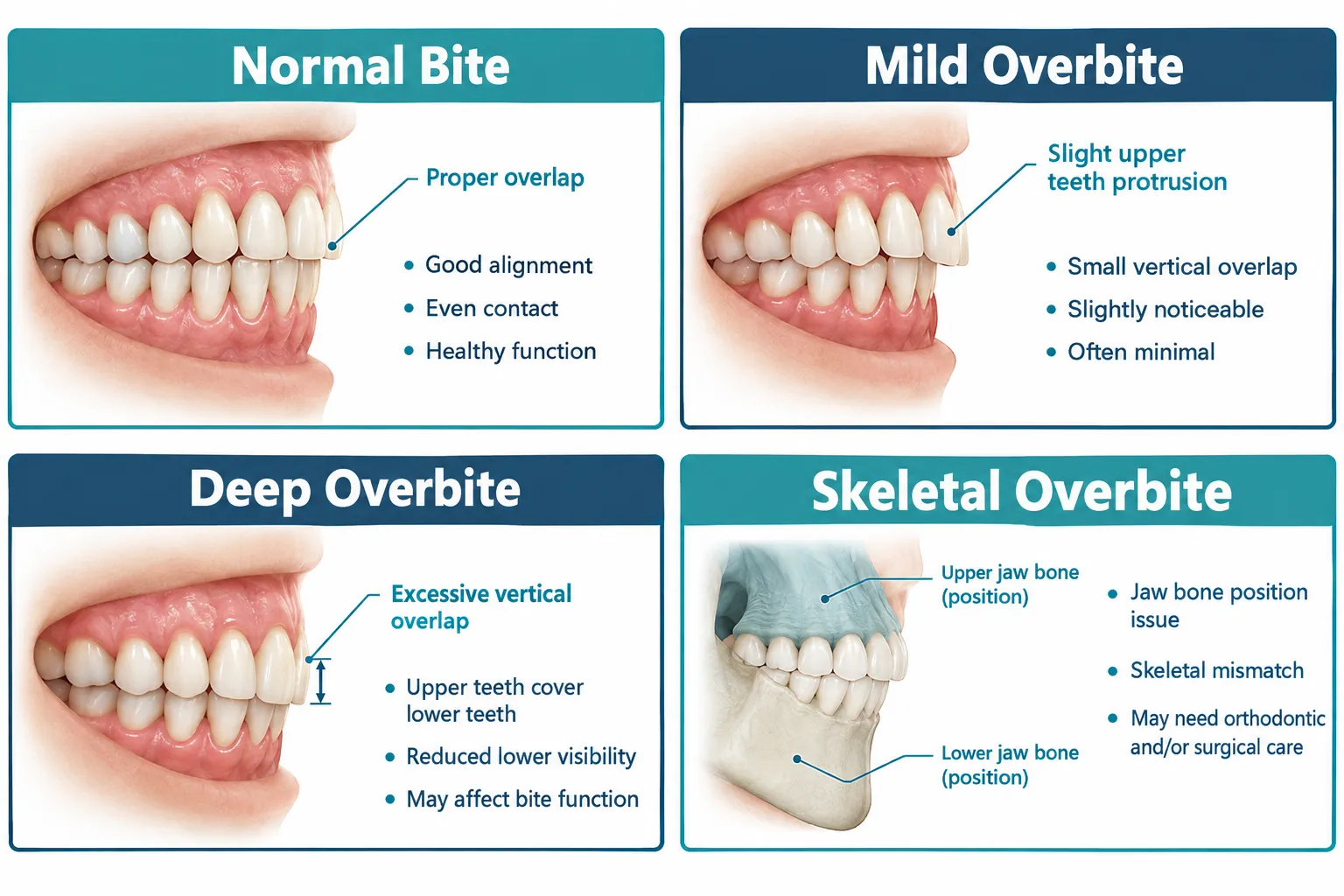
There are two fundamental categories:
Dental overbite: The jaw bones are positioned normally, but the teeth themselves are angled or positioned in a way that creates excessive overlap. This is the most common type and the most responsive to Invisalign treatment.
Skeletal overbite: The upper jaw (maxilla) or lower jaw (mandible) is structurally mispositioned. The problem originates in the bone, not just the teeth. Clear aligners alone are often insufficient for significant skeletal cases.
Clinical note:A dentist or orthodontist cannot determine your overbite type from a visual exam alone. A proper diagnosis requires digital X-rays and, in many cases, a 3D panoramic scan to assess jaw structure and bone support.
Comprehending your overbite type is the single most important factor in predicting how well Invisalign will work for you. If you are unsure, a visit to an experienced orthodontist is the only way to get a reliable answer. To learn more about how orthodontists approach this condition, read our detailed guide on how orthodontists fix overbites, treatments, and timelines.
How Invisalign Corrects an Overbite: The Mechanics
Clear aligners reduce overbite depth through a process called incisor intrusion, gradually pressing the upper front teeth slightly upward into the jaw, which reduces the vertical overlap. At the same time, aligners can help guide the lower front teeth into a better position. The combined effect lowers the bite depth over time.
Here is how the main mechanical elements work together:
| Feature | Role in Overbite Correction |
|---|---|
| Sequential aligner trays | Each tray moves teeth in small, precise increments |
| Tooth-colored attachments | Small bonded bumps that give aligners more grip for intrusion movements |
| Bite ramps / bite planes | Built-in plastic ridges that prevent back teeth from fully touching, encouraging the bite to open |
| Precision cuts | Aligner modifications that allow elastic bands to be attached for jaw guidance |
Recent clinical evidence confirms that clear aligners can achieve meaningful overbite reductions, primarily through incisor intrusion, and that outcomes for mild to moderate dental deep bites are comparable to those achieved with traditional braces. Nevertheless, researchers consistently note that the predictability of planned overbite correction remains a limitation. In other words, the aligner system may plan a 4mm reduction, but real-world expression of that movement often falls short of the digital prediction.
This is not a reason to dismiss Invisalign, it is a reason to have realistic expectations and to work with a skilled provider who understands these nuances. For a deeper look at treatment time and effectiveness specifically, see our article on Invisalign for overbite: treatment time and effectiveness.
When Invisalign May Not Be Enough
There are situations where Invisalign alone will not fully resolve an overbite:
- Severe skeletal discrepancies, cases where the jaw bones are significantly misaligned may ultimately require orthognathic (jaw) surgery in combination with orthodontic treatment.
- Very deep bites with significant crowding, when multiple complex movements are needed simultaneously, traditional braces may provide more controlled force delivery.
- Growing patients with skeletal issues, younger patients whose jaws are still developing may benefit from growth-modification appliances before aligner therapy begins.
If you are curious about when jaw surgery becomes part of the conversation, our article on jaw surgery for overbite: procedure, recovery, and when it is needed provides a thorough overview.
What to Expect Before You Start Invisalign for an Overbite
Answering “can Invisalign fix an overbite, what to expect before you start” requires walking through the pre-treatment process step by step. Knowing what is ahead helps you make an informed decision and sets you up for the best possible outcome.
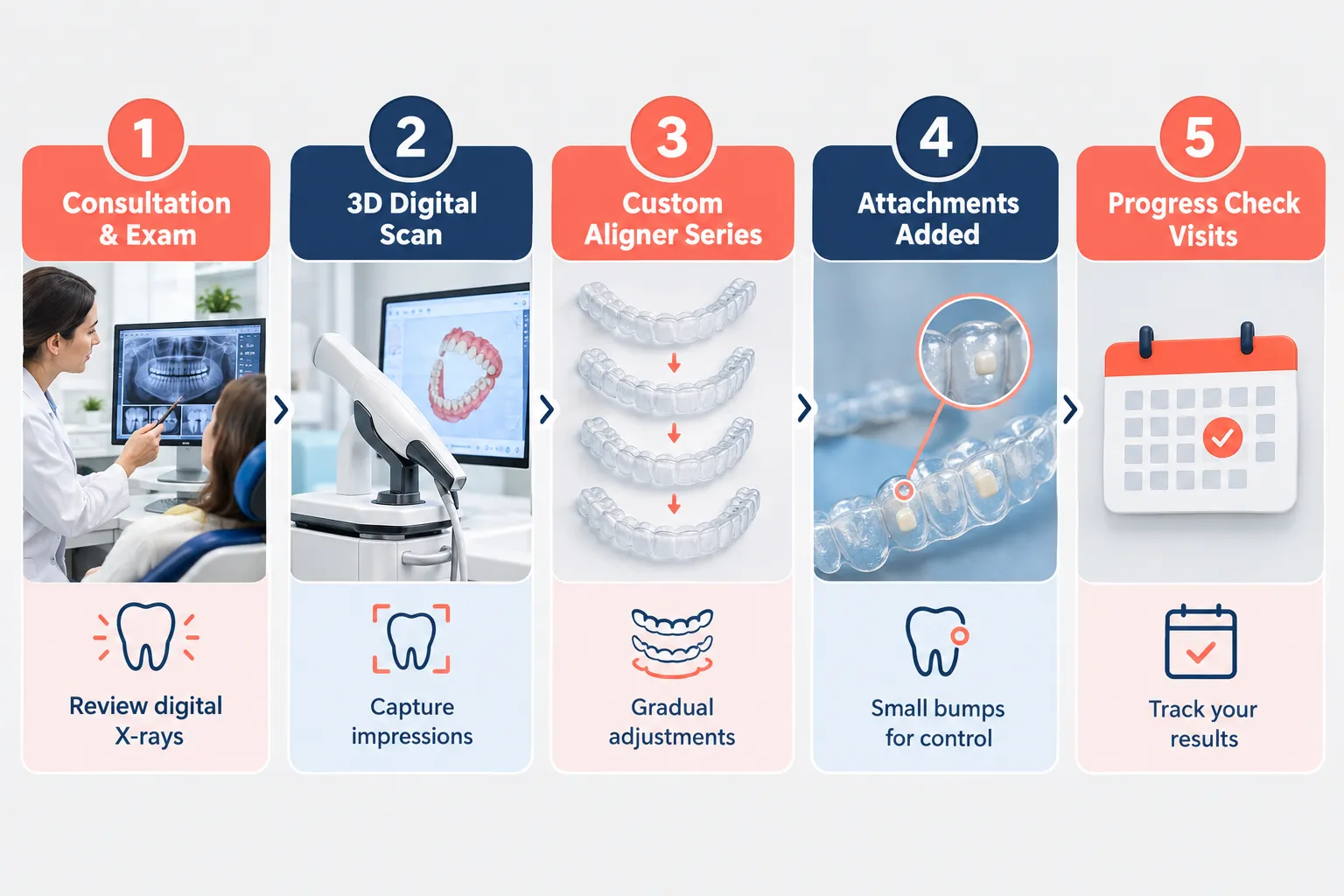
Step 1: The Comprehensive Consultation
Your first appointment is about far more than looking at your teeth. A thorough evaluation will include:
- A full clinical exam of your bite, jaw joints, and gum health
- Digital X-rays to assess bone levels and root positions
- A 3D panoramic scan to evaluate jaw structure
- A review of your dental and medical history
At Madison Dental Art, our orthodontist Dr. Susan Huh brings specialized expertise in teeth alignment and functional bite correction for patients of all ages. Dr. Huh’s background in pharmacology and orthodontics means she approaches each case with both scientific rigor and genuine attention to the patient’s goals.
Step 2: Determining Candidacy
Not every overbite patient is an ideal Invisalign candidate. Your provider will assess:
- Overbite severity and type (dental vs. skeletal)
- Gum and bone health, active gum disease must be treated before orthodontic work begins
- Existing restorations, crowns, bridges, or implants can affect aligner fit and movement
- Patient compliance potential, aligners must be worn 20 to 22 hours per day, every day
If gum health is a concern, Madison Dental Art has Dr. Robert Weber, a Diplomate of the American Board of Periodontology, available in-house to address any periodontal issues before orthodontic treatment begins. This kind of integrated, specialist-level care under one roof is one of the advantages of choosing a full-service practice.
Step 3: Digital Treatment Planning
If you are a good candidate, your provider will take digital impressions (no messy putty) and upload them into Invisalign’s ClinCheck software. This generates a 3D simulation of your projected tooth movements from start to finish. You will be able to see a preview of your expected results before a single aligner is made.
This is also when attachments are planned. Most overbite cases require small tooth-colored composite bumps bonded to certain teeth. These are not visible from a normal conversational distance, but they are critical for achieving the precise movements needed to reduce your bite depth.
Step 4: Comprehending the Timeline
Overbite correction with Invisalign typically takes between 12 and 24 months for moderate cases, though complex cases can extend beyond that. Research shows that most of the meaningful correction occurs during the initial aligner series, subsequent refinement rounds tend to produce progressively smaller improvements. This is important to know going in, so you do not expect unlimited correction through endless refinements.
For a realistic sense of how long the overall process takes, our article on how long it takes for Invisalign to work is a helpful reference.
Step 5: Planning for Retention
Overbite correction is not permanent on its own. Once your active aligner treatment ends, you will need to wear retainers, typically every night, to hold your teeth in their new positions. Teeth have a natural tendency to drift back, and this is especially true after deep-bite correction where significant intrusion has occurred. Our guide on how to keep teeth straight after Invisalign covers everything you need to know about the retention phase.
Invisalign vs. Braces for Overbite: A Practical Comparison
A common question is whether traditional braces would be more effective. Head-to-head clinical comparisons show that for mild to moderate dental deep bites, clear aligners and braces produce similarly effective outcomes. The practical differences come down to lifestyle, compliance, and case complexity.
| Factor | Invisalign | Traditional Braces |
|---|---|---|
| Visibility | Nearly invisible | Clearly visible |
| Removability | Removable for eating/cleaning | Fixed |
| Deep bite correction | Effective for mild-moderate | Effective across a wider severity range |
| Complex skeletal cases | May need adjuncts | Generally preferred |
| Compliance required | High (patient-driven) | Lower (fixed to teeth) |
| Adjustment visits | Every 6-8 weeks | Every 4-6 weeks |
If you are weighing both options carefully, our comparison article are traditional braces faster than Invisalign offers a balanced breakdown. And if you are wondering whether braces are even necessary for an overbite, do you need braces for an overbite: treatment options explained addresses that question directly.
FAQs
Can Invisalign fix a severe overbite on its own?
For most adults with a severe dental deep bite, Invisalign can produce significant improvement, but it may not achieve complete correction without additional tools such as elastics or, in skeletal cases, jaw surgery. A thorough clinical evaluation, including 3D imaging, is the only way to know what your specific case requires. Attempting to self-assess severity based on appearance alone is unreliable.
Does fixing an overbite with Invisalign hurt?
Most patients experience mild pressure or soreness for one to three days each time they switch to a new aligner tray. This is normal and indicates that the teeth are moving. The discomfort is generally much milder than what is associated with traditional braces wire adjustments. Over-the-counter pain relievers and switching to new trays at bedtime can help manage any temporary discomfort.
How often do I need to change my Invisalign trays during overbite treatment?
Most providers recommend changing trays every one to two weeks, depending on your specific treatment plan. Sticking to this schedule is critical for overbite correction because each tray builds incrementally on the movement of the previous one. Delaying tray changes slows progress and can affect the accuracy of your final result.
What happens if I do not treat my overbite?
An untreated deep bite can lead to uneven tooth wear, increased risk of chipping the lower front teeth, jaw joint (TMJ) strain, and in some cases, gum recession where the lower teeth bite into the upper palate tissue. Over time, these issues tend to worsen rather than stabilize. Early intervention generally produces better outcomes and may prevent more complex restorative work later.
References
Ke, Y., Zhu, Y., & Zhu, M. (2019). A comparison of treatment effectiveness between clear aligner and fixed appliance therapies. BMC Oral Health, 19(1), 24. https://bmcoralhealth.biomedcentral.com/articles/10.1186/s12903-019-0716-z
Papageorgiou, S. N., Koletsi, D., Iliadi, A., Peltomäki, T., & Eliades, T. (2020). Treatment outcome with orthodontic aligners and fixed appliances: a systematic review with meta-analyses. European Journal of Orthodontics, 42(3), 331-343. https://doi.org/10.1093/ejo/cjz094
American Association of Orthodontists. (2023). Clear aligner therapy: clinical considerations and evidence. https://www.aaoinfo.org/
National Institute of Dental and Craniofacial Research. (2022). Orthodontic treatments. U.S. Department of Health & Human Services. https://www.nidcr.nih.gov/
Invisalign / Align Technology. (2024). Treating deep bite with Invisalign clear aligners: clinical guide. https://www.aligntech.com/
Ruellas, A. C., Ruellas, R. M., & Pithon, M. M. (2021). Effectiveness of clear aligners versus fixed appliances in the treatment of Class II malocclusion: A systematic review. Dental Press Journal of Orthodontics, 26(4). https://doi.org/10.1590/2177-6709.26.4.e2119253
Madison Dental Art
Content written and reviewed by
Madison Dental Art Review Board
Madison Dental Art : Experienced dentists and specialists dedicated to providing accurate, trusted, and patient-focused oral health information.
Important information
The content of this article is for strictly educational and informational purposes. It does not replace in-person professional medical diagnosis, advice, or treatment.


