 by Madison Dental Art Review Board
More than 40 million Americans are missing all of their teeth, and millions more face full-arch extractions each year, yet most patients say the fear of going without teeth during recovery was never fully explained to them before their appointment. Comprehending immediate dentures: what to expect the day your teeth come out is one of the most searched dental topics in 2026, and for good reason. When your dentist removes multiple teeth and places a denture on the very same day, the experience is unlike any other dental visit, and knowing what lies ahead makes an enormous difference in how smoothly you recover.
Table of Contents
Key Takeaways
- Immediate dentures are placed in your mouth the same day your natural teeth are extracted, so you are never without teeth.
- Pre-extraction planning, including impressions and jaw measurements, happens weeks before removal day.
- The denture stays in for the first 24 hours to protect the sockets and control bleeding; do not remove it on your own.
- Gum and bone shrinkage is expected in the months following extraction, which means the denture will loosen and require relining.
- Long-term options such as permanent dentures or dental implants can be discussed once full healing is complete.
What Exactly Are Immediate Dentures and How Are They Different
An immediate denture is a complete or partial removable appliance that is fabricated before your extractions and inserted the moment your teeth are removed, all in a single appointment. Unlike conventional dentures, which require you to wait four to six weeks (or longer) for gum tissue to heal before a denture can be fitted, the immediate version eliminates any toothless period entirely.
This matters for several practical reasons. Patients keep the ability to speak and chew from day one. The denture also acts as a bandage over the extraction sites, helping control bleeding, reducing swelling, and protecting the clots that form inside each socket. Without that protective cover, those clots, which are essential to healing, are far more vulnerable to disruption.
It is worth comprehending that an immediate denture is often considered a transitional appliance rather than a permanent solution. Because your gums and underlying bone will change shape significantly during the first year of healing, the fit you leave with on extraction day will not match your anatomy six months later. This is completely normal, expected, and manageable, but it is something every patient deserves to know upfront.
If you have been weighing your options, our guide on save your teeth or get dentures can help you think through whether extraction and immediate dentures are the right path for your situation.
The Planning Appointments That Happen Before Extraction Day
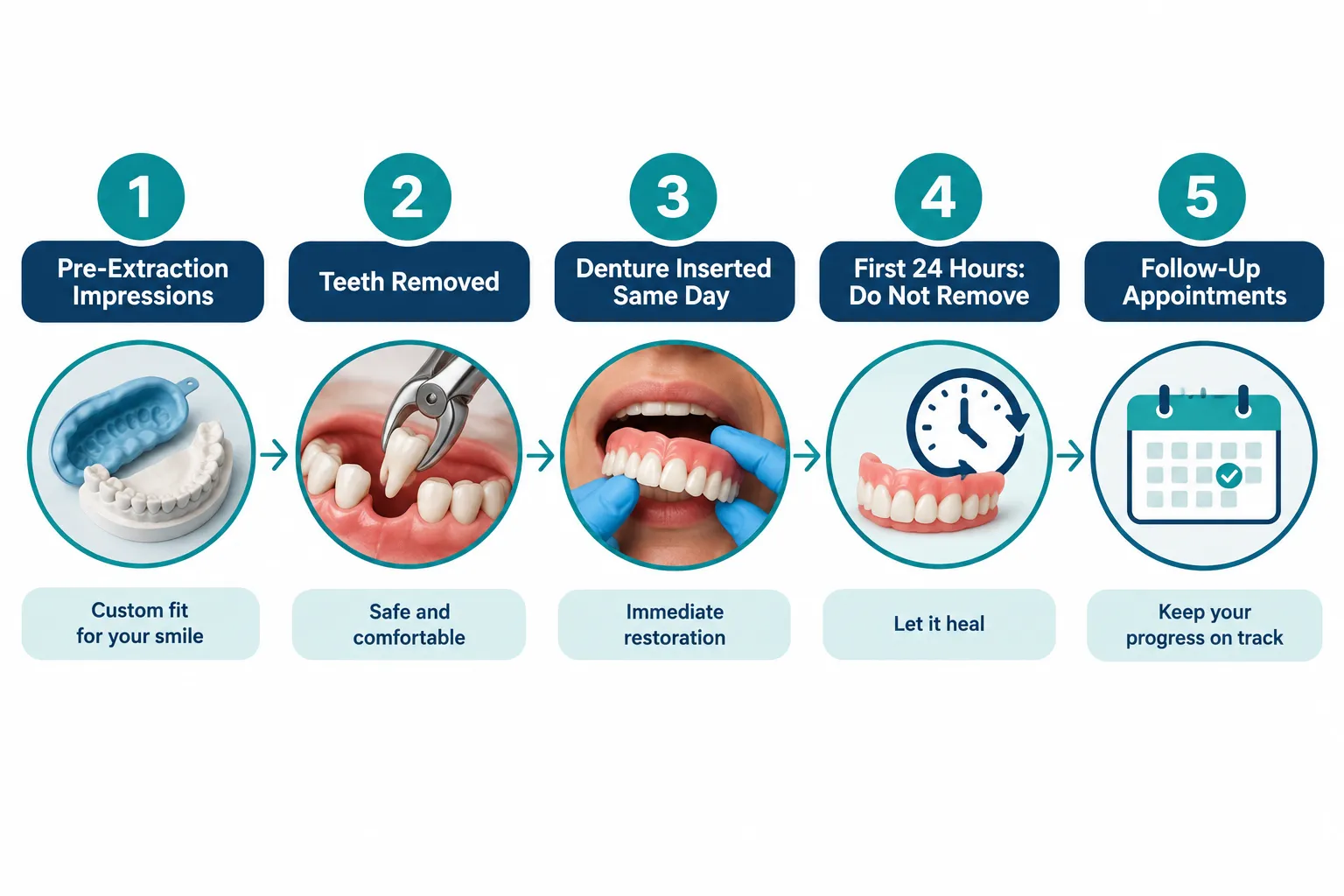
The work for your immediate denture begins weeks before the day your teeth come out. During one or more pre-extraction visits, your dental team takes detailed impressions of your current teeth and gums, records how your upper and lower jaws come together (bite records), and selects the tooth shape and shade that will be used to fabricate your appliance.
Why These Appointments Are So Important
Because the lab technician must build your denture before your natural teeth are removed, your dentist is essentially designing a replacement for something that still exists. That requires precise measurements. Any inaccuracy at this stage leads to a poorly fitting denture on day one, which compounds the discomfort you are already managing from the extractions themselves.
During these visits, your provider will also review your medical history, discuss any medications that might affect bleeding or healing, and explain the post-operative instructions you will need to follow. If significant gum disease or bone loss is present, a specialist such as a periodontist may be involved in the planning. At Madison Dental Art, our periodontology specialist Dr. Robert Weber works closely with our prosthodontic team to ensure that patients with complex gum and bone conditions receive coordinated care before, during, and after this procedure.
What the Lab Does With Your Records
Once your impressions and bite records are sent to the dental laboratory, technicians use them to create a custom denture based on your pre-extraction anatomy. They remove the tooth images from the model and set artificial teeth in their place. This is done with careful attention to proportions so the final denture looks natural, not like a generic set of plastic teeth.
What Happens on the Day Your Teeth Are Removed
On extraction day, you will typically arrive having followed specific preparation instructions: usually nothing to eat or drink for a period beforehand if sedation is involved, and arrangements made for someone to drive you home afterward.
The sequence of events generally goes like this:
- Anesthesia is administered, Local anesthesia numbs the area. Nitrous oxide or another form of sedation may be offered for patients with significant anxiety.
- Teeth are extracted, Your dentist or oral surgeon removes the teeth, working methodically through each site.
- Sockets are cleaned, The extraction sites are examined, any sharp bone edges may be smoothed, and the tissue is prepared for the denture.
- Immediate denture is seated, The pre-fabricated denture is placed directly into your mouth and adjusted as needed for fit and bite.
- Post-op instructions are reviewed, Before you leave, you receive detailed written and verbal care instructions.
The entire appointment can take anywhere from one to two hours depending on how many teeth are being removed and the complexity of each extraction. You will leave the office wearing your new denture, and this is where recovery truly begins.
To understand what the broader oral surgery healing process looks like over the days and weeks ahead, our article on what to expect during the oral surgery healing process covers this in helpful detail.
The First 24 Hours: Why the Denture Must Stay In
This is the instruction patients most often question: leave the denture in place for the first 24 hours, even while sleeping.
The reason is straightforward. Removing the denture too soon disrupts the blood clots forming in each socket. Those clots are the foundation for healing. Without them, patients risk a painful condition called dry socket, increased bleeding, and delayed recovery. The denture also acts as a pressure bandage, keeping swelling more localized and manageable.
You may notice bleeding that stains your saliva pink or light red, this is normal during the first few hours. Significant, constant bleeding that does not slow should prompt you to call your dental office immediately.
What you should do in the first 24 hours:
- Keep the denture in place at all times
- Apply gentle biting pressure on gauze pads if bleeding persists
- Keep your head elevated, including while resting
- Apply an ice pack to the outside of your face in 20-minute cycles to reduce swelling
- Take prescribed or recommended pain relief before the anesthesia fully wears off
- Drink cool or room-temperature liquids, nothing hot, carbonated, or through a straw
After the first 24 hours, your dentist will see you for a follow-up appointment to remove the denture, inspect the sockets, clean the appliance, and make any immediate adjustments needed. This visit is not optional, it is a critical checkpoint.
For guidance on what to eat during recovery, our resource on what to eat with no teeth while waiting for dentures provides practical, easy-to-follow suggestions.
Pain, Swelling, Sore Spots, and What to Do About Them
Some degree of discomfort after extraction is universal. The level varies from patient to patient based on how many teeth were removed, the difficulty of each extraction, and individual pain tolerance. Most patients describe the first two to three days as the most uncomfortable, with significant improvement by day five to seven.
Common post-operative symptoms include:
- Soreness and aching at extraction sites, managed with over-the-counter pain relievers or prescribed medication
- Swelling of the cheeks and jaw, peaks around 48 hours, then gradually subsides
- Sore spots under the denture, pressure points where the appliance presses unevenly on healing gum tissue
- Difficulty speaking, a temporary adjustment as your tongue and lips learn to work with the new appliance
- Excess saliva, your mouth interprets the denture as a foreign object and produces more saliva initially
Sore spots are particularly common and are addressed at your follow-up appointments through a process called adjustment or relief, your dentist identifies the exact pressure point and makes a small modification to the denture base. Never attempt to grind or adjust the denture yourself at home.
If you are feeling anxious about communicating discomfort to your provider, our article on how to tell your dentist you have anxiety offers reassuring, practical advice.
Eating, Speaking, and Adapting in the First Weeks
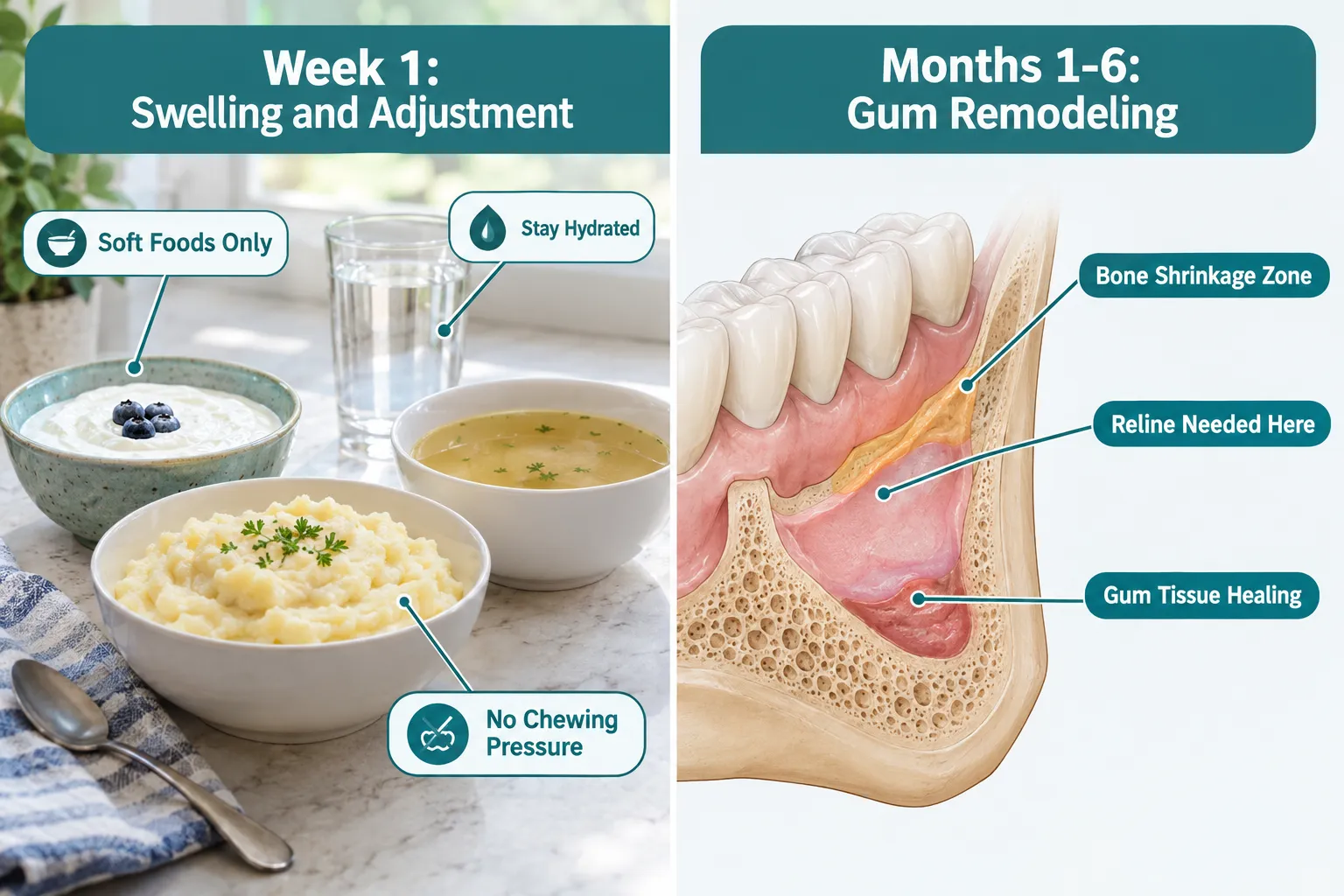
During the first week, your diet will be limited to soft, easy-to-swallow foods: yogurt, mashed potatoes, smoothies, scrambled eggs, soft fish, and well-cooked vegetables. Avoid hard, crunchy, sticky, or spicy foods that could irritate the healing tissue or dislodge the denture.
Speaking with an immediate denture takes practice. Words containing “s,” “f,” and “th” sounds are typically the most challenging at first. Reading aloud at home, even for just 10 to 15 minutes a day, accelerates adaptation significantly. Most patients find their speech normalizes within two to three weeks.
For more on adapting to life with dentures over the longer term, our detailed guide on are dentures comfortable and how to adjust answers the questions patients most frequently ask after their first few weeks.
Gum and Bone Shrinkage: Why Your Denture Will Loosen Over Time
Here is a fact many patients are not warned about clearly enough: the bone and gum tissue beneath your immediate denture will shrink. This is not a complication, it is a normal, predictable biological process that occurs whenever teeth are removed.
Teeth stimulate the jawbone through the forces of biting and chewing. When that stimulation stops, the bone begins to resorb (shrink inward). Most of this change happens rapidly in the first three to six months, then continues more gradually for up to a year or longer. As the ridge shrinks, the denture that once fit snugly becomes loose.
What this means practically:
- Expect to need temporary relines (a material added inside the denture to restore fit) at roughly six to eight weeks and again around the three-month mark
- A permanent reline or new denture is typically recommended after six to twelve months, once the bone has stabilized
- Loose dentures are not something to live with, they cause sore spots, inefficient chewing, and can accelerate further bone loss
This is one reason many patients eventually explore implant-supported options. Our article on whether you can get dental implants after dentures explains how and when that transition is possible.
Your Follow-Up Schedule and Path to a Permanent Solution
A well-managed immediate denture transition follows a predictable schedule:
| Timeframe | Appointment Purpose |
|---|---|
| 24 hours post-extraction | First check, socket inspection, initial adjustments |
| 1 week | Suture removal (if applicable), sore spot relief |
| 4-6 weeks | Soft reline to compensate for early shrinkage |
| 3 months | Reassessment, possible second reline |
| 6-12 months | Evaluation for permanent denture or implant planning |
Staying consistent with these follow-ups is as important as the extraction itself. Patients who skip reline appointments often struggle unnecessarily with looseness and irritation that is entirely preventable.
At Madison Dental Art, our prosthodontics team guides patients through every stage of this journey, from the first impression appointment through the transition to a long-term solution. If implants eventually become part of your plan, our periodontology services support implant placement once the bone has healed. You can also explore what permanent dentures are and how they work to understand the options that become available after the healing period ends.
FAQs:
Can I eat normally on the day I get my immediate dentures?
No. On the day of your extractions, you should limit yourself to cool or room-temperature liquids only. Over the following days, soft foods such as yogurt, soup, and mashed potatoes are appropriate. Hard, crunchy, or sticky foods should be avoided for at least the first one to two weeks to protect the healing extraction sites and prevent dislodging the denture.
Will my immediate denture look like my natural teeth?
Your dental team works from impressions and shade selections made before extraction day to create an appliance that resembles your natural teeth as closely as possible. Most patients are pleasantly surprised by the aesthetic result. Because the denture is designed before the teeth are removed, the final look is based on your existing anatomy and your input during the planning visits.
How long before I get a permanent denture?
Most patients are ready for a permanent, well-fitted conventional or implant-supported denture between six and twelve months after extractions. This timeline allows the jawbone and gum tissue to finish most of their remodeling. Moving too quickly to a permanent denture before the bone has stabilized risks ending up with an appliance that fits poorly within a short time.
Is there anything I can do to slow down bone shrinkage?
Dental implants are currently the most effective way to preserve jawbone after tooth loss, because they replicate the stimulation that natural tooth roots once provided. If bone preservation is a priority for you, discuss implant placement timing with your dentist early in the process. Some patients opt for implants placed during the same appointment as extractions, while others prefer to wait until initial healing is complete.
References
- American Dental Association. (2022). Dentures. ADA.org. https://www.ada.org/resources/research/science-and-research-institute/oral-health-topics/dentures
- National Institute of Dental and Craniofacial Research. (2023). Tooth loss in adults (age 20 to 64). NIDCR.NIH.gov. https://www.nidcr.nih.gov/research/data-statistics/tooth-loss/adults
- American College of Prosthodontists. (2022). Facts & figures: Edentulism and the need for implant therapy. ACP.org. https://www.prosthodontics.org/assets/1/7/ACP_Facts_and_Figures_for_Implant_Therapy1.pdf
- Moreno Hay, I., & Okeson, J. P. (2021). Managing the edentulous patient: Prosthodontic and occlusal considerations. Journal of Prosthodontics, 30(S1), 62-70. https://doi.org/10.1111/jopr.13293
Madison Dental Art
Content written and reviewed by
Madison Dental Art Review Board
Madison Dental Art : Experienced dentists and specialists dedicated to providing accurate, trusted, and patient-focused oral health information.
Important information
The content of this article is for strictly educational and informational purposes. It does not replace in-person professional medical diagnosis, advice, or treatment.


