 by Madison Dental Art Review Board
More than 15 million root canals are performed in the United States every year, yet fear of the procedure keeps countless patients from getting treatment they urgently need. The question “do root canals hurt?” is one of the most searched dental topics online, and the honest answer may surprise you: for most people, a modern root canal is no more painful than getting a cavity filled.
That reputation for being agonizing? It belongs to a different era of dentistry, one that existed before today’s advanced local anesthetics, precision instruments, and specialist-level techniques. This article breaks down what the clinical evidence actually shows, what you will realistically feel before, during, and after the procedure, and how the team at Madison Dental Art in Forest Hills, Queens, helps patients move through this treatment with confidence.
Table of Contents
Key Takeaways
- Modern root canals are largely pain-free during the procedure thanks to effective local anesthesia; clinical studies report a mean intraoperative pain score of about 1.2 out of 10, with more than half of patients feeling no pain at all.
- The tooth infection causing you to need a root canal is almost always more painful than the treatment itself.
- Mild soreness after a root canal is normal and typically peaks within 24 to 48 hours, then fades within a week.
- Only about 3 to 6 percent of patients report severe post-procedure pain; most manage comfortably with over-the-counter pain relievers.
- Delaying treatment allows the infection to worsen, making both pain and complications far more likely.
The Myth vs. The Reality: Do Root Canals Hurt?
The fear surrounding root canals is real, but it is largely based on outdated experiences. Decades ago, before modern anesthetics and refined techniques, dental procedures could be genuinely difficult to endure. Today, that picture has changed dramatically.
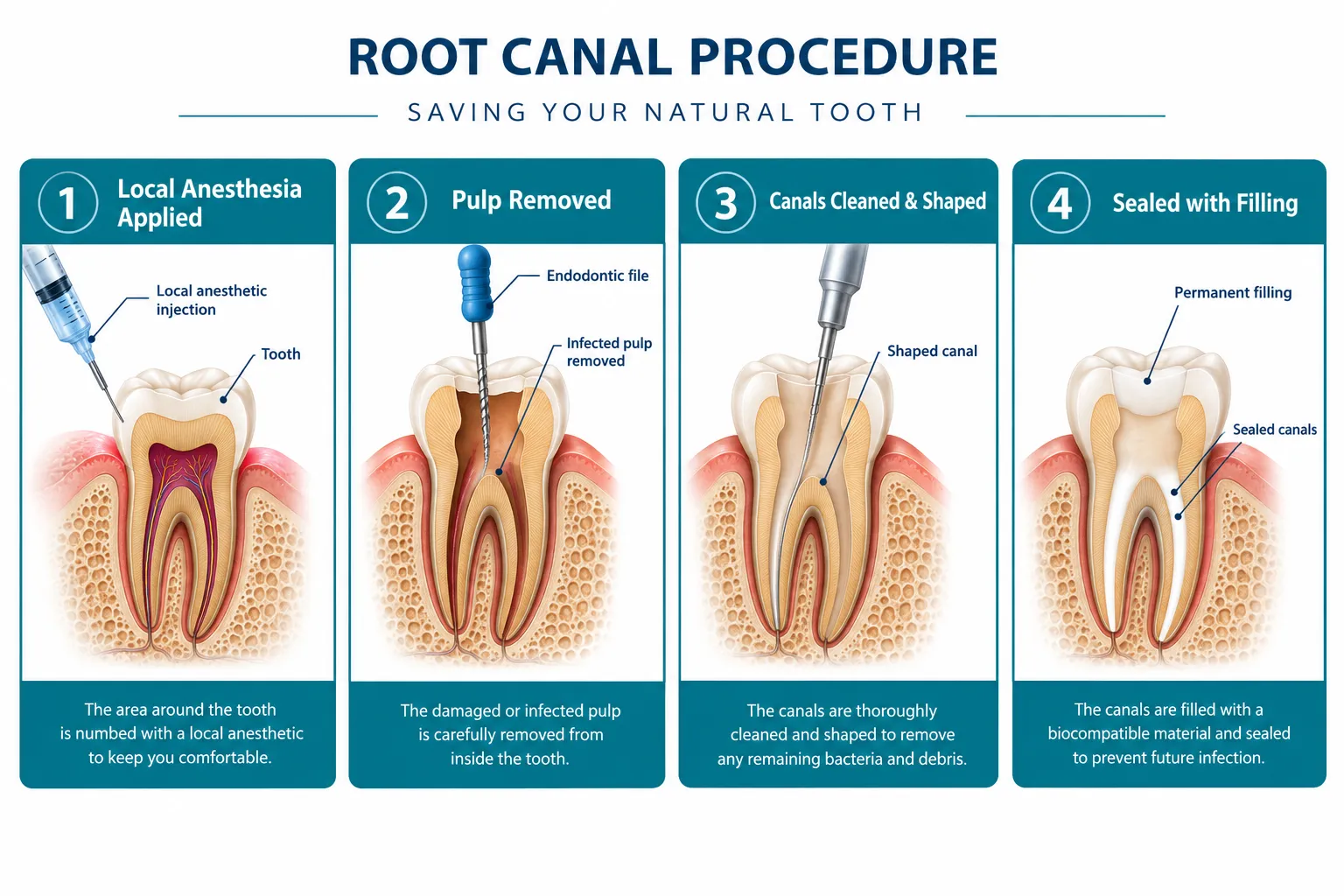
Major professional organizations, including the American Association of Endodontists, are direct on this point: with current local anesthetics and techniques, a root canal should not hurt more than a routine filling. Large-scale clinical studies back this up. Research tracking patients through the procedure found a mean intraoperative pain score of roughly 1.2 on a scale of 0 to 10. More than half of those patients reported feeling no pain at all during the treatment.
What patients typically do feel is pressure and vibration, sensations that come from the instruments working inside the tooth. These are not painful, but they can feel unfamiliar. Most patients who have had root canals describe the experience as similar to having a deep filling or a crown placed, not the ordeal they had imagined.
For a detailed, step-by-step breakdown of what happens in the chair, see our guide to the root canal procedure and process.
Why the Tooth Infection Hurts More Than the Treatment
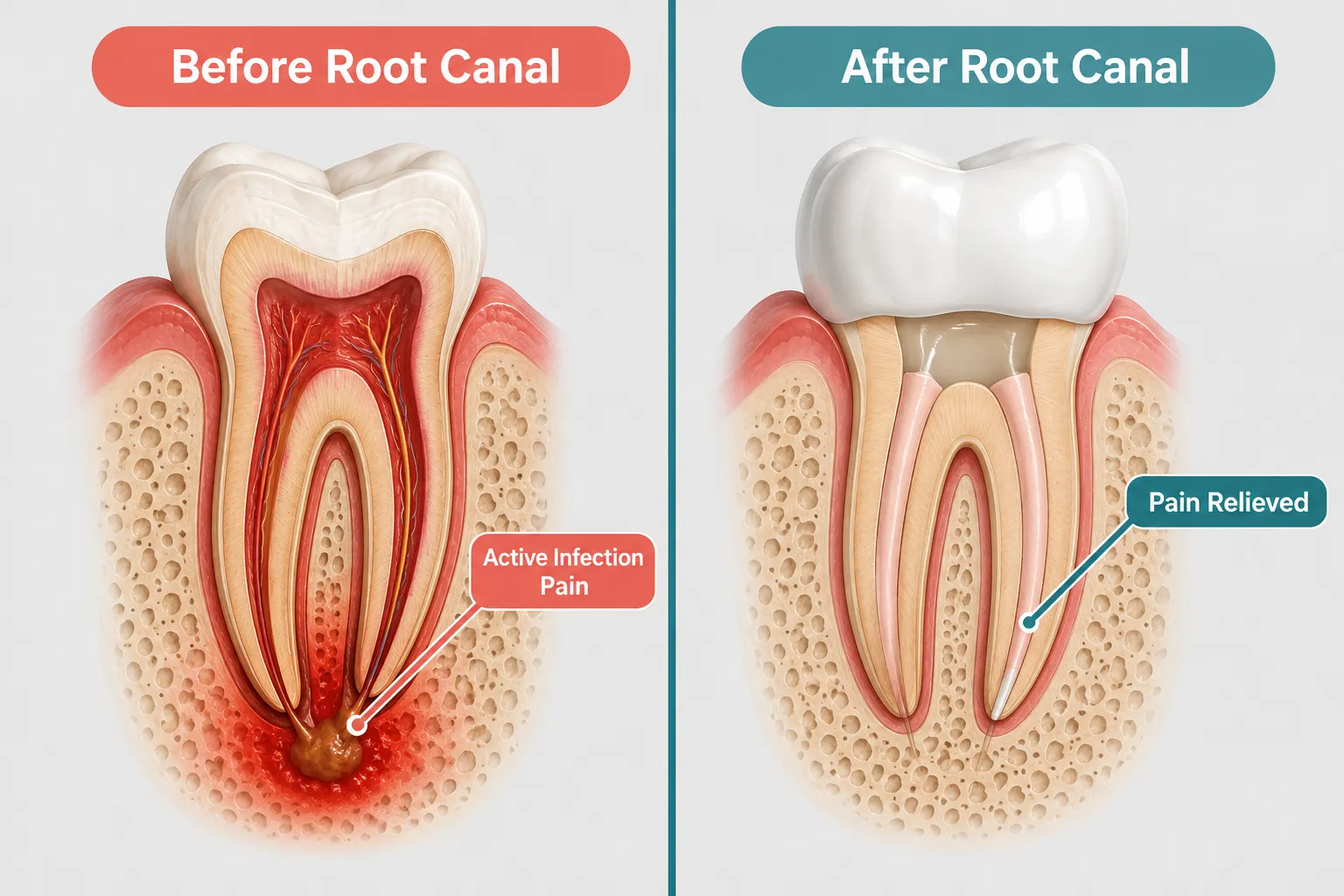
Here is a fact that often surprises patients: the pain you feel before a root canal is usually far worse than anything you will feel during or after it. A tooth infection creates intense, throbbing, sometimes unbearable pressure inside a confined space. The root canal procedure removes that source of pain.
A prospective study of more than 1,000 patients published in the Journal of Dentistry found that the mean “worst pain” score dropped from 5.3 before treatment to 2.6 just one week after the root canal. The procedure is, in the most literal sense, a pain-relieving intervention.
If you are unsure whether your symptoms point to needing this treatment, our article on symptoms and the need for a root canal can help you recognize the warning signs.
What Modern Anesthesia Actually Does
Local anesthetics used in dentistry today are highly effective. Before any instrument touches the interior of your tooth, your dentist or endodontist will ensure the area is completely numb. You should feel no sharp sensation. If at any point during the procedure you do feel discomfort, you can signal your provider and additional anesthetic can be applied.
At Madison Dental Art, patients who experience significant dental anxiety also have access to nitrous oxide sedation, which creates a relaxed, calm state without putting you fully to sleep. This option is particularly helpful for patients who feel tense even when they know the procedure will not hurt.
Pain After a Root Canal: What to Expect During Recovery
The question “do root canals hurt afterward?” deserves its own honest answer. Yes, some soreness is normal, but it is manageable, temporary, and far less intense than what most people expect.
The Typical Pain Timeline
Post-procedure discomfort follows a predictable pattern for most patients:
| Timeframe | What Most Patients Experience |
|---|---|
| First 24 hours | Mild to moderate soreness around the treated tooth |
| 24 to 48 hours | Peak discomfort, still manageable with OTC pain relievers |
| Days 3 to 7 | Noticeable improvement; soreness fades significantly |
| After 1 week | Most patients are back to normal with no notable pain |
Over-the-counter medications such as ibuprofen or acetaminophen are typically sufficient to manage this discomfort. Your provider will give you specific guidance based on your situation.
For a complete recovery plan, including what to eat, what to avoid, and when to call your dentist, see our article on what to do after a root canal.
Who Is More Likely to Experience More Discomfort
Not everyone recovers the same way. Research on more than 1,000 root canal patients identified several factors associated with a higher likelihood of significant post-treatment pain:
- Severe pain before the procedure, the more inflamed the tissue, the more it needs to settle afterward
- Female sex, hormonal factors appear to influence pain sensitivity and recovery
- Temporomandibular disorder (TMJ issues), jaw joint problems can amplify post-dental discomfort
- Fibromyalgia, a systemic pain-sensitivity condition
- Use of pain medication in the week before treatment, suggesting the infection was already severe
If any of these factors apply to you, your provider at Madison Dental Art can build a more targeted pain-management plan before you even sit in the chair. This is not a reason to avoid treatment, it is a reason to communicate openly with your care team.
When to Be Concerned
Mild soreness for a few days is expected. Nevertheless, certain signs warrant a call to your dentist:
- Pain that gets worse after the first 48 hours rather than better
- Swelling that is spreading in your jaw or face
- A return of severe, throbbing pain after several days of improvement
- Visible pus or a bad taste that does not resolve
These could indicate a complication or an incomplete treatment response. Learn more about the warning signs in our guide on how to know if a root canal is failing.
How Madison Dental Art Keeps Root Canals Comfortable
At Madison Dental Art, endodontic care is delivered with both clinical precision and genuine human attention. Founded in Forest Hills in 1994 by Dr. Alexander Chao, who graduated in the top 3% of his class at NYU College of Dentistry, the practice has grown into one of Queens’ most trusted dental providers precisely because it combines specialist-level expertise with a warm, patient-centered environment.
The practice uses digital X-rays and 3D panoramic imaging to map the tooth’s root anatomy with accuracy before treatment begins. This preparation reduces surprises during the procedure and supports more predictable outcomes. For patients who need it, nitrous oxide sedation is available to ease anxiety from start to finish.
If you are in Forest Hills, Queens, or anywhere in greater New York City and have been putting off treatment because of fear, the endodontist root canal services at our Forest Hills location are designed specifically to address that concern.
“The goal of a root canal is not to cause pain, it is to end it. Modern techniques make that possible for the vast majority of patients.”
FAQs
Is it normal to feel pain during a root canal even with anesthesia?
It is uncommon but possible to feel some discomfort if the anesthetic does not fully penetrate inflamed tissue. Clinical data shows that more than half of patients feel no pain at all during the procedure, and the average intraoperative pain score is very low. If you feel anything sharp, signal your provider immediately, additional anesthetic can be given. Feeling pressure and vibration is normal and expected; sharp pain is not.
How long does pain last after a root canal?
For most patients, soreness peaks within the first 24 to 48 hours and then declines steadily. By the end of the first week, the majority of patients report little to no discomfort. Only about 3 to 6 percent of people experience what would be classified as severe post-procedure pain. Over-the-counter pain relievers are usually all that is needed.
Is a root canal more painful than a tooth extraction?
This depends on the individual case, but many patients find that a root canal, which preserves the natural tooth, involves less post-procedure discomfort than an extraction, which requires healing of the surrounding bone and gum tissue. Extractions also introduce the need for a replacement tooth, such as an implant or bridge. Saving the natural tooth through a root canal is generally the preferred clinical option when the tooth structure is intact.
Can a root canal get infected again after treatment?
Yes, though it is uncommon. A root canal can become reinfected if bacteria re-enter the tooth through a cracked crown, a failed seal, or an untreated accessory canal. Signs of reinfection include a return of pain, swelling, or a pimple-like bump on the gum near the treated tooth. If you suspect this has happened, prompt evaluation is important.
References
- American Association of Endodontists. (2023). Myths about root canals. https://www.aae.org/patients/root-canal-treatment/what-is-a-root-canal/root-canal-myths/
- National Institute of Dental and Craniofacial Research. (2021). Dental pulp and periapical diseases. U.S. Department of Health and Human Services. https://www.nidcr.nih.gov/
- Cleveland Clinic. (2023). Root canal treatment. https://my.clevelandclinic.org/health/treatments/10391-root-canal-treatment
- Harvard Health Publishing. (2022). Root canals: What to expect. Harvard Medical School. https://www.health.harvard.edu/
- Penn Dental Medicine. (2023). Root canal myths and facts. University of Pennsylvania School of Dental Medicine. https://www.dental.upenn.edu/
Madison Dental Art
Content written and reviewed by
Madison Dental Art Review Board
Madison Dental Art : Experienced dentists and specialists dedicated to providing accurate, trusted, and patient-focused oral health information.
Important information
The content of this article is for strictly educational and informational purposes. It does not replace in-person professional medical diagnosis, advice, or treatment.


