 by Madison Dental Art Review Board
A tooth infection left untreated can spread to the jaw, neck, and even the brain, yet millions of people delay care simply because they are not sure whether their symptoms are serious enough. If you have been wondering how do you know if you need a root canal, the short answer is: certain pain patterns, visible changes in your tooth, and signs of infection are reliable red flags that demand a professional evaluation, and the sooner you act, the better your chances of saving the tooth.
This guide breaks down the essential warning signs, explains how dentists confirm a root canal diagnosis, and outlines what modern treatment actually looks like at a practice like Madison Dental Art in Forest Hills, Queens.
Table of Contents
Key Takeaways
- Persistent tooth pain, especially pain that wakes you at night or radiates to the jaw or ear, is one of the strongest indicators that a root canal evaluation is needed.
- Sensitivity to hot or cold that lingers for 30 seconds or more after the stimulus is removed suggests the pulp inside the tooth is damaged, not just surface enamel.
- Visible signs such as a pimple on the gum, tooth darkening, or facial swelling signal that infection may have already spread beyond the pulp.
- Dentists do not rely on symptoms alone; they use percussion tests, thermal tests, and digital X-rays or 3D scans to confirm the diagnosis.
- Not every case of pulp damage automatically requires a full root canal, newer vital pulp therapies can preserve more of the tooth’s natural tissue when the pulp is still partially healthy.
Warning Signs That Suggest You May Need a Root Canal
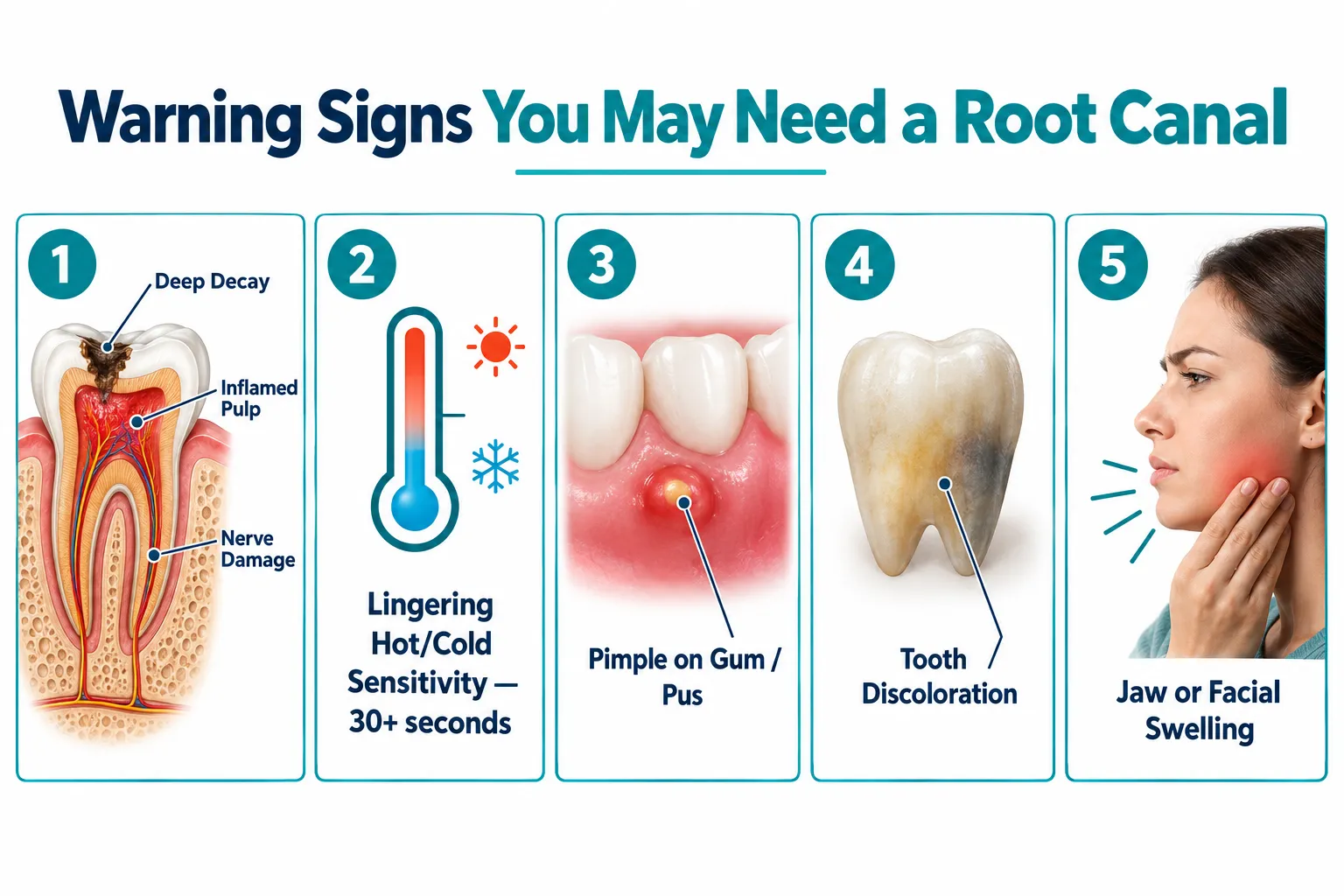
Comprehending how do you know if you need a root canal starts with recognizing a specific cluster of symptoms. These are not the same as a mild toothache after eating something cold. The signs below are more persistent, more intense, and often progressive.
Severe or Persistent Tooth Pain
Pain that does not go away on its own is the most common reason patients seek an endodontic evaluation. Specifically, watch for:
- Throbbing pain that lasts more than two to three days without improvement
- Pain that wakes you at night, even without any trigger
- Pain that radiates to the jaw, ear, temple, or face on the same side
- Sharp pain when biting or chewing, even on soft foods
This type of pain typically means the pulp, the soft tissue of nerves and blood vessels inside the tooth, is inflamed or infected. It is called pulpitis, and when it reaches an irreversible stage, root canal therapy or a related pulp procedure is usually required to eliminate the source of pain. For a deeper look at what to expect, see our guide on root canal pain: what to expect during and after.
Lingering Sensitivity to Hot or Cold
Everyone experiences brief discomfort when biting into ice cream. That is normal. What is not normal is sensitivity that persists for 30 seconds or more after the hot or cold stimulus is removed. This lingering reaction is a clinical hallmark of damaged pulp tissue rather than simple enamel sensitivity.
If sipping hot coffee causes a sharp ache that stays with you for a minute or longer, that tooth deserves professional attention. Our article on symptoms and the need for a root canal covers this pattern in greater detail.
Swollen Gums, a Pimple on the Gum, or Facial Swelling
“Facial swelling that spreads, difficulty swallowing, or swelling that feels warm and firm are dental emergencies, do not wait for a scheduled appointment.”
Infection that has moved beyond the pulp into the surrounding bone and tissue produces visible signs:
| Sign | What It May Indicate |
|---|---|
| Tender or swollen gum near one tooth | Abscess forming at the root tip |
| A small pimple or boil on the gum | Fistula draining pus from an infection |
| Jaw swelling or facial puffiness | Infection spreading into surrounding tissue |
| Loose adult tooth (no injury) | Bone loss around the root from chronic infection |
If you recognize any of these, review our resource on signs of tooth infection: symptoms you should know and call a dentist promptly. Spreading facial swelling is a medical emergency.
Tooth Discoloration
A tooth that appears noticeably darker than its neighbors, gray, brown, or yellow, may have a dying or dead nerve. This can happen after trauma, deep decay, or a long-standing infection that has slowly destroyed the pulp tissue. The discoloration often develops gradually, and the tooth may cause little or no pain at this stage. Absence of pain does not mean the tooth is healthy; it may simply mean the nerve has already died. Learn more about what happens with a crown on a dead tooth and why treatment is still necessary.
Deep Decay, Cracks, or Prior Trauma
A cavity that has been left untreated long enough will eventually reach the pulp. Similarly, a cracked or chipped tooth can allow bacteria to travel directly into the pulp chamber. If you have experienced a blow to the mouth, even years ago, that tooth may develop pulp problems later. These structural issues are common reasons dentists recommend root canal evaluation even before severe pain develops.
How Dentists Confirm You Need a Root Canal
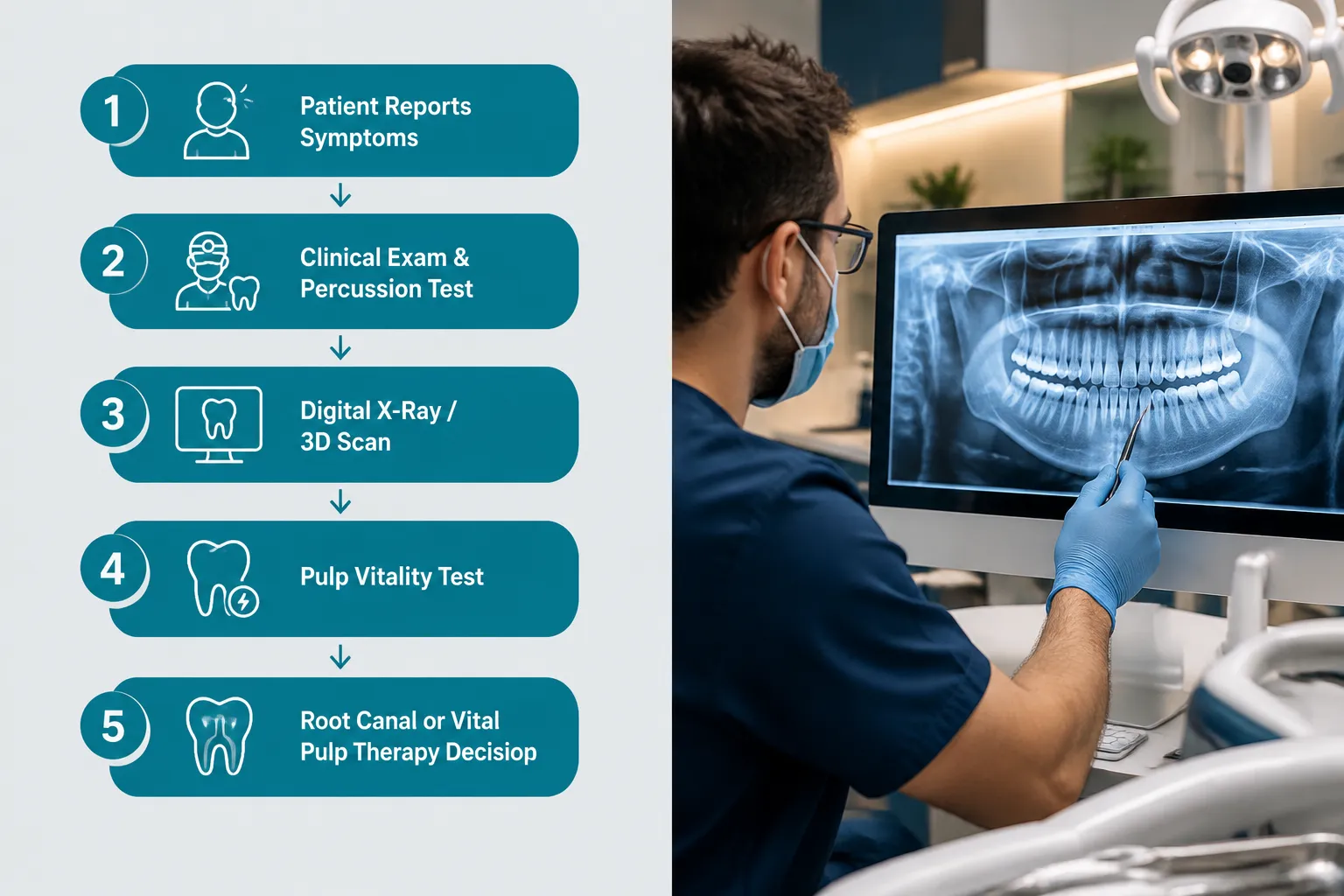
Knowing how do you know if you need a root canal is not something you can determine with certainty on your own. Dentists and endodontists use a structured diagnostic process that combines your reported symptoms with objective clinical findings.
The Clinical Examination
Your dentist will begin with a thorough review of your dental and medical history, then perform several targeted tests:
- Percussion test, Gently tapping on the tooth to check for pain in the ligament around the root, which signals infection or inflammation at the root tip.
- Thermal (cold or heat) test, Applying a cold stimulus or warm gutta-percha to assess how the pulp responds and whether that response lingers abnormally.
- Electric pulp test, In some cases, a small electrical stimulus is used to determine whether the pulp is still vital (alive) or has died.
- Palpation, Pressing on the gum and jaw to locate swelling or tenderness that might indicate an abscess.
Imaging: Digital X-Rays and 3D Scans
No diagnosis is complete without imaging. At Madison Dental Art, we use digital X-rays and 3D panoramic scans to visualize the root canals, surrounding bone, and any dark “apical lesion” at the root tip, a classic radiographic sign of chronic infection. Three-dimensional imaging is especially valuable for complex cases involving multiple roots or unusual anatomy.
Root Canal vs. Vital Pulp Therapy: A Newer Decision
One of the most significant shifts in modern endodontics is that a diagnosis of irreversible pulpitis no longer automatically means a full root canal. When diagnostic tests show that part of the pulp is still healthy, dentists may now discuss vital pulp therapy, specifically a procedure called a full pulpotomy, as a minimally invasive alternative that preserves more of the tooth’s living tissue.
Recent clinical research shows that full pulpotomy in mature permanent teeth can achieve success rates comparable to traditional root canal therapy, with some studies reporting clinical success above 97% for both approaches. Patients treated with pulpotomy also tend to report greater reductions in pain on the first day after treatment.
This does not mean root canals are outdated, far from it. For teeth with advanced infection, bone loss at the root tip, or a completely non-vital pulp, root canal therapy remains the standard of care. The main point is that your treatment plan should be based on a thorough, individualized evaluation rather than symptoms alone. Our detailed overview of the root canal procedure and process explains exactly what each step involves.
What Happens If You Wait?
Delaying treatment when these warning signs are present carries real risks:
- The infection can spread to adjacent teeth, the jawbone, or the soft tissues of the neck and face.
- The tooth may become non-restorable, meaning extraction becomes the only option.
- Systemic infection, while rare, is a documented risk of untreated dental abscesses.
Tooth extraction followed by a dental implant or bridge is always more complex and costly than treating the original tooth. If you are curious about what happens when a treated tooth develops new problems, our article on how do you know if a root canal is failing is a helpful resource.
Getting Evaluated at Madison Dental Art in Forest Hills
Madison Dental Art has served patients in Forest Hills, Queens, and greater New York City since 1994. Founded by Dr. Alexander Chao, who graduated in the top 3% of his class at NYU College of Dentistry, the practice brings together general dentists and specialists under one roof, so patients receive coordinated, expert care without being referred to multiple offices.
Our endodontic services are supported by advanced imaging technology, including digital X-rays and 3D panoramic scans, which allow our team to make precise, confident diagnoses. For patients with dental anxiety, nitrous oxide sedation is available to make the experience as comfortable as possible.
If you are experiencing any of the warning signs described in this article, do not wait. Call us at (718) 268-8228 or visit our contact page to schedule an evaluation. We are located at 112-03 Queens Boulevard, Suite 211, Forest Hills, NY 11375, and we welcome patients Monday through Saturday.
FAQs
Can a tooth need a root canal even if it does not hurt?
Yes. Some teeth require root canal therapy despite causing little or no pain. A tooth with a dead nerve, for example, may have stopped hurting because the nerve tissue has already been destroyed by infection. Dentists identify these cases through discoloration, deep decay, prior trauma, and radiographic findings such as a dark area at the root tip. This is one reason regular dental checkups are so important, problems can be caught before they become emergencies.
How do you know if you need a root canal versus just a filling?
A filling is appropriate when decay is limited to the outer layers of the tooth, the enamel and dentin, and has not reached the pulp. A root canal is indicated when the pulp itself is inflamed or infected. The distinction is made through clinical testing and X-rays, not symptoms alone. Lingering sensitivity, spontaneous pain, or a visible abscess all suggest the infection has gone deeper than a filling can address.
Is a root canal painful?
Modern root canal treatment is performed under local anesthesia and is generally no more uncomfortable than having a filling placed. Most patients report that the pain they felt before treatment, from the infection itself, was far worse than the procedure. Post-treatment soreness typically resolves within a few days.
Can a tooth that has already had a root canal get infected again?
Yes, though it is uncommon. A previously treated tooth can become reinfected if the seal placed after treatment breaks down, if new decay develops, or if the original infection was not fully eliminated. Symptoms of a reinfected root canal are similar to those of an original infection: pain, swelling, and sensitivity.
References
- American Association of Endodontists. (2022). Endodontics: Colleagues for Excellence, Vital Pulp Therapy. American Association of Endodontists. https://www.aae.org/specialty/clinical-resources/colleagues-for-excellence/
- Cushley, S., Duncan, H. F., Lappin, M. J., Chua, P., Elamin, A. D., Clarke, M., & El-Karim, I. A. (2021). Efficacy of direct pulp capping for management of cariously exposed pulps in permanent teeth: a systematic review and meta-analysis. International Endodontic Journal, 54(4), 556-571. https://doi.org/10.1111/iej.13449
- European Society of Endodontology. (2023). ESE position statement: Vital pulp therapy. International Endodontic Journal, 56(5), 512-519. https://doi.org/10.1111/iej.13902
- National Institute of Dental and Craniofacial Research. (2023). Tooth decay. U.S. Department of Health & Human Services. https://www.nidcr.nih.gov/health-info/tooth-decay
- Harvard Health Publishing. (2022). Root canal treatment: What you need to know. Harvard Medical School. https://www.health.harvard.edu/dental-health/root-canal-treatment-what-you-need-to-know
- MedlinePlus. (2023). Root canal. U.S. National Library of Medicine. https://medlineplus.gov/ency/article/007622.htm
Madison Dental Art
Content written and reviewed by
Madison Dental Art Review Board
Madison Dental Art : Experienced dentists and specialists dedicated to providing accurate, trusted, and patient-focused oral health information.
Important information
The content of this article is for strictly educational and informational purposes. It does not replace in-person professional medical diagnosis, advice, or treatment.


