 by Madison Dental Art Review Board
A non-vital tooth is up to twice as likely to fracture under normal chewing forces compared to a healthy, living tooth, and for most patients, that fracture means losing the tooth entirely. If your dentist has recommended a crown for a dead tooth, that recommendation is not optional maintenance. It is a clinically grounded strategy to keep a structurally vulnerable tooth in your mouth for years to come.
This article explains exactly what a dead tooth is, why placing a crown on it is often essential, what the procedure involves, and when other options may apply. Whether you are dealing with a tooth that recently had a root canal or one that has been slowly dying for years, comprehending the reasoning behind a crown can help you make a confident, informed decision.
Root Canal Treatment in Forest Hills, Queens NY.
Table of Contents
Key Takeaways
- A dead tooth has lost its nerve and blood supply, making it significantly more brittle and fracture-prone than a living tooth.
- Placing a crown on a dead tooth is the standard of care for most posterior (back) teeth following root canal treatment.
- Without a crown, a non-vital tooth faces a high risk of catastrophic fracture that may require extraction.
- Front teeth may sometimes be monitored rather than crowned immediately, but clinical judgment is required.
- Prompt treatment at a qualified dental practice protects both your tooth and your overall oral health.
What Does “Dead Tooth” Actually Mean?
The term “dead tooth” refers to a tooth in which the pulp, the soft inner tissue containing nerves and blood vessels, has lost all function. Clinically, this is called a non-vital tooth. The pulp can die from untreated tooth decay, trauma, a severe crack, or advanced tooth infection.
Once the pulp dies, the tooth no longer receives nutrients or moisture from the body’s circulatory system. This is the core reason a dead tooth behaves so differently from a healthy one.
Why a Dead Tooth Becomes Brittle
Living teeth stay flexible because dentin, the hard layer beneath enamel, remains hydrated through the pulp’s fluid supply. When that supply is cut off, dentin gradually dehydrates. The result is a tooth that becomes stiff and brittle, much like a dried-out twig compared to a green branch.
This mechanical change is not cosmetic. It means the tooth can no longer absorb and distribute biting forces the way it once did. Cusps become vulnerable to chipping. The entire crown portion of the tooth becomes susceptible to vertical fractures that can extend below the gum line, a scenario that typically ends in extraction.
If you have noticed a tooth that has changed color, become darker, or caused persistent tooth pain followed by no sensation at all, those are classic signs of a dying or dead pulp. You can also learn more about the early warning signs of nerve involvement by reading about dying tooth nerve treatment in Forest Hills, Queens.
Why a Crown Dead Tooth Combination Is the Standard of Care
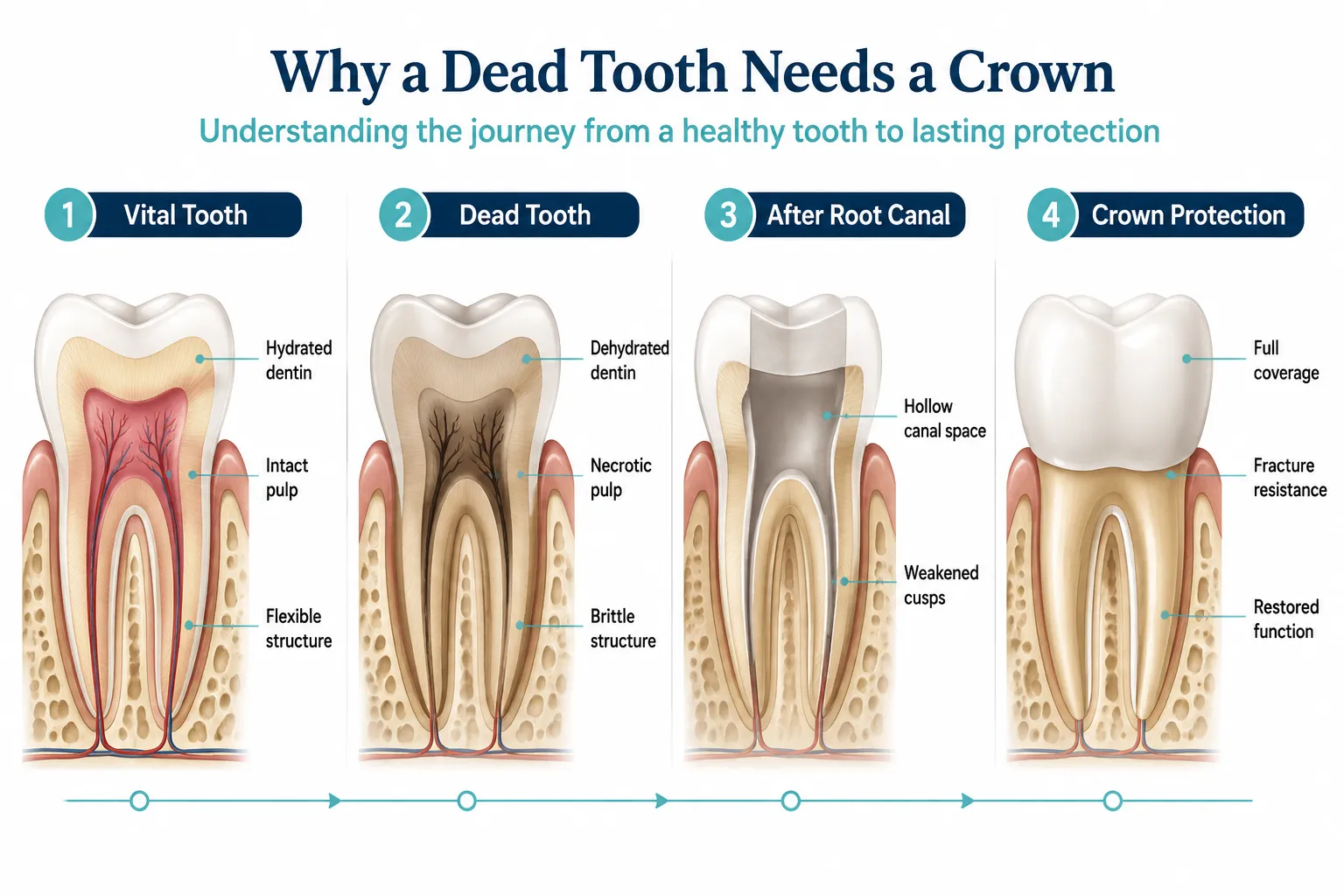
The clinical rationale for placing a crown on a dead tooth comes down to one word: protection. Once root canal treatment removes the necrotic pulp and seals the canals, the tooth is structurally hollow. The walls that remain are thinner, drier, and more prone to cracking under the repetitive stress of chewing.
Research consistently shows that root-canal-treated posterior teeth, molars and premolars, that are restored with a crown have significantly better long-term survival rates than those restored with a filling alone. A direct composite or amalgam filling can restore the shape of the tooth, but it cannot reinforce the remaining walls against fracture the way a full-coverage crown does.
Clinical principle: A crown does not just replace what was lost. It encircles and splints the remaining tooth structure, preventing the walls from splitting apart under load.
When a Crown Is Strongly Recommended
- All root-canal-treated molars and premolars: These teeth bear the heaviest chewing forces. Crowning them promptly is the standard of care in 2026 and has been for many years.
- Teeth with large existing restorations: If a tooth already had a large filling before the root canal, very little natural tooth structure remains. A crown is essential.
- Teeth with visible cracks: A cracked tooth that also has a dead pulp is at extreme risk of fracture without crown coverage.
- Teeth used as bridge abutments: Non-vital teeth serving as anchors for a dental bridge carry additional mechanical load, making crown coverage critical.
When a Crown May Be Deferred or Reconsidered
Front teeth (incisors and canines) are subject to lighter biting forces and may sometimes be monitored after root canal treatment rather than crowned immediately, particularly if the tooth structure is largely intact. Nevertheless, this is a clinical judgment call. Factors such as the amount of remaining tooth structure, the patient’s bite, and esthetic concerns all influence the decision.
To understand more about whether a crown is truly necessary in your specific case, the team at Madison Dental Art recommends reviewing our detailed guide on whether a dental crown is necessary.
The Crown Dead Tooth Procedure: Step by Step
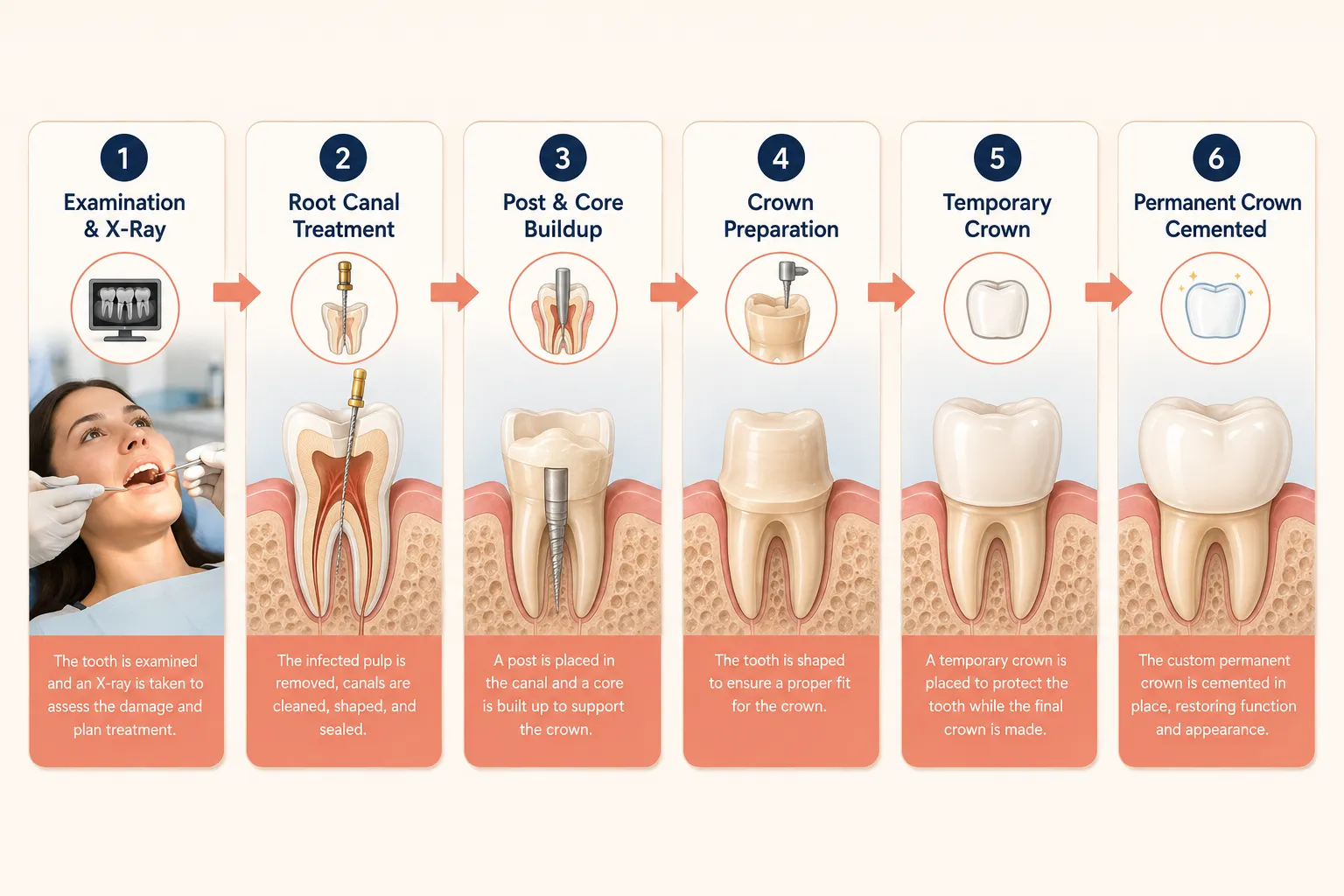
Placing a crown on a non-vital tooth follows a well-established sequence. Here is what patients at Madison Dental Art can expect:
Step 1, Examination and Imaging The process begins with a thorough clinical exam and digital X-rays or a 3D panoramic scan to assess the root, bone levels, and existing restoration. This determines whether the tooth is a good candidate for a crown or whether other treatment is needed first.
Step 2, Root Canal Treatment (if not already completed) If the pulp is still present but necrotic, root canal treatment must be completed before a crown is placed. Our endodontics page explains this process in detail. In some cases, a patient may wonder whether a root canal can even be performed through an existing crown, that question is answered in depth in our article on whether an endodontist can do a root canal through a crown.
Step 3, Post and Core Buildup (when needed) If significant tooth structure was lost to decay or fracture, a post may be placed inside the root canal to anchor a core buildup. This creates a stable foundation for the crown.
Step 4, Tooth Preparation The tooth is shaped to create room for the crown. Because the tooth is non-vital, this step is typically performed with local anesthesia for patient comfort, even though the nerve is gone, the surrounding gum and bone tissue still have sensation.
Step 5, Temporary Crown A temporary crown protects the prepared tooth while the permanent restoration is being fabricated.
Step 6, Permanent Crown Placement The final crown, commonly made from porcelain-fused-to-metal, full zirconia, or all-ceramic materials, is cemented permanently. For a detailed walkthrough of each stage, see our complete guide to the dental crown procedure steps.
What Happens If You Skip the Crown?
Skipping the crown on a dead posterior tooth is one of the most common, and most costly, decisions patients regret. Without the protective coverage a crown provides, the brittle walls of a non-vital tooth are exposed to the full force of every bite.
The most common outcome is a vertical root fracture, a crack that runs down the length of the root. Unlike a chipped cusp, which can often be repaired, a vertical root fracture almost always results in extraction. At that point, the patient faces the cost and time of tooth replacement options such as a dental implant or bridge, which are significantly more involved than a crown would have been.
There is also the risk of reinfection. A tooth that has had a root canal but no crown is more vulnerable to bacterial leakage back into the sealed canals, potentially leading to a new dental abscess and the need for retreatment or extraction.
Special Situations: Dark Teeth, Fallen Crowns, and Esthetic Concerns
My Crown Fell Off and the Tooth Underneath Looks Dark
A tooth that appears dark or grayish beneath a lost crown has likely been non-vital for some time. The discoloration comes from breakdown products within the dehydrated dentin. This is not necessarily an emergency, but it does require prompt evaluation. If you are in this situation, our guide on what to do when a dental crown falls out is a helpful starting point.
Esthetic Concerns With Front Teeth
A dead front tooth can darken noticeably over time. For patients concerned about appearance, a crown, particularly an all-ceramic crown, can restore both the function and the color of the tooth. Internal bleaching combined with a crown is another option your dentist may discuss.
Caring for Your Crown Long-Term
Once your crown is in place, proper maintenance is essential. Crowns on non-vital teeth do not get cavities, but the margins where the crown meets the natural tooth can. Regular brushing, flossing, and professional checkups protect both the crown and the surrounding gum tissue. Our tips for caring for a dental crown cover everything you need to know.
FAQs
Can a dead tooth survive long-term without a crown?
A dead front tooth with minimal structural loss may survive for years without a crown if monitored carefully. Nevertheless, a dead molar or premolar is at high risk of fracture without crown protection. Most clinical guidelines recommend crowning non-vital posterior teeth as soon as root canal treatment is complete. Delaying significantly increases the chance of a fracture that cannot be repaired.
Does placing a crown on a dead tooth hurt?
The tooth itself no longer has a functioning nerve, but the surrounding gum and bone tissue do. Local anesthesia is used during preparation to ensure patient comfort. Most patients report that the procedure is no more uncomfortable than a standard filling. Post-procedure sensitivity in the gum area typically resolves within a few days.
How long does a crown on a dead tooth last?
With proper care, a well-placed crown on a non-vital tooth can last 10 to 15 years or longer. Longevity depends on the material chosen, the quality of the underlying tooth structure, the patient’s bite, and daily oral hygiene habits. Regular dental checkups allow your dentist to monitor the crown and catch any issues early.
What if the dead tooth cannot support a crown?
If too little tooth structure remains above the gum line, or if there is significant bone loss around the root, a crown may not be feasible. In those cases, extraction followed by a tooth replacement option, such as a dental implant, is typically recommended. Your dentist will evaluate the tooth thoroughly before recommending extraction as the only path forward.
References
- Bürklein, S., Schäfer, E., & Jöhren, H. P. (2022). Survival of endodontically treated teeth: A systematic review of the literature. Journal of Endodontics, 48(3), 303-315. https://doi.org/10.1016/j.joen.2021.11.009
- Skupien, J. A., Opdam, N., Winnen, R., Bronkhorst, E., Kreulen, C., Pereira-Cenci, T., & Huysmans, M. C. (2021). A practice-based study on the survival of restored endodontically treated teeth. Journal of Endodontics, 39(11), 1335-1340. https://doi.org/10.1016/j.joen.2013.06.023
- American Association of Endodontists. (2023). Colleagues for excellence: Restoration of endodontically treated teeth. https://www.aae.org/specialty/clinical-resources/colleagues-for-excellence/
- Fedorowicz, Z., Carter, B., de Souza, R. F., Chaves, C. A., Nasser, M., & Sequeira-Byron, P. (2021). Single crowns versus conventional fillings for the restoration of root-filled teeth. Cochrane Database of Systematic Reviews, 2021(5). https://doi.org/10.1002/14651858.CD009109.pub3
- National Institute of Dental and Craniofacial Research. (2023). Tooth decay. U.S. Department of Health and Human Services. https://www.nidcr.nih.gov/health-info/tooth-decay
Madison Dental Art
Content written and reviewed by
Madison Dental Art Review Board
Madison Dental Art : Experienced dentists and specialists dedicated to providing accurate, trusted, and patient-focused oral health information.
Important information
The content of this article is for strictly educational and informational purposes. It does not replace in-person professional medical diagnosis, advice, or treatment.


