 by Madison Dental Art Review Board
More than 36 million Americans have no remaining teeth, and over 120 million are missing at least one, yet the question of how to replace them remains one of the most consequential decisions a patient can make. If you have been wondering what is the difference between dental implants and dentures, you are not alone. These two restorative options dominate the conversation in dental offices across Forest Hills, Queens, and all of New York City, and choosing between them involves far more than cost. It touches on your daily comfort, your long-term oral health, and how you want to live your life.
This guide breaks down every meaningful distinction, from how each option is placed, to how it feels, to what it costs over a decade, so you can walk into your next appointment fully informed.
Table of Contents
Key Takeaways
- Dental implants are surgically anchored into the jawbone and function like natural teeth; dentures are removable appliances that rest on the gums.
- Implants preserve jawbone density and facial structure over time; traditional dentures do not stimulate the bone and can accelerate bone loss.
- Dentures carry a lower upfront cost, but implants often prove more cost-effective over a 10-20 year period due to durability and fewer replacements.
- Implant-supported overdentures offer a hybrid solution that combines the stability of implants with the coverage of a full arch restoration.
- Your candidacy for either option depends on bone density, overall health, budget, and personal lifestyle preferences, a personalized evaluation is essential.
Comprehending the Core Difference Between Dental Implants and Dentures
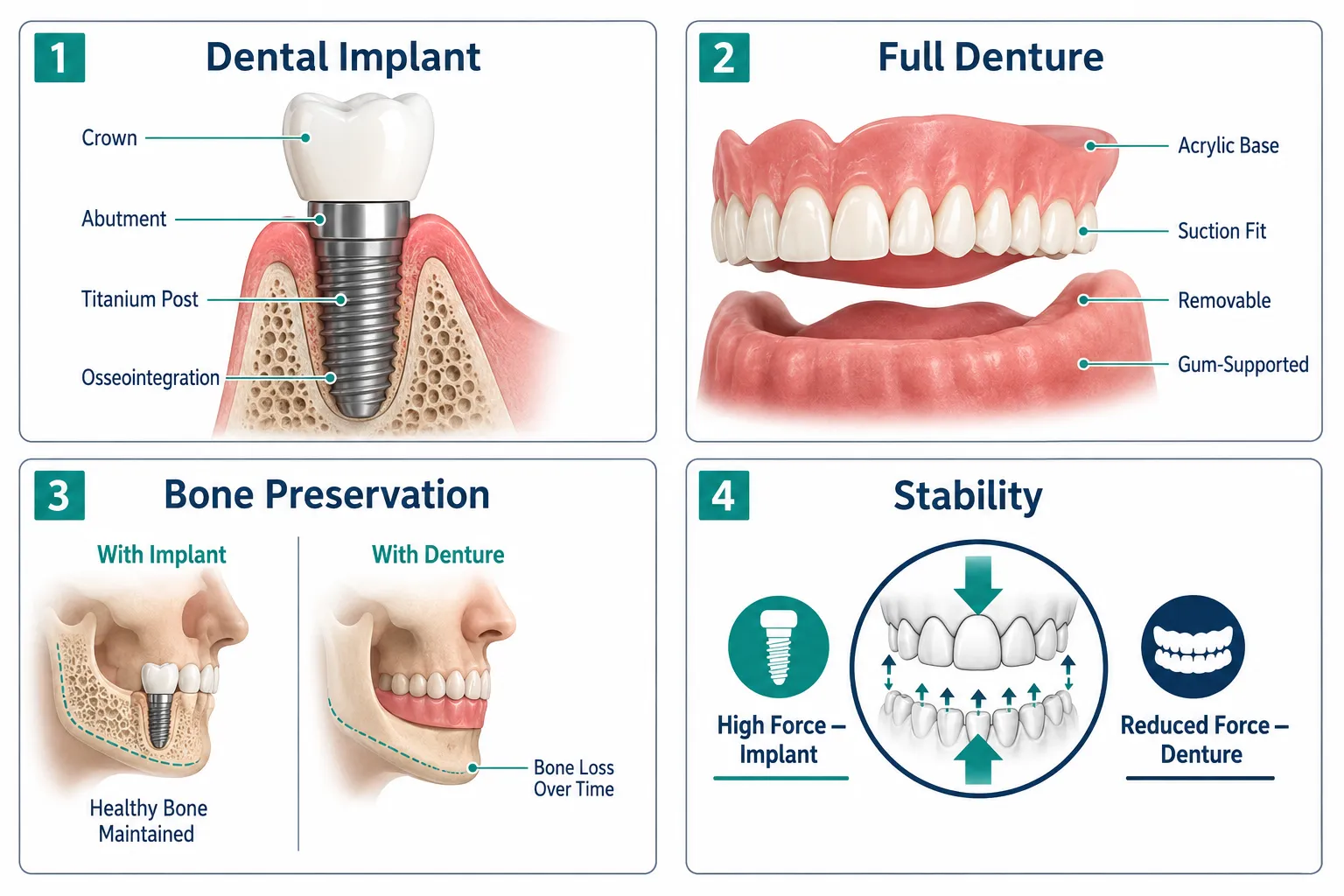
At the most fundamental level, the difference between dental implants and dentures comes down to one word: permanence. A dental implant is a small titanium post that a periodontist or oral surgeon places directly into your jawbone. Over a period of several months, the bone grows around and fuses to that post, a process called osseointegration. Once healed, a custom crown is attached on top, creating a restoration that looks, feels, and functions almost identically to a natural tooth.
A denture, by contrast, is a removable prosthetic arch made of acrylic resin and, in some cases, a metal framework. It sits on top of the gum tissue and is held in place either by natural suction, adhesive paste, or, in the case of implant-supported overdentures, by snapping onto strategically placed implants. Dentures can replace a full arch (complete dentures) or fill gaps between remaining teeth (partial dentures).
The structural distinction matters for everything that follows: stability, bone health, maintenance, longevity, and cost all trace back to whether your replacement teeth are rooted in bone or resting on soft tissue.
How Each Option Is Placed
The dental implants procedure is surgical and multi-stage. After a thorough evaluation, including 3D panoramic scans and digital X-rays, the implant post is placed under local anesthesia. Healing typically takes three to six months. Some patients require a bone graft for dental implants if their jawbone has already experienced significant resorption. Once osseointegration is complete, an abutment and crown are attached.
Dentures require no surgery. Impressions of your gums and remaining teeth are taken, and a custom prosthetic is fabricated in a dental lab. The process takes a few weeks and several fitting appointments. If you are waiting between an extraction and your final denture, you may need guidance on what to eat with no teeth while waiting for dentures.
Stability, Comfort, and Daily Function
One of the most practical ways to understand what is the difference between dental implants and dentures is to think about your daily life: eating, speaking, laughing, and simply forgetting that you have a dental restoration at all.
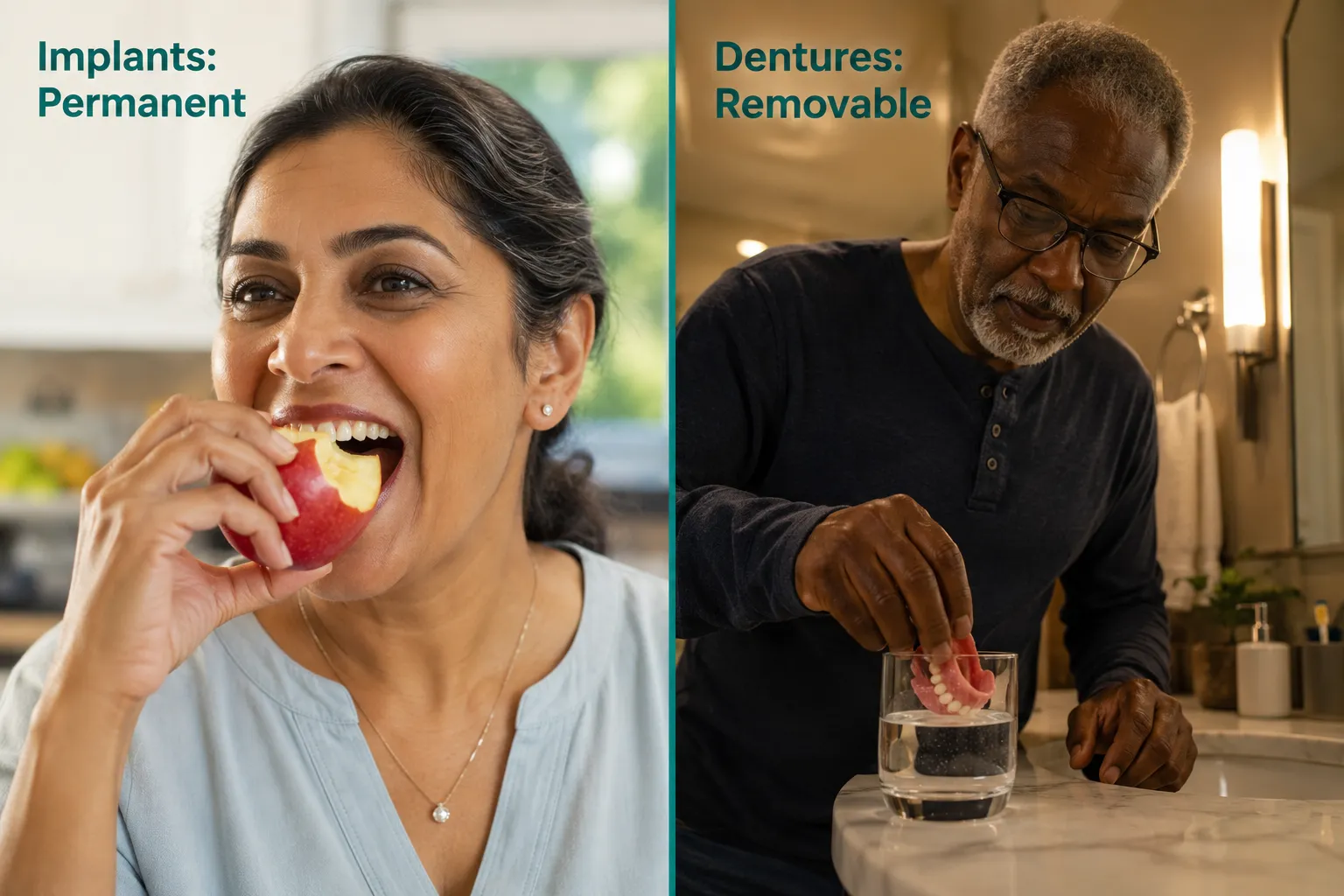
Chewing power is where the gap between the two options is most dramatic. A natural tooth transmits roughly 200-250 pounds of bite force through its root into the jawbone. A dental implant replicates this almost entirely. Traditional dentures, nonetheless, rest on soft gum tissue and deliver only about 20-25% of natural bite force. That means hard foods, raw apples, crusty bread, steak, can remain difficult or off-limits for many denture wearers, even after years of use. You can learn more about this in our guide to eating comfortably with dentures.
Speech is similarly affected. New denture wearers often experience slipping or clicking, particularly when pronouncing “s” and “f” sounds. Implants, being fixed, produce no such interference.
Comfort over time also diverges. Dentures rest on gum ridges that gradually shrink as the underlying bone resorbs, a natural consequence of no longer having tooth roots stimulating the bone. This means dentures require periodic relining or replacement (typically every five to seven years) as the fit loosens. Implants, anchored in bone, do not shift. Many patients report that after the initial healing period, they forget the implant is even there. If you are curious about the adjustment experience, our article on whether dentures are comfortable walks through what to expect.
Jawbone Health and Facial Structure
This is perhaps the most clinically significant long-term difference. When a natural tooth root is removed and not replaced with an implant, the jawbone in that area begins to resorb, it literally shrinks because it is no longer being stimulated. Over years, this bone loss can alter the shape of your face, causing the cheeks to appear sunken and the lower jaw to shift forward.
Dental implants are the only tooth replacement option that actively prevents this bone loss by mimicking the mechanical stimulation of a natural root. Traditional dentures do not provide this benefit and, in fact, can accelerate bone resorption through the constant pressure they place on the ridge. Comprehending what happens if you don’t replace a missing tooth makes clear why timely intervention matters.
Maintenance, Longevity, and Cost
Daily Care Routines
Implants are maintained almost identically to natural teeth: brush twice daily, floss, and attend regular professional cleanings. There are no adhesives, no soaking solutions, and no removal at night.
Dentures require removal every night, soaking in a cleaning solution, and careful brushing with a soft brush. They must be kept moist to prevent warping. Adhesive pastes, while helpful, add an ongoing daily step and cost.
How Long Each Option Lasts
| Feature | Dental Implants | Traditional Dentures |
|---|---|---|
| Lifespan | 20-30+ years (often lifetime with proper care) | 5-10 years before relining or replacement |
| Bone preservation | Yes, stimulates jawbone | No, bone resorption continues |
| Surgery required | Yes | No |
| Adjustments needed | Minimal | Frequent relining as fit changes |
| Adhesives required | No | Often yes |
Cost: Upfront vs. Long-Term Value
Dentures carry a significantly lower upfront investment. A complete set of dentures in the New York City area typically ranges from a few hundred to several thousand dollars depending on materials and complexity. Implants involve a higher initial cost, a single implant with crown and abutment, plus any preparatory procedures, can range from $3,000 to $6,000 or more per tooth. A full-arch implant restoration is a major investment. For a detailed breakdown, see our guide on how much a full set of dental implants costs.
Nevertheless, the 10-20 year picture often reverses this equation. When you account for denture relining, replacement sets, adhesive costs, and the potential need for additional bone and gum treatments due to ongoing resorption, the cumulative cost of dentures can approach or exceed that of implants. Implants, once integrated, rarely require significant additional expense. It is also worth reviewing whether dental insurance covers implants before making a final decision, as coverage varies widely.
Implant-Supported Overdentures: A Hybrid Solution
For patients who want greater stability than traditional dentures provide but are not candidates for, or cannot afford, a full fixed implant restoration, implant-supported overdentures offer a compelling middle ground. Two to four implants are placed in the jaw, and a specially designed denture snaps onto them. The result is dramatically improved stability, reduced bone loss compared to conventional dentures, and a more natural chewing experience.
This option is especially relevant for older adults and seniors, who may have experienced significant bone loss but still want a more secure solution. Our comparison of implant dentures vs. traditional dentures explores this option in greater depth. And if you already wear dentures and are wondering whether implants are still possible, our article on getting dental implants after dentures addresses that directly.
Which Option Is Right for You?
There is no universal answer to what is the difference between dental implants and dentures that ends with a single recommendation, because the right choice is deeply personal. Here is a practical framework:
Dental implants may be the better fit if you:
- Have sufficient jawbone density (or are willing to undergo a bone graft)
- Are in good general health and a non-smoker, or willing to quit
- Want a permanent, low-maintenance solution
- Are investing in a long-term outcome and can manage the higher upfront cost
- Want to preserve facial structure and bone health over decades
Dentures may be the better fit if you:
- Need a faster, non-surgical solution
- Have significant bone loss that makes implants complex without extensive grafting
- Have health conditions that make surgery inadvisable
- Are working within a tighter budget in the near term
- Are open to a hybrid solution like implant-supported overdentures later
At Madison Dental Art in Forest Hills, Queens, our team, including Dr. Robert Weber, a Diplomate of the American Board of Periodontology and our resident specialist in dental implants and gum health, evaluates each patient as an individual. We use 3D panoramic scanning and digital X-rays to assess your bone structure precisely before recommending any treatment path.
FAQs
Can I switch from dentures to dental implants later?
Yes, in many cases. Even patients who have worn dentures for years can transition to implants, though bone loss from prolonged denture wear may require a bone graft first. A thorough evaluation with imaging will determine your candidacy. Our article on getting dental implants after dentures covers this in detail.
Do dental implants hurt more than getting dentures?
The implant procedure is surgical and involves a healing period, but most patients report that discomfort is manageable with prescribed pain relief and is well within what they expected. Dentures involve no surgery but can cause soreness during the adjustment period as the gums adapt. Your dentist will guide you through what to expect at every stage.
How do I know if I have enough bone for dental implants?
This is determined through a clinical examination and 3D imaging. If bone density is insufficient, a bone graft procedure can often rebuild the necessary foundation. Many patients who initially believe they are not candidates discover that grafting makes implants possible.
Does dental insurance typically cover implants or dentures?
Coverage varies significantly by plan. Most insurance plans provide some coverage for dentures as a prosthetic benefit. Implant coverage has become more common but is still inconsistently covered. We recommend visiting our insurance information page or calling our office at (718) 268-8228 to review your specific benefits before committing to a treatment plan.
References
- American College of Prosthodontists. (2023). Facts & figures: Edentulism and dentures. https://www.prosthodontics.org/patient-education/facts-figures/
- National Institute of Dental and Craniofacial Research. (2022). Tooth loss in adults (age 20 to 64). U.S. Department of Health and Human Services. https://www.nidcr.nih.gov/research/data-statistics/tooth-loss/adults
- American Academy of Periodontology. (2022). Dental implants. https://www.perio.org/for-patients/periodontal-treatments-and-procedures/dental-implant-surgery/
- Moraschini, V., Poubel, L. A., Ferreira, V. F., & Barboza, E. S. (2021). Evaluation of survival and success rates of dental implants reported in longitudinal studies with a follow-up period of at least 10 years. International Journal of Oral and Maxillofacial Surgery, 50(3), 379-388. https://doi.org/10.1016/j.ijom.2020.08.011
- American Dental Association. (2023). Mouth healthy: Dentures. https://www.mouthhealthy.org/en/az-topics/d/dentures
- Schimmel, M., Müller, F., Suter, V., & Buser, D. (2021). Implants for elderly patients. Periodontology 2000, 85(1), 219-228. https://doi.org/10.1111/prd.12358
Madison Dental Art
Content written and reviewed by
Madison Dental Art Review Board
Madison Dental Art : Experienced dentists and specialists dedicated to providing accurate, trusted, and patient-focused oral health information.
Important information
The content of this article is for strictly educational and informational purposes. It does not replace in-person professional medical diagnosis, advice, or treatment.


