 by Madison Dental Art Review Board
More than 4 million Americans are currently wearing braces or clear aligners, yet most patients spend less than 15 minutes deciding which option is right for them. That gap between the length of treatment and the time spent choosing it can lead to frustration, slower results, and regret. When it comes to Invisalign vs. Braces: How to Choose the Right Option for Your Smile, the decision deserves far more than a quick guess. Both systems are clinically proven, but they serve different lifestyles, bite complexities, and personal priorities.
At Madison Dental Art in Forest Hills, Queens, our orthodontic specialist Dr. Susan Huh guides patients of all ages through exactly this choice every day. This guide gives you the facts you need to walk into that consultation fully informed.
Table of Contents
Key Takeaways
- Both Invisalign and traditional braces achieve similar success rates (around 88-90%) for correcting malocclusion, with comparable long-term stability when retainers are worn.
- Invisalign typically takes 12-18 months for adults; traditional braces average 18-24 months for comparable cases.
- Clear aligners score significantly higher for comfort and aesthetics, but require strict daily wear of 20-22 hours to be effective.
- Braces remain the stronger clinical choice for severe crowding, complex bite corrections, and patients who may struggle with compliance.
- Cost, lifestyle, age, and case complexity are the four factors that most reliably guide the right choice.
Comprehending the Two Options: What Each System Actually Does
Before comparing them head-to-head, it helps to understand what each system is doing inside your mouth.
Traditional braces use metal (or ceramic) brackets bonded directly to each tooth, connected by an archwire that the orthodontist tightens at regular appointments. That constant mechanical pressure moves teeth gradually into alignment. You can read more about what braces are made of and the materials involved if you want a deeper look at how the hardware works.
Invisalign uses a series of custom-fabricated, removable clear plastic aligners. Each set of trays is worn for roughly one to two weeks before being swapped for the next set in the series. The movement is planned digitally before treatment begins, giving both patient and orthodontist a preview of the projected outcome.
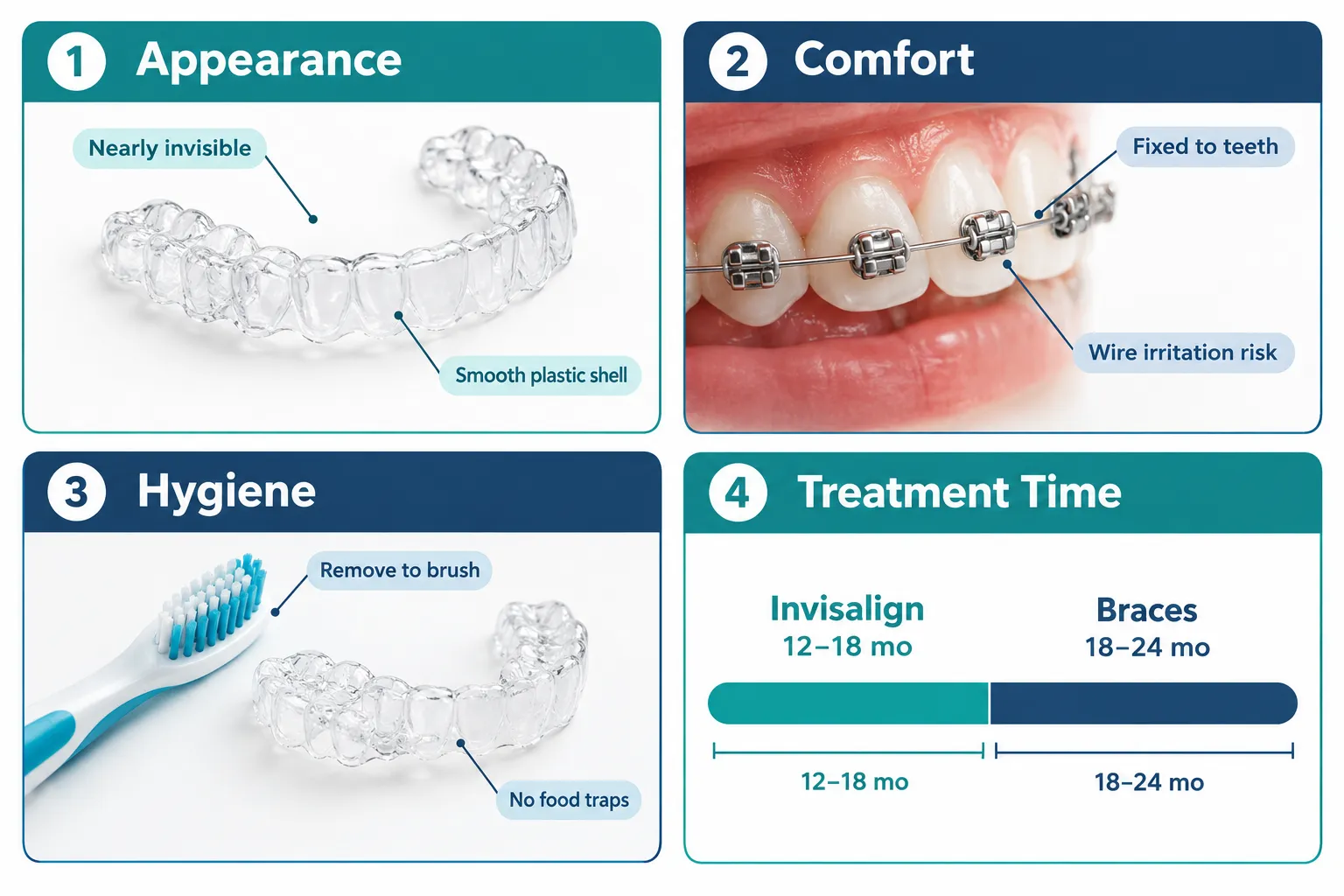
Both systems apply controlled force to shift teeth. The core difference is how that force is delivered, and that difference ripples out into comfort, hygiene, lifestyle, and suitability for different clinical cases.
How Treatment Time Compares
Clinical data consistently shows that Invisalign finishes faster for most adult cases. Average treatment duration for adults runs about 14-18 months with clear aligners versus 18-24 months with traditional braces. For teenagers, one large study found aligner patients finished roughly six months sooner on average. That said, treatment time depends heavily on case complexity. Severe crowding or significant bite issues may require the full range of either system, or may point toward braces as the better tool.
Curious about the specifics? Our article on whether traditional braces are faster than Invisalign breaks down the timeline data in more detail.
Invisalign vs. Braces: How to Choose the Right Option for Your Smile, The Five Main Factors
Choosing between these two systems is not about which one is universally “better.” It is about which one fits your specific clinical needs, daily habits, and personal priorities. Here are the five factors that matter most.
1. Complexity of Your Case
This is the single most important factor, and it is one only an orthodontist can assess.
Invisalign and other clear aligner systems are well-suited for roughly 90% of cases, mild to moderate crowding, spacing issues, and many bite problems including overbites and underbites. If you want to explore whether aligners can address your specific bite concern, see our dedicated article on whether Invisalign can fix overbite issues.
Nevertheless, traditional braces retain a clear advantage for:
- Severe crowding requiring tooth extraction
- Significant skeletal discrepancies
- Complex movements such as substantial root torque, extrusion, or intrusion
- Cases where precise final occlusion is critical
A 2020 meta-analysis (cited in recent orthodontic literature) found that fixed braces still deliver superior results for detailed bite correction in complex cases. If your situation falls into this category, braces are likely the clinically stronger recommendation regardless of your aesthetic preferences.
2. Compliance and Lifestyle
Invisalign aligners must be worn 20-22 hours per day. They are removed only for eating, drinking anything other than water, and brushing. Patients who are honest with themselves about their habits, whether that is forgetting to put trays back in after meals, or frequently snacking throughout the day, often achieve better outcomes with braces, which work continuously because they cannot be removed.
This is not a judgment; it is a clinical reality. An aligner sitting on a restaurant table for three hours is not moving teeth.
Who tends to do best with Invisalign:
- Adults and older teens with consistent daily routines
- Patients motivated by aesthetics and comfort
- Those who travel frequently or play contact sports or wind instruments
Who tends to do best with braces:
- Younger teens who may struggle with compliance
- Patients with complex cases requiring precise mechanical control
- Anyone who prefers a “set it and forget it” approach to treatment
3. Comfort and Aesthetics
Patient satisfaction surveys consistently favor clear aligners. In one adult trial, 85% of aligner patients reported high satisfaction compared with 65% of brace patients. Discomfort scores told an even clearer story: aligners averaged 2.3 out of 10 on a pain scale versus 5.6 for braces. Soft-tissue irritation from brackets and wires is a real consideration, especially in the first weeks of treatment. Our article on whether braces hurt and how to reduce discomfort offers practical guidance for managing that adjustment period.
For patients who are anxious about dental procedures, the removability of aligners and the absence of sharp hardware can make treatment feel significantly less intimidating. Dr. Linda Lee and the Madison Dental Art team are experienced in helping anxiety-prone patients navigate orthodontic care, and our article on how to tell your dentist you have anxiety is a good starting point.
4. Hygiene and Diet
One of the most underappreciated advantages of Invisalign is the ability to maintain normal oral hygiene. With braces, brackets and wires create additional surfaces where plaque accumulates. Brushing and flossing require more time and specialized tools. Certain foods, sticky candies, hard nuts, popcorn, chewy bread, are off-limits entirely.
With Invisalign, you remove the trays to eat and brush normally. This makes it easier to maintain gum health throughout treatment, which matters especially for patients who already show early signs of gum sensitivity. Maintaining healthy gums during orthodontic treatment is important; if you want to understand the relationship between gum health and long-term outcomes, our overview of how long you can keep your teeth with periodontal disease provides useful context.
5. Cost and Insurance
In 2026, traditional metal braces in the United States typically range from approximately $2,500 to $7,500. Invisalign generally runs from $3,500 to $8,500, reflecting higher laboratory and digital fabrication costs. The ranges overlap significantly, and local pricing varies based on case complexity and provider.
Many dental insurance plans cover a portion of orthodontic treatment regardless of which system you choose, though coverage limits and terms differ. Madison Dental Art accepts multiple insurance plans, visit our insurance page for details. For a deeper look at what to expect financially, our guide on how much braces cost with insurance covers real numbers and coverage scenarios.
What to Expect at Madison Dental Art
At Madison Dental Art, orthodontic consultations with Dr. Susan Huh begin with a thorough clinical evaluation that may include digital X-rays or a 3D panoramic scan, technology available in-house at our Forest Hills office. This imaging allows Dr. Huh to assess bone structure, root positions, and bite relationships before recommending a treatment path.
Whether the recommendation is Invisalign in Forest Hills or traditional braces, patients receive a personalized treatment plan with a clear timeline, visit schedule, and expected outcomes. The practice has served Queens families since 1994, and that depth of experience means Dr. Huh has managed a wide range of cases, from simple alignment corrections to complex bite reconstructions.
A Quick Side-by-Side Summary
| Factor | Invisalign | Traditional Braces |
|---|---|---|
| Visibility | Nearly invisible | Visible brackets and wires |
| Comfort | Higher (avg. 2.3/10 discomfort) | Lower (avg. 5.6/10 discomfort) |
| Avg. Treatment Time | 12-18 months (adults) | 18-24 months |
| Compliance Required | 20-22 hrs/day (patient-dependent) | Continuous (fixed) |
| Complex Cases | Suitable for ~90% of cases | Preferred for severe/complex |
| Diet Restrictions | None (remove to eat) | Yes (avoid hard/sticky foods) |
| Long-Term Stability | Excellent with retainer use | Excellent with retainer use |
FAQs
Is Invisalign as effective as braces for fixing crooked teeth?
For most patients, yes. Clinical studies show both systems achieve success rates of around 88-90% for correcting malocclusion, and long-term stability is comparable when retainers are worn consistently after treatment. The main distinction is case complexity, for severe crowding or complex bite issues, traditional braces often deliver more precise results. For mild to moderate alignment problems, Invisalign performs equally well and often finishes faster. The best way to know which applies to your situation is a thorough evaluation with an orthodontist.
Can teenagers use Invisalign, or is it only for adults?
Invisalign offers a teen-specific program, and clinical data supports its use for adolescents. One study tracking 12- to 18-year-olds found that teens using clear aligners finished treatment roughly six months sooner than those in traditional braces (18 months vs. 24 months on average). The main consideration for teens is compliance, aligners must be worn 20-22 hours per day, which requires consistent self-discipline. For teens who may struggle with that responsibility, braces provide the same corrective force without relying on the patient to remember to wear them.
What happens after orthodontic treatment ends, do I need a retainer?
Yes, regardless of whether you used Invisalign or braces. Teeth have a natural tendency to shift back toward their original positions after active treatment ends. Wearing a retainer as directed by your orthodontist is the primary factor determining long-term stability. Research confirms that both systems show excellent durability when retainers are used, with no clinically significant difference in relapse rates between the two.
How do I know which option is right for me without seeing a dentist first?
A: Honestly, you cannot make a fully informed decision without a clinical evaluation. Online quizzes and comparison articles, including this one, can help you comrehend the factors involved and prepare smart questions for your consultation. But the right choice depends on your specific bite, bone structure, age, and lifestyle, all of which require an in-person assessment. At Madison Dental Art, Dr. Susan Huh uses digital imaging and a comprehensive clinical review to give each patient a personalized recommendation.
References
- American Association of Orthodontists. (2022). Clinical practice guidelines for orthodontic treatment. https://www.aaoinfo.org/
- National Institute of Dental and Craniofacial Research. (2023). Orthodontic treatments: What you need to know. U.S. Department of Health and Human Services. https://www.nidcr.nih.gov/
- Ke, Y., Zhu, Y., & Zhu, M. (2019). A comparison of treatment effectiveness between clear aligner and fixed appliance therapies. BMC Oral Health, 19(1), 24. https://doi.org/10.1186/s12903-018-0695-z (cited in 2023 systematic reviews)
- Papageorgiou, S. N., Koletsi, D., & Eliades, T. (2020). Does combined orthodontic treatment with clear aligners lead to fewer occlusal contacts? European Journal of Orthodontics, 42(5), 531-537. https://doi.org/10.1093/ejo/cjaa006
- American Dental Association. (2023). Orthodontics. MouthHealthy patient education resource. https://www.mouthhealthy.org/en/az-topics/o/orthodontics
- University of Michigan School of Dentistry. (2022). Orthodontic treatment outcomes: Aligners vs. fixed appliances, a clinical review. https://dent.umich.edu/
Madison Dental Art
Content written and reviewed by
Madison Dental Art Review Board
Madison Dental Art : Experienced dentists and specialists dedicated to providing accurate, trusted, and patient-focused oral health information.
Important information
The content of this article is for strictly educational and informational purposes. It does not replace in-person professional medical diagnosis, advice, or treatment.


