 by Madison Dental Art Review Board
More than 40 million Americans wear some form of removable denture, yet a surprisingly large number quietly struggle with appliances that slip, rock, or require growing amounts of adhesive just to stay in place. If your dentures feel loose, the problem is rarely the adhesive brand you are using. It is almost always the shape of the tissue underneath. The good news is that a professional denture reline can often restore a secure, comfortable fit without the cost of starting over entirely. This guide explains why dentures loosen, what a reline actually does, when one is the right call, and when a different solution makes more sense.
Key Takeaways
- Jaw bone and gum tissue shrink gradually after tooth loss, causing even well-made dentures to loosen over time.
- A denture reline resurfaces the tissue side of your denture to match your current gum contours, restoring fit without replacing the whole appliance.
- Soft relines offer comfort for sensitive or healing tissue; hard relines deliver longer-lasting stability once tissue has settled.
- Most dentures benefit from a reline every one to two years; immediate dentures often need one within the first six to twelve months.
- Relying on more adhesive instead of addressing poor fit can mask underlying changes and lead to sore spots or oral irritation.
Table of Contents
Why Dentures Loosen Over Time
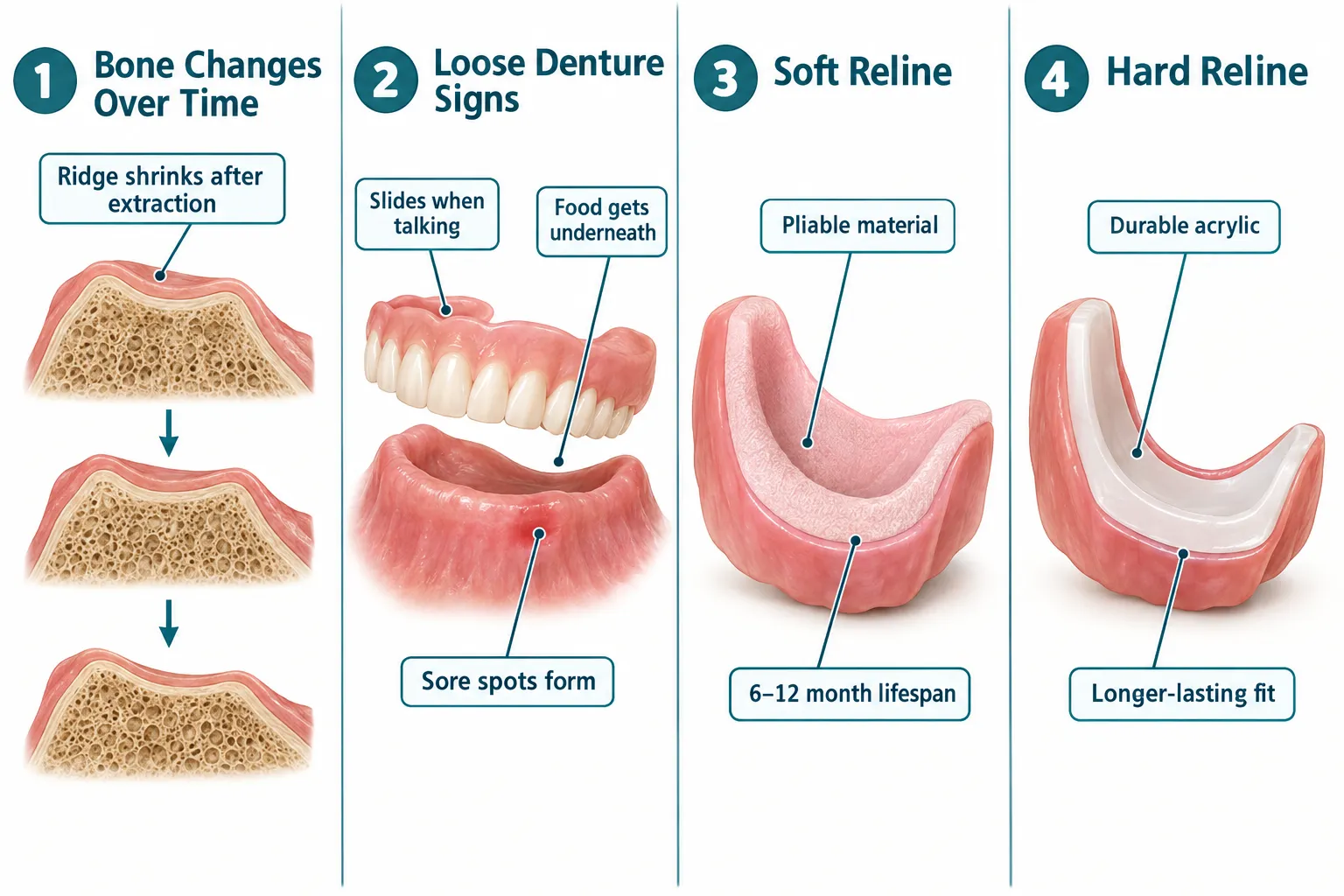
The moment teeth are removed, the underlying jawbone begins to remodel. Without tooth roots to stimulate the bone, the ridge that once supported your natural teeth gradually resorbs, it shrinks both in height and width. Your gum tissue follows suit, changing shape over months and years. The denture, which was custom-fitted to a specific ridge shape at the time it was made, slowly loses contact with that shifting surface.
This is not a sign of a poorly made denture or something you did wrong. It is a predictable biological process. In the first twelve months after extractions, the changes can be especially rapid. That is why are dentures comfortable? What to expect, how to adjust, and living with them daily is such a common question for new denture wearers, early loosening often catches people off guard.
Common signs that your denture fit has changed:
- The denture shifts, rocks, or “floats” when you talk or chew
- Food consistently gets trapped underneath the base
- You need noticeably more adhesive than you did six months ago
- Sore spots develop on the gums, particularly after eating
- Your speech has changed, with more slipping sounds or clicks
- Your face looks slightly sunken or your bite feels uneven
The American Dental Association is clear: denture adhesives are not a remedy for an ill-fitting denture. Using more adhesive to compensate for a loose appliance can actually mask the underlying tissue changes and lead to oral sores or lesions. If any of the signs above sound familiar, the right move is a professional evaluation, not another tube of adhesive.
Loose dentures also carry functional consequences beyond discomfort. Unstable appliances make it harder to chew a nutritious diet, which matters especially for older adults. You can read more about this in our guide on can you eat with dentures? Here’s what to know. In some cases, chronic instability can even accelerate bone loss by creating uneven pressure on the ridge, reinforcing why prompt attention to fit is a health matter, not just a comfort preference.
The Role of Immediate Dentures
Patients who received immediate dentures, appliances placed the same day as extractions, are especially likely to need an early reline. Because the denture is fitted before healing is complete, the jaw changes substantially in the first months post-surgery. Most clinicians recommend expecting a first reline within six to twelve months for immediate dentures, with additional adjustments as healing progresses.
What a Denture Reline Is (and the Types Available)
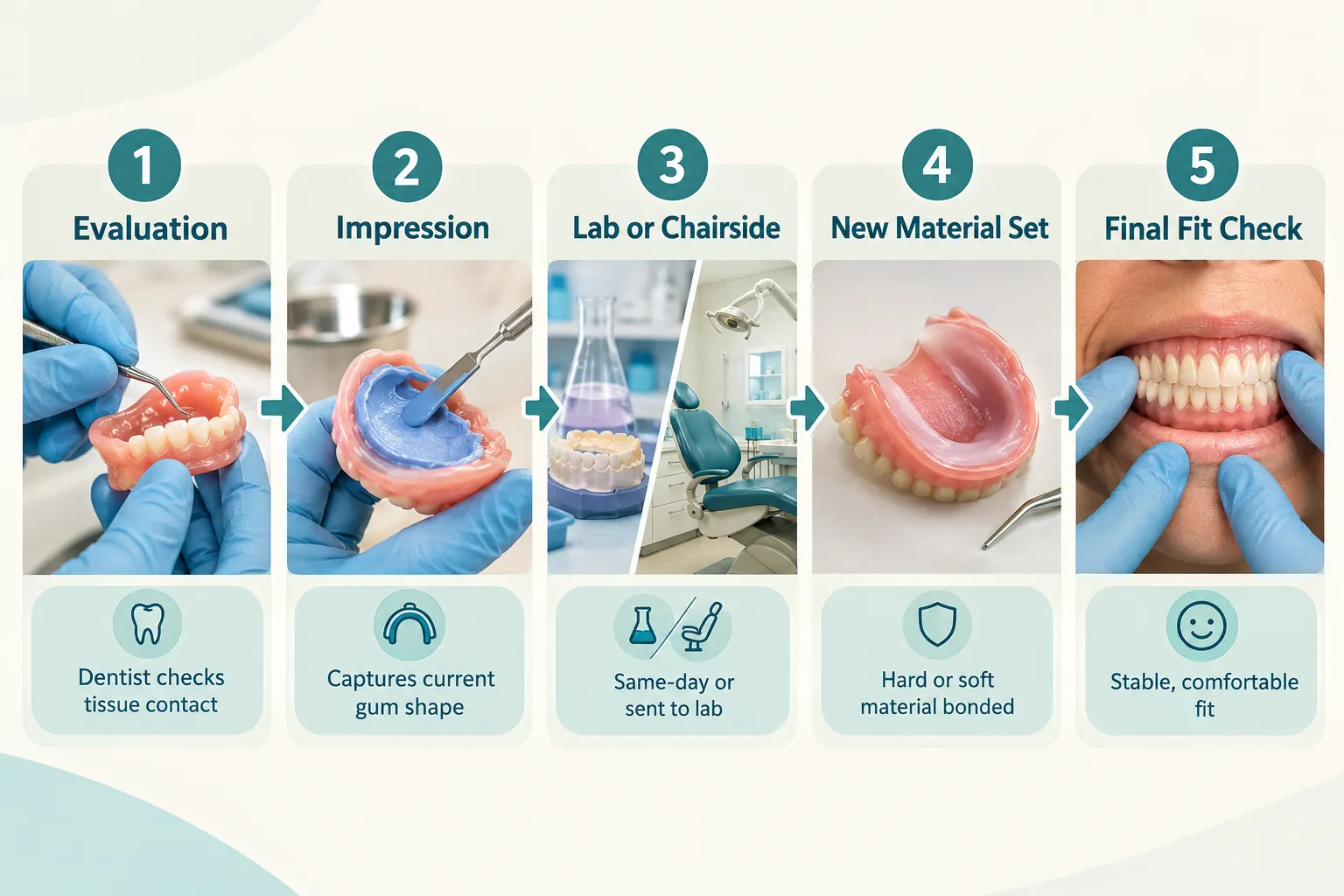
A reline is a procedure that resurfaces the tissue-side of your existing denture, the part that sits against your gums, so that it conforms closely to your current gum and bone contours. The visible teeth and the overall shape of the denture remain the same. Only the inner surface is updated to close the gap that has developed between the appliance and your mouth.
Think of it like re-soling a well-made shoe. The upper is still good; only the contact surface needs renewal.
Soft Reline
A soft reline uses a pliable, cushioning material applied to the tissue side of the denture. It is best suited for patients whose gum tissue is tender, thin, or still healing. Because the material is flexible, it distributes pressure more evenly across sensitive ridges, reducing sore spots significantly. The trade-off is longevity, soft reline materials typically need to be replaced every six to twelve months, as they compress and degrade with daily wear. They are a comfort-first option rather than a permanent fix.
Hard Reline
A hard reline uses rigid acrylic material, essentially the same type used in the denture base itself. It is the standard, longer-lasting option and is generally recommended once tissues have stabilized. A hard reline can be performed chairside (directly in the office) or as a laboratory-processed procedure.
Chairside reline: The dentist takes an impression directly inside your denture and adds new material while you are in the chair. The process typically takes thirty to ninety minutes, and you leave with your adjusted denture the same day. It is convenient, but the material may not be as precisely finished as a lab-processed version.
Lab-processed reline: The impression is taken chairside, but the denture is sent to a dental laboratory where technicians replace the impression material with finished denture acrylic. You are without your denture for a day or two, but the result is more precise and typically more durable. For patients who rely heavily on their dentures for daily function and appearance, the lab-processed route is often worth the short wait.
Most dentures benefit from a reline roughly every one to two years, though this varies based on how rapidly your bone and tissue change, your overall health, and how heavily you use the appliance.
When a Reline Is the Right Answer, and When It Is Not
A reline is usually the right choice when:
- The denture looks good and the teeth show minimal wear
- The looseness developed gradually rather than from a crack or break
- The denture is fewer than five years old
- No significant changes in bite alignment have occurred
Replacement becomes the better option when the denture is more than five years old, when teeth are excessively worn or stained, when the base material is cracked or warped, or when the bite relationship no longer functions correctly. A professional evaluation is the only reliable way to know which category you fall into.
For patients wondering whether implant-supported options might offer a more permanent answer to chronic looseness, our comparison of implant vs traditional dentures: which is more secure? offers a useful overview.
Comprehending Cost
Reline costs in the U.S. vary by region, type, and whether laboratory work is involved. Soft relines tend to fall in a lower range, chairside hard relines in the mid range, and lab-processed hard relines at the higher end of the spectrum. Many dental insurance plans that cover dentures will also contribute toward reline fees, often with a frequency limitation of once every one to two years depending on the plan. The team at Madison Dental Art can review your coverage and help you understand what to expect, visit our insurance information page for a full list of accepted plans.
If cost is a broader concern and you are weighing all your options, our guide on how much does a complete set of dentures cost? provides context for both new dentures and maintenance procedures.
FAQs:
Can I use an over-the-counter reline kit instead of seeing a dentist?
Over-the-counter reline kits are marketed as short-term, stopgap solutions. They can provide temporary relief, but they are not a substitute for a professional reline. Home-applied materials are less precise, may alter your bite if not applied correctly, and can make a subsequent professional reline more difficult. The American Dental Association’s position is that ill-fitting dentures should be professionally relined or replaced, not managed indefinitely with self-applied products or more adhesive.
How do I know if I need a reline or entirely new dentures?
If your dentures are fewer than five years old, the teeth look good, and the base is intact, a reline is usually the first recommendation. If the denture is older, the teeth are significantly worn, the base has cracked, or the bite feels wrong even after a reline, your dentist may recommend new dentures. Our article on what are permanent dentures and how do they work can help you understand longer-term options if a replacement is on the horizon.
Will a denture reline change how my dentures look?
No. A reline only modifies the inner, tissue-facing surface of the denture. The visible teeth and the outer shape of the appliance remain exactly the same. Most patients report that their dentures look identical after a reline, they just fit and feel noticeably better.
How do I find a qualified provider for a denture reline in Forest Hills or Queens?
You want a practice with dedicated prosthodontic expertise and a team experienced in removable appliances. At Madison Dental Art, founded in Forest Hills by Dr. Alexander Chao in 1994, our prosthodontics team handles denture care, including relines, using current clinical standards. You can schedule an evaluation by calling (718) 268-8228 or visiting our contact page. We are located at 112-03 Queens Boulevard, Suite 211, Forest Hills, NY 11375, and we welcome patients from across greater New York City.
References
- American Dental Association. Denture Care and Oral Health Guidance. ADA.org. https://www.ada.org/resources/research/science-and-research-institute/oral-health-topics/dentures
- American College of Prosthodontists. Dentures. Prosthodontics.org. https://www.prosthodontics.org/patient-resources/dentures/
- National Institute on Aging, National Institutes of Health. Taking Care of Your Teeth and Mouth. NIH.gov. Updated 2021. https://www.nia.nih.gov/health/dental-health/taking-care-your-teeth-and-mouth
- Vojdani M, Giti R. Polyamide as a Denture Base Material: A Literature Review. Journal of Dentistry, Shiraz University of Medical Sciences. 2015 (referenced in updated clinical context through 2022). https://www.ncbi.nlm.nih.gov/pmc/articles/PMC4536962/
- Koshiyama Y, et al. Factors affecting residual ridge resorption under complete dentures. Journal of Prosthodontic Research. 2022. https://www.ncbi.nlm.nih.gov/
Madison Dental Art
Content written and reviewed by
Madison Dental Art Review Board
Madison Dental Art : Experienced dentists and specialists dedicated to providing accurate, trusted, and patient-focused oral health information.
Important information
The content of this article is for strictly educational and informational purposes. It does not replace in-person professional medical diagnosis, advice, or treatment.


