 by Madison Dental Art Review Board
A single missing tooth may seem like a small problem, but left untreated it can shift neighboring teeth, affect your bite, and compromise long-term oral health. Among the fixed options available to replace it, the cantilever bridge dental design is one of the least understood, and one of the most misapplied. Knowing exactly what it is, where it succeeds, and where it creates risk can help patients and clinicians make better decisions together.
Table of Contents
Key Takeaways
- A cantilever bridge dental prosthesis is anchored on one side only, unlike a conventional bridge that uses abutment teeth on both sides.
- It works best in low-force anterior (front) areas; it carries significant mechanical risk in posterior (back) regions.
- Resin-bonded cantilever bridges (Maryland-style) offer a minimally invasive option for certain anterior single-tooth replacements.
- Connector size, occlusal load, and abutment tooth health are the most critical factors determining long-term success.
- Dental implants remain the standard of care for most single-tooth replacements, but cantilever bridges are a recognized, evidence-supported alternative in carefully selected cases.
What Is a Cantilever Bridge Dental Prosthesis?
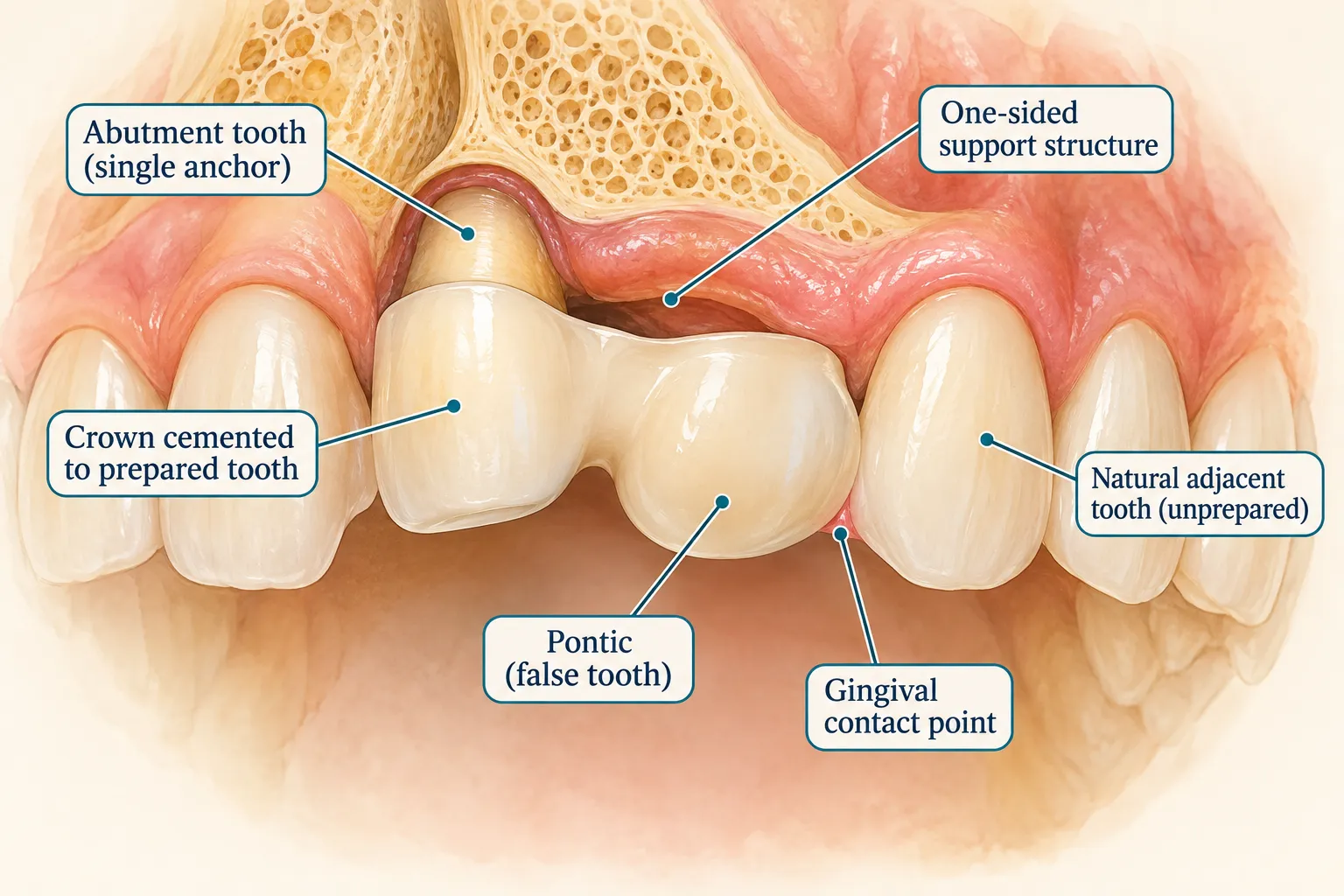
In standard bridge design, a false tooth (the pontic) hangs between two crowns that are cemented onto the prepared teeth on either side. A cantilever bridge dental prosthesis is different: the pontic is supported on one end only. One or more abutment teeth anchor the structure on a single side, leaving the other end of the prosthesis unsupported, like a diving board fixed to a wall at one end.
Dentistry treats it as a fixed prosthodontic design distinct from a conventional bridge: a legitimate option, but one with its own biomechanics.
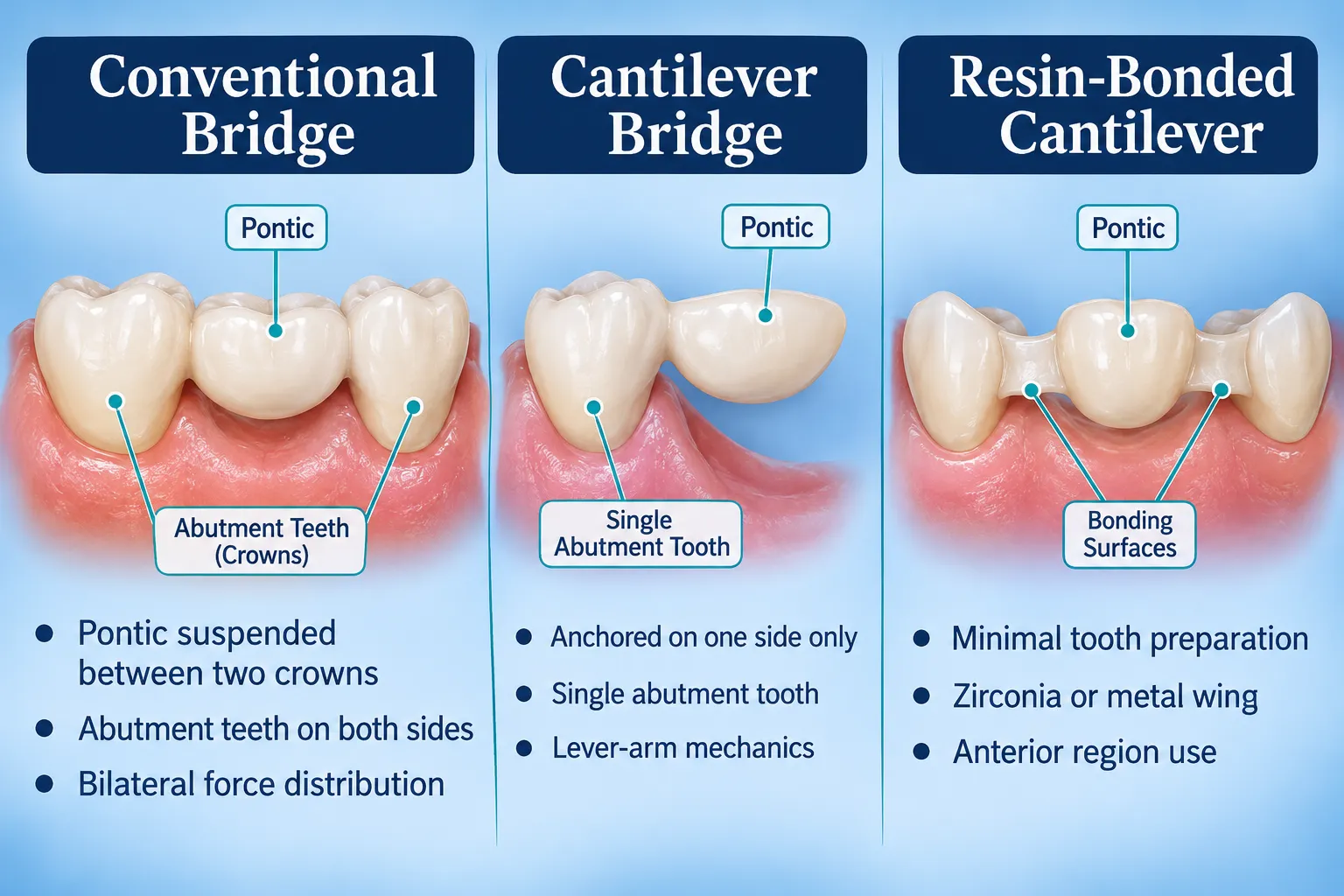
There are two main forms in clinical use today:
| Type | Abutment Prep | Typical Use |
|---|---|---|
| Full-coverage cantilever bridge | Crowns placed on abutment teeth | Single posterior or anterior tooth replacement |
| Resin-bonded cantilever bridge (RBFDP) | Minimal or no enamel removal; wing bonded to adjacent tooth | Anterior single-tooth replacement, younger patients |
The resin-bonded variant, often called a Maryland bridge, has gained ground with the arrival of high-strength zirconia ceramics. No-preparation zirconia cantilever resin-bonded prostheses have performed well over the medium term in everyday practice.
How a Cantilever Bridge Dental Design Differs Biomechanically
Understanding the physics here matters because it directly predicts where problems arise.
In a conventional three-unit bridge, forces applied to the pontic are distributed across both abutments simultaneously. In a cantilever design, the same force creates a lever arm, the pontic acts like the long end of a seesaw, transferring amplified rotational stress onto the single abutment. The result is:
- Higher tipping forces on the supporting tooth
- Greater risk of abutment loosening when implants are used instead of natural teeth
- Increased fracture risk at the connector between pontic and abutment
Connector dimensions, ceramic material properties and the direction of bite load all affect how that stress is distributed. Adequate connector height and thickness are not aesthetic details, they are structural requirements.
Conventional bridge geometry resists fracture better than a cantilever extension on a single support, which is why it stays the preferred choice whenever the anatomy allows it.
For dental bridge treatment in Forest Hills, the team at Madison Dental Art evaluates each patient’s occlusion, bone support, and abutment tooth health before recommending any bridge configuration.
When a Cantilever Bridge Dental Design Works Well
Anterior Single-Tooth Replacement
The anterior region, particularly the upper lateral incisors, sees relatively low bite forces and favorable load angles. This makes it the most appropriate zone for cantilever bridge use. Specific scenarios where a cantilever approach is well supported include:
- Congenitally missing lateral incisors in younger patients who are not yet candidates for implants
- Patients who want to avoid surgery and are willing to accept a conservative bonded solution
- Cases where the adjacent tooth requires a crown anyway, making a full-coverage cantilever a logical extension of existing treatment
For a missing upper lateral incisor, an anterior cantilever zirconia resin-bonded prosthesis, combined where needed with soft-tissue work, can give an esthetic result with very little intervention, a viable alternative to implant therapy for patients who prioritise tissue preservation.
When Implants Are Not an Option
Some patients cannot receive implants due to insufficient bone volume, systemic health factors, or personal preference. In these cases, a resin-bonded cantilever bridge can serve as a long-term conservative alternative without the need for bone grafting procedures that implants sometimes require.
A well-designed anterior cantilever bridge, bonded with meticulous enamel preparation and controlled occlusion, can be a durable, tooth-preserving solution, not a compromise.
When a Cantilever Bridge Dental Design Does Not Work
Posterior Regions
Clinical guidance is unambiguous here: cantilever construction should be avoided in posterior areas. Molar and premolar regions generate bite forces several times higher than the anterior zone, and the lever-arm effect described above becomes far more destructive at the back of the mouth. The likely consequences include:
- Abutment tooth fracture
- Crown debonding
- Bone loss around the supporting tooth
- Implant screw loosening if implants are used
On implant-supported cantilever prostheses the abutment screws also tend to loosen more readily than on splinted designs, a telling sign of mechanical instability.
Patients with Bruxism or Heavy Occlusal Load
Teeth grinders place unpredictable, high-magnitude forces on restorations. A cantilever design has no tolerance for this type of stress. Parafunctional habits are a contraindication unless they are well managed with an occlusal guard.
Poor Abutment Tooth Health
If the supporting tooth has significant bone loss, prior root canal treatment, or large existing restorations, it may lack the structural integrity to serve as a sole anchor. The health and periodontium of the abutment tooth are as important as the design of the prosthesis itself. Regular monitoring, including periodic dental crown evaluation for the abutment restoration, is essential.
Resin-Bonded Cantilever Bridges: The Minimally Invasive Option
The most conservative form of cantilever bridge dental treatment involves bonding a pontic to a single adjacent tooth via a thin zirconia or metal wing, with little or no drilling of the supporting tooth.
Advantages:
- Preserves natural tooth structure
- Reversible in many cases
- Shorter treatment time
- No surgical procedure
Limitations:
- Lower long-term data compared to full-coverage designs
- Dependent on excellent bonding technique
- Not suitable for high-force areas
What decides whether these restorations last is meticulous enamel bonding, occlusal control and strict patient selection. CAD/CAM technology has advanced this option further, enabling “prepless” cantilever resin-bonded bridges fabricated with precise digital workflows that improve fit and reduce technique sensitivity.
For patients exploring all tooth replacement paths, it is worth reviewing what distinguishes dental implants from other options before committing to any fixed prosthesis.
Cantilever Bridge vs. Conventional Bridge vs. Implant
| Factor | Cantilever Bridge | Conventional Bridge | Implant |
|---|---|---|---|
| Tooth preparation | One tooth (or none for RBFDP) | Two teeth | None |
| Surgical procedure | No | No | Yes |
| Best for posterior | Generally not recommended | Yes | Yes |
| Best for anterior | Yes (selected cases) | Yes | Yes |
| Bone preservation | Moderate | Moderate | Best |
Implants remain the gold standard for most single-tooth replacements because they preserve bone, do not involve adjacent teeth, and carry strong long-term outcome data. Patients curious about the implant route can explore dental implant options at our Forest Hills practice to understand if that path is appropriate for their situation.
Understanding whether a dental bridge is permanent is another important question patients raise, full-coverage bridges, including cantilever designs, are fixed restorations but are not lifetime guarantees; they require maintenance and may eventually need replacement.
Frequently Asked Questions
Is a cantilever bridge dental option suitable for back teeth? Generally no. Clinical guidelines and biomechanical evidence strongly advise against cantilever designs in posterior regions because bite forces there are too high for a single-abutment design to sustain safely over time.
How long does a cantilever bridge last? Longevity depends heavily on patient selection, abutment tooth health, occlusal load, and maintenance. No specific guarantee can be given, but well-designed anterior resin-bonded cantilever bridges hold up steadily over many years.
Does a resin-bonded cantilever bridge require drilling the supporting tooth? Modern no-prep zirconia designs require minimal to no removal of tooth structure. This is one of their primary advantages, particularly for younger patients where preserving enamel is a priority.
Can a cantilever bridge be supported by an implant? Implant-supported cantilever bridges exist, but they carry significant mechanical concerns. Abutment screw loosening is a well-known risk, and clinicians generally prefer splinted or conventional designs over implant cantilevers wherever feasible.
What happens if the abutment tooth of a cantilever bridge fails? If the sole supporting tooth is lost or severely damaged, the entire prosthesis fails. This is a key vulnerability of the cantilever design compared to a conventional bridge with two abutments or an independent implant.
Who is an ideal candidate for a cantilever bridge dental procedure? An ideal candidate has a missing anterior tooth, healthy adjacent teeth with good bone support, a controlled bite with no bruxism, and either cannot receive an implant or prefers a non-surgical option.
Conclusion
The cantilever bridge dental design is not a shortcut or an inferior option, in the right clinical scenario, it is a well-supported, evidence-backed prosthetic solution. Its strength lies in anterior single-tooth cases where minimal tooth preparation matters and surgical procedures are not preferred. Its weakness is everywhere else, particularly in the posterior region where bite forces overwhelm the single-abutment design.
Actionable next steps:
- If you are missing a front tooth and want to explore conservative options, ask your dentist specifically about resin-bonded cantilever bridges using zirconia.
- If the missing tooth is a molar or premolar, discuss conventional bridge or implant options instead, the biomechanics simply do not favor a cantilever here.
- Have your abutment tooth assessed thoroughly, bone level, existing restorations, and periodontal health all determine whether it can bear the load.
- For a comprehensive evaluation, contact Madison Dental Art in Forest Hills, Queens to discuss which fixed prosthetic solution fits your specific anatomy and goals.
The right bridge design saves teeth and function. The wrong one risks both.
Madison Dental Art
Content written and reviewed by
Madison Dental Art Review Board
Madison Dental Art : Experienced dentists and specialists dedicated to providing accurate, trusted, and patient-focused oral health information.
Important information
The content of this article is for strictly educational and informational purposes. It does not replace in-person professional medical diagnosis, advice, or treatment.


