 by Madison Dental Art Review Board
A missing front tooth is one of the most immediately noticeable dental changes a person can experience, it affects speech, biting function, and the first impression a smile makes. Dental bridges for front teeth offer a reliable, fixed solution that restores both appearance and function without the surgical timeline of an implant. Whether you are missing a single incisor or multiple anterior teeth, understanding the bridge options available, the materials involved, and the realistic treatment process will help you make a confident, informed decision.
Table of Contents
Key Takeaways
- Dental bridges for front teeth come in three primary types: traditional (tooth-supported), Maryland (resin-bonded), and implant-supported, each suited to different clinical situations.
- Material choice matters significantly for front teeth; porcelain-fused-to-metal and all-ceramic zirconia are the most common options, with real trade-offs between aesthetics and long-term durability.
- Adjacent healthy teeth must typically be prepared as abutments for a traditional bridge, which is an irreversible step patients should weigh carefully.
- A Maryland bridge is a conservative, metal-free or metal-winged alternative designed specifically for anterior (front) teeth where biting forces are lower.
- With proper oral hygiene and regular professional care, a well-made front tooth bridge can remain functional and aesthetic for ten or more years.
Types of Dental Bridges for Front Teeth
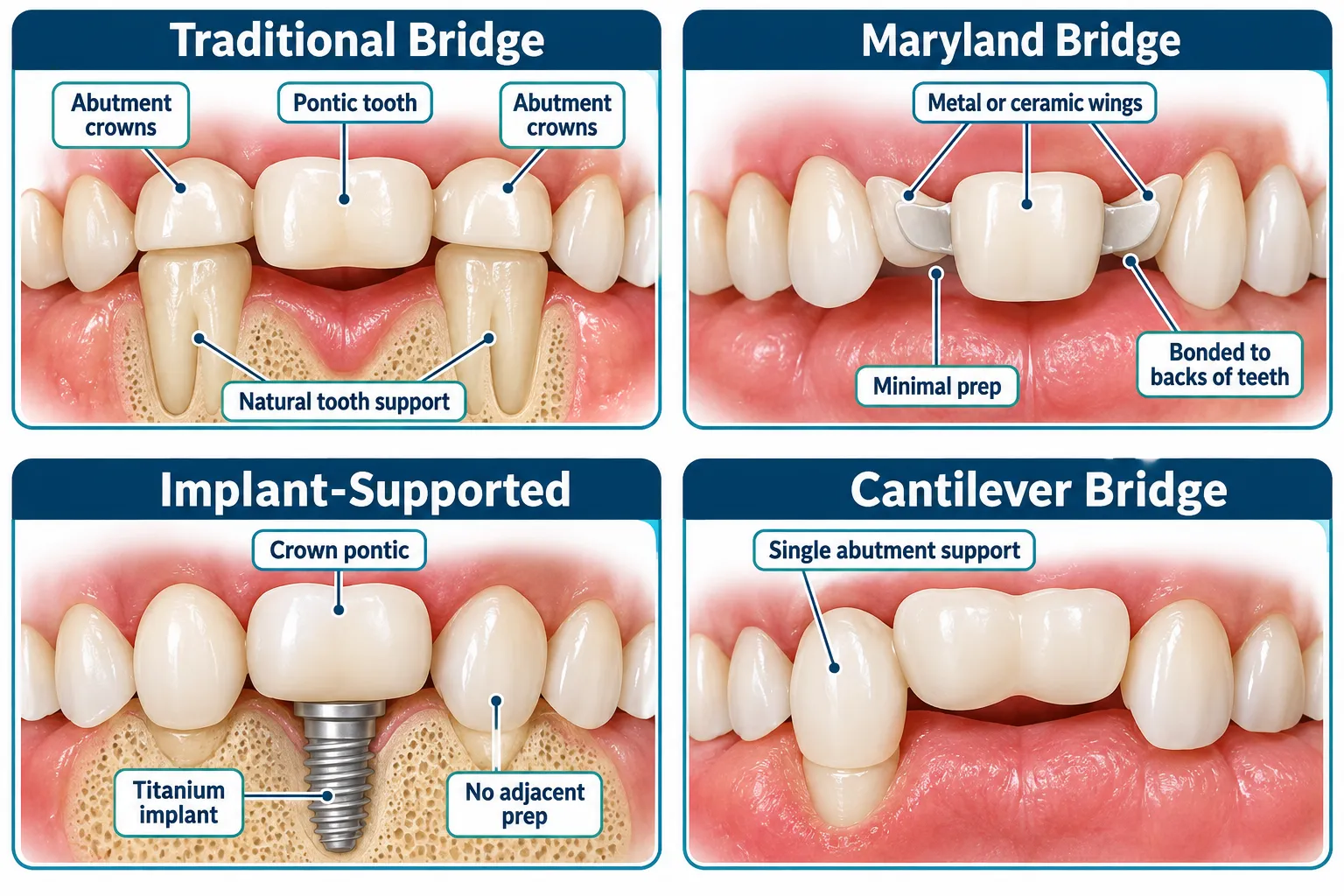
Not every bridge design works equally well in the front of the mouth. The anterior region has different demands from the back, lower biting force, higher cosmetic visibility, and closer proximity to the lip line. Here is how the main options compare.
Traditional (Tooth-Supported) Bridge
A traditional fixed bridge uses the two teeth on either side of the gap, called abutment teeth, as anchors. Each abutment is permanently reshaped and fitted with a crown, and a false tooth (the pontic) is fused between them to fill the space.
This is the most common bridge type and works well for front teeth when the neighboring teeth already have large restorations or significant decay, since those teeth will receive crowns regardless. The main trade-off is that two otherwise healthy teeth must be permanently altered. For more on how crowns function as part of this process, see dental crowns for front teeth: cost, procedure and aesthetics.
Maryland (Resin-Bonded) Bridge
The Maryland bridge is designed specifically for front teeth. A porcelain or ceramic pontic is flanked by thin metal or tooth-colored ceramic wings that bond to the backs of adjacent teeth with minimal or no drilling. Because front teeth absorb lighter forces than molars, this conservative design holds well in most cases.
Key advantages include:
- Minimal removal of natural tooth structure
- Fully reversible in many cases
- Shorter treatment timeline
- Good aesthetic results when matched correctly
The main limitation is that the wings can debond over time, particularly if the patient grinds their teeth or has a deep bite. If you are exploring whether tooth grinding affects your restorations, the article on whether to wear a night guard on upper or lower teeth offers relevant guidance.
Implant-Supported Bridge
When one or more implants are placed to support a pontic, no natural teeth are used as abutments. This is widely considered the most biomechanically sound option because it replaces the tooth root itself, preserving jawbone and protecting neighboring teeth from preparation. The trade-off is a longer overall timeline, often six months or more, and a surgical component. Learn more about what that process involves at how to fix a broken front tooth with a dental implant.
Cantilever Bridge
A cantilever design anchors the pontic to only one adjacent tooth rather than two. It is used sparingly for front teeth when only one neighboring tooth is available, and it carries a higher risk of stress on that single abutment over time.
Worth knowing:A Maryland bridge is often the first recommendation for a single missing front tooth in a younger patient whose adjacent teeth are cavity-free and unrestored, precisely because it spares healthy tooth structure.
Materials Used in Front Tooth Bridges
The front of the mouth is unforgiving when a bridge does not match the surrounding teeth in color, translucency, or texture. Material selection is therefore one of the most consequential decisions in anterior bridge treatment.
Porcelain-Fused-to-Metal (PFM)
PFM bridges combine a metal substructure for strength with a porcelain outer layer for aesthetics. They have decades of clinical track record and remain a highly reliable choice. One drawback for front teeth is a thin grey line that can appear at the gumline over time as gums recede, a cosmetic concern in a highly visible area.
All-Ceramic Zirconia
Zirconia bridges have grown rapidly in popularity for anterior cases because they are metal-free, offer excellent translucency, and match natural tooth color more closely. Zirconia frameworks are strong and hold up well over many years. The trade-off is that the porcelain veneer layer applied over the framework chips more readily than the surface of a traditional metal-ceramic bridge, an important consideration when cosmetic perfection in the smile zone is the goal.
Compared with metal-ceramic bridges, zirconia restorations tend to show more ceramic chipping over time. That does not make zirconia a poor choice for front teeth, the aesthetic benefits are real, but they do mean that connector dimensions, occlusal design, and parafunctional habits need careful assessment before committing to a zirconia bridge.
Lithium Disilicate (e.max)
Pressed ceramic materials like lithium disilicate offer an excellent balance of strength and lifelike translucency, making them a popular choice for single-unit anterior pontics, particularly in Maryland bridge designs.
| Material | Best For | Key Consideration |
|---|---|---|
| Porcelain-Fused-to-Metal | Multi-unit traditional bridges | Possible grey line at gumline |
| Zirconia (all-ceramic) | Metal-free, cosmetic priority | Higher veneer chipping risk |
| Lithium Disilicate | Single-unit anterior pontics | Less suitable for long spans |
What to Expect: The Dental Bridge Procedure for Front Teeth
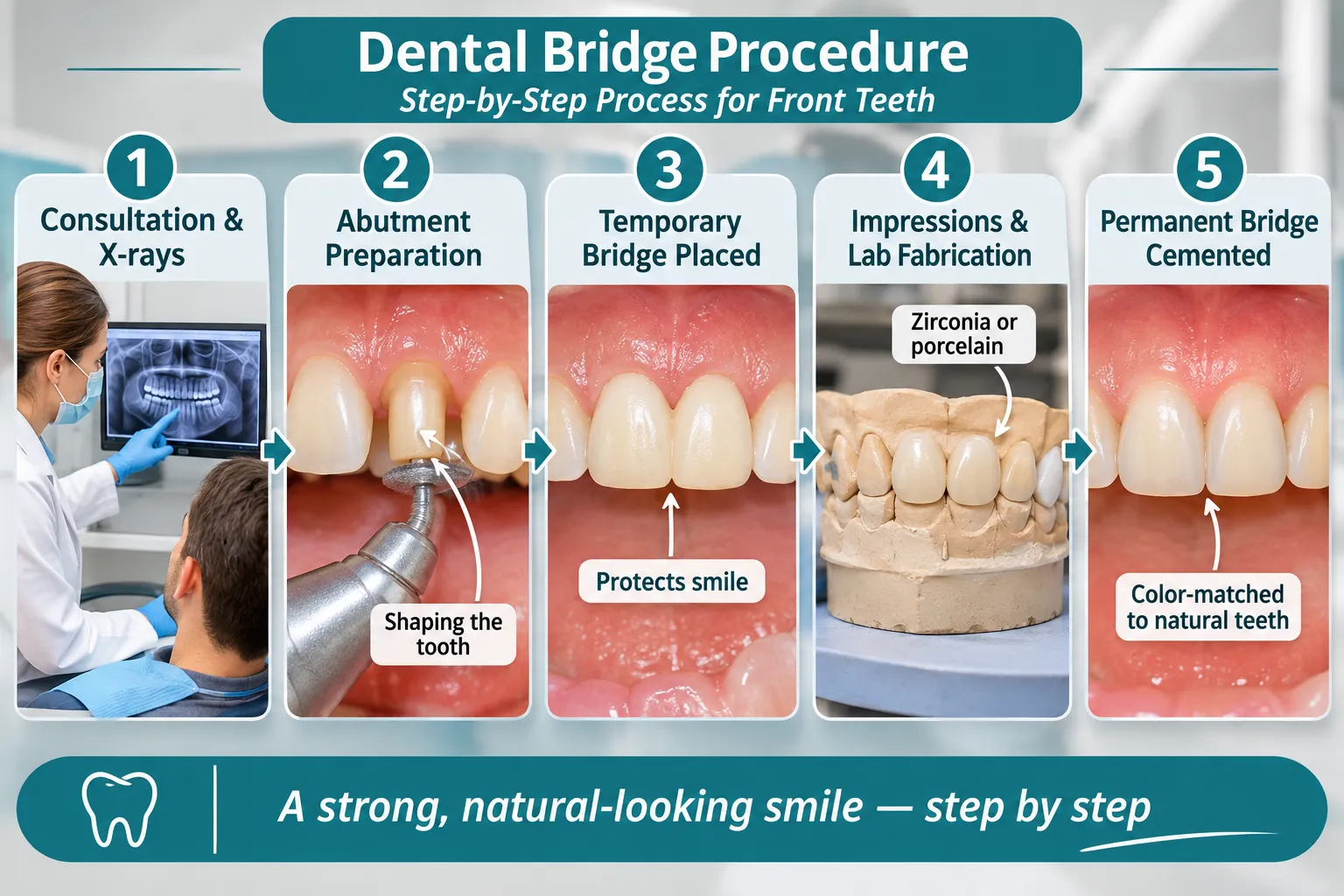
Understanding the step-by-step process helps patients plan their time and manage expectations. For dental bridge treatment in Forest Hills, the typical workflow at Madison Dental Art follows these stages:
Step 1, Consultation and Diagnosis The dentist examines the gap, surrounding teeth, gum health, and bite. X-rays assess bone levels and root health. Any underlying issues, such as gum disease, must be addressed before bridge work begins. If gum inflammation is a concern, a dental teeth scaling appointment may be recommended first.
Step 2, Abutment Preparation (Traditional Bridge) For a traditional or cantilever bridge, the abutment teeth are numbed and reshaped to accommodate the crowns. For a Maryland bridge, only minimal surface etching of the enamel backs of adjacent teeth is required.
Step 3, Impressions or Digital Scans Precise records of the prepared teeth are taken, either physical impressions or high-resolution digital scans, and sent to the dental laboratory.
Step 4, Temporary Bridge A temporary restoration protects the prepared teeth and maintains the appearance of the smile while the permanent bridge is fabricated, typically over two to three weeks.
Step 5, Fitting and Cementation At the follow-up appointment, the permanent bridge is tried in for fit, bite, and color before being permanently cemented. Minor adjustments may be made chairside.
Step 6, Follow-Up A check-up at a few weeks post-cementation allows the dentist to confirm the bite and gum response are ideal.
How a Front Tooth Bridge Looks and Feels
Modern all-ceramic and zirconia bridges can be color-matched with high precision to blend seamlessly with surrounding natural teeth. Digital shade-matching technology and skilled laboratory technicians can replicate the subtle gradients and translucency of natural enamel. For patients concerned about how whitening might affect the match, it is worth knowing that dental crowns cannot be whitened after placement, so any whitening of natural teeth should ideally be completed before the final shade is chosen.
After cementation, most patients adapt to the feel of the bridge within days. Speech may feel slightly different at first, particularly with upper front tooth bridges, but this typically resolves quickly.
Caring for Dental Bridges for Front Teeth
A bridge requires slightly different hygiene habits compared to natural teeth, primarily because the pontic sits against the gum and cannot be flossed from above. Recommended daily care includes:
- Floss threaders or interdental brushes to clean beneath the pontic
- Water flossers as a helpful adjunct for flushing debris
- Soft-bristle toothbrushing twice daily along the gumline
- Avoiding hard or very sticky foods that could dislodge or chip the bridge
- Regular professional cleanings to monitor the gum tissue beneath the pontic and check the margins of the abutment crowns
If gum disease develops around the abutment teeth, the bridge’s longevity is directly threatened. Patients who notice bleeding around the bridge should not ignore it, bleeding gums when brushing can signal early inflammation that is easier to treat when caught promptly.
Wondering how long a bridge is expected to last? The article is a dental bridge permanent gives a thorough breakdown of longevity expectations and what affects them.
Dental Bridges for Front Teeth vs. Implants: A Quick Comparison
Both options replace a missing front tooth with a fixed, non-removable restoration. The key differences are:
| Factor | Dental Bridge | Implant |
|---|---|---|
| Bone preservation | No | Yes |
| Adjacent teeth affected | Yes (traditional) | No |
| Surgical procedure required | No | Yes |
| Treatment timeline | 2-4 weeks | 3-9+ months |
| Longevity | 10-15+ years typical | 15-25+ years typical |
The right choice depends on bone availability, the condition of neighboring teeth, overall health, and personal preference. A dentist at Madison Dental Art can review imaging and clinical findings to recommend which option suits a specific patient’s situation. For a wider view of implant options, are dental implants worth it: pros and cons provides useful context.
FAQ
Can a dental bridge for front teeth be done in one visit? A traditional or Maryland bridge typically requires at least two visits, one for preparation and impressions, and one for cementation of the permanent bridge. Same-visit options using in-office milling (CAD/CAM) exist at some practices but require specific equipment and case suitability.
Will a front tooth bridge look natural? Modern all-ceramic and zirconia bridges are designed to closely match the shade, shape, and translucency of natural teeth. When shade selection is done carefully and fabricated by a skilled laboratory, the results are typically very difficult to distinguish from natural teeth.
Does getting a bridge for front teeth hurt? The preparation appointment is performed under local anesthesia, so the process itself should be comfortable. Some sensitivity is common for a few days after the abutment teeth are shaped, and again after permanent cementation as the bite settles.
How long does a front tooth bridge last? With good oral hygiene and regular check-ups, a front tooth bridge commonly lasts ten to fifteen years or longer. The gum health around the abutments and the patient’s bite habits are among the biggest factors influencing lifespan.
Is a Maryland bridge strong enough for front teeth? Yes, for most patients. Front teeth experience significantly lower biting forces than back teeth, which makes the bonded-wing design of a Maryland bridge well-suited to this region. However, it may not be appropriate for patients with a very deep overbite or parafunctional habits such as grinding.
Will insurance cover a front tooth bridge? Many dental insurance plans classify bridges as a major restorative procedure and cover a portion of the cost, though the share varies widely from plan to plan. Our front desk can review your benefits with you before treatment begins. For a detailed breakdown of what dental plans typically include, dental insurance plans that cover cosmetic dentistry is a helpful starting point.
Conclusion
Dental bridges for front teeth are a well-established, effective way to restore a complete smile after tooth loss. The choice between a traditional, Maryland, or implant-supported bridge, and between porcelain-fused-to-metal or all-ceramic materials, depends on the number of teeth missing, the health of neighboring teeth, the patient’s bite, and aesthetic goals. Each option involves real trade-offs that deserve a thorough conversation with a qualified dentist.
If you are considering a front tooth bridge in Queens, New York, the team at Madison Dental Art in Forest Hills offers a full evaluation to determine which restoration fits your clinical and cosmetic needs. Schedule a consultation to review your X-rays, discuss material options, and get a clear picture of what the process will involve for your specific situation.
Madison Dental Art
Content written and reviewed by
Madison Dental Art Review Board
Madison Dental Art : Experienced dentists and specialists dedicated to providing accurate, trusted, and patient-focused oral health information.
Important information
The content of this article is for strictly educational and informational purposes. It does not replace in-person professional medical diagnosis, advice, or treatment.


