 by Madison Dental Art Review Board
Nearly 80% of adults say an attractive smile is a social asset, yet most people do not know that the treatment delivering the best result depends entirely on why their teeth look the way they do, not just how dark they appear. When patients come to us weighing veneers vs teeth whitening, the wrong choice can mean spending money on a result that either fades in months or permanently alters healthy tooth structure when a simpler fix would have worked. This guide cuts through the confusion so you can walk into your next consultation already knowing the right questions to ask.
Talk to our cosmetic dentist — find the right treatment for you.
Table of Contents
Key Takeaways
- Teeth whitening removes surface and near-surface stains; it cannot fix chips, cracks, uneven shape, or intrinsic (deep) discoloration.
- Porcelain veneers address color, shape, size, and minor alignment issues simultaneously, but they require permanent enamel removal.
- Whitening is reversible and lower in cost; veneers are a long-term commitment with a higher upfront investment.
- Some patients benefit from whitening before veneers to match surrounding teeth, a sequencing decision best made with a dentist.
- Neither treatment is appropriate without a baseline oral health evaluation; active gum disease or decay must be resolved first.
Comprehending the Basics: Veneers vs Teeth Whitening
Before comparing outcomes, it helps to know what each treatment actually does at the tooth level.
How Professional Teeth Whitening Works
Professional in-office whitening uses a concentrated hydrogen peroxide or carbamide peroxide gel applied directly to the enamel. The bleaching agent breaks apart chromogen molecules, the compounds responsible for staining, through an oxidation reaction. At Madison Dental Art, our in-office teeth whitening in Forest Hills, Queens uses professional-grade concentrations that are significantly stronger than anything available over the counter, delivering faster and more uniform results.
Whitening works best on:
- Yellow or brown stains from coffee, tea, wine, or tobacco
- Age-related surface darkening
- Mild generalized discoloration of otherwise healthy enamel
Whitening cannot fix:
- Tetracycline antibiotic staining (gray or banded discoloration embedded in dentin)
- Fluorosis stains (white or brown spots from excess fluoride during tooth development)
- Chips, cracks, or worn edges
- Gaps or uneven tooth shape
- Existing crowns, bridges, or bonding, these do not respond to bleach
If you have noticed white spots appearing on your teeth, this is a separate issue worth investigating before whitening. Our guide on why you have white spots on your teeth suddenly explains the most common causes.
How Porcelain Veneers Work
A porcelain veneer is a thin ceramic shell, typically 0.5 to 0.7 mm thick, custom-fabricated to bond to the front surface of a tooth. To place a veneer, a small amount of enamel (roughly the same thickness as the shell) is permanently removed from the tooth surface to ensure a flush, natural fit. Because this step is irreversible, veneers represent a long-term commitment.
Our porcelain veneers service in Forest Hills, Queens is led by Dr. Alexander Chao, who graduated in the top 3% of his class at NYU College of Dentistry and ranked No. 1 in both clinical and laboratory practice. That level of precision matters enormously in cosmetic work where millimeters determine whether a smile looks natural or artificial.
Veneers work best for:
- Intrinsic (deep) stains that bleaching cannot reach
- Chipped, cracked, or worn front teeth
- Slightly misaligned or uneven teeth
- Gaps between front teeth (diastema)
- Teeth that are too small or irregularly shaped
If gaps are your primary concern, our article on how to fix a gap in front teeth walks through veneers alongside other options including bonding and orthodontics.
Veneers vs Teeth Whitening: A Side-by-Side Decision Guide
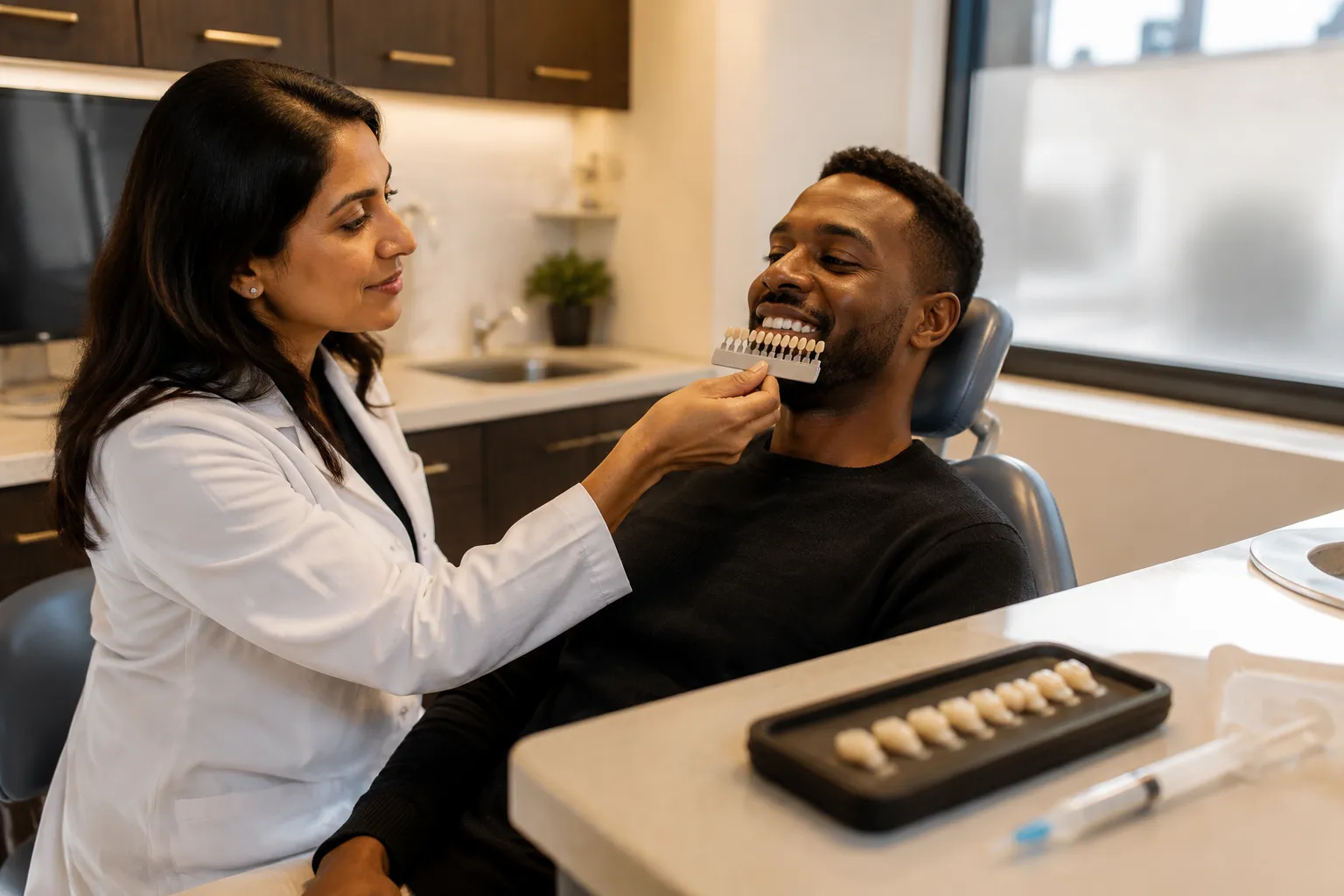
The table below summarizes the most important practical differences between the two treatments.
| Factor | Teeth Whitening | Porcelain Veneers |
|---|---|---|
| Primary purpose | Color correction only | Color, shape, size, minor alignment |
| Invasiveness | Non-invasive | Requires enamel removal (irreversible) |
| Longevity | 6 months to 2 years with maintenance | 10-20 years with proper care |
| Works on intrinsic stains | No | Yes |
| Fixes chips or cracks | No | Yes |
| Sensitivity risk | Temporary, mild to moderate | Possible during adjustment period |
| Reversibility | Fully reversible | Not reversible |
When Whitening Is the Right Call
Whitening is the appropriate starting point when your teeth are structurally sound, no chips, no cracks, no significant shape irregularities, and the discoloration is extrinsic (on or near the enamel surface). If you drink coffee daily or notice gradual yellowing with age, a professional whitening session followed by periodic touch-ups is often all you need.
It is also worth knowing what professional whitening costs before assuming it is out of reach. Our breakdown of how much professional teeth whitening costs provides current pricing context for Forest Hills and NYC patients.
One important note: if you already have veneers on some teeth and want to brighten the rest of your smile, the sequencing matters. Read our dedicated resource on teeth whitening and porcelain veneers, what you can and cannot do before proceeding.
When Veneers Are the Right Call
Veneers become the stronger clinical choice when one or more of the following apply:
- Deep or intrinsic staining, Tetracycline stains, severe fluorosis, or gray discoloration embedded in the dentin layer will not respond to bleaching. Veneers physically cover the discolored surface.
- Structural damage, A chipped or worn front tooth needs physical restoration, not just color correction. Veneers rebuild the tooth’s visible form.
- Shape and size concerns, Teeth that are too small, uneven, or have noticeable gaps can be reshaped comprehensively with veneers in a way whitening simply cannot achieve.
- Multiple cosmetic concerns at once, If you are addressing color, shape, and minor spacing simultaneously, veneers deliver a complete transformation in fewer appointments than combining multiple separate treatments.
The Role of Oral Health Before Any Cosmetic Treatment
This point cannot be overstated: neither whitening nor veneers should be placed over unhealthy teeth or gums. Active gum disease, untreated decay, or worn enamel must be addressed first. Placing cosmetic treatments over compromised oral health is like painting over a cracked wall, the underlying problem will eventually surface and compromise the cosmetic result.
If you have concerns about tooth sensitivity, our team can evaluate whether it signals worn tooth enamel or another underlying condition before any cosmetic work begins. Similarly, if you have been told you have gum concerns, our periodontics team, led by Dr. Robert Weber, a Diplomate of the American Board of Periodontology, ensures the foundation of your smile is solid before any cosmetic layer is added.
How Madison Dental Art Approaches the Veneers vs Teeth Whitening Decision
At Madison Dental Art, we do not recommend a treatment before we understand your full smile picture. Dr. Chao and our cosmetic team use a thorough consultation process, including digital X-rays and 3D panoramic imaging, to assess tooth structure, enamel thickness, gum health, and bite alignment before recommending whitening, veneers, or a combination of both.
Our practice has served Forest Hills, Queens, and greater New York City since 1994. We were voted Best Dentist in Queens in 2015, and our approach has always been to match the right treatment to the right patient, not to upsell the most expensive option.
FAQs
Can I whiten my teeth and then get veneers later?
Yes, and in many cases this is the recommended sequence. Whitening your natural teeth first allows your dentist to match your veneer shade to a brighter baseline, creating a more uniform result across your full smile. Nevertheless, you should wait at least two weeks after whitening before veneer impressions are taken, as the bleaching process temporarily affects how well bonding agents adhere to enamel.
Does teeth whitening damage enamel?
Professional whitening, when performed at recommended concentrations and intervals, does not permanently damage enamel. Research published in peer-reviewed dental journals confirms that clinically supervised bleaching protocols are safe for enamel structure. Temporary sensitivity is common and typically resolves within 24 to 48 hours.
How long do porcelain veneers last compared to whitening results?
Porcelain veneers typically last 10 to 20 years with proper care, including avoiding biting hard objects, wearing a night guard if you grind your teeth, and maintaining regular dental checkups. Professional teeth whitening results, by contrast, last roughly 6 months to 2 years depending on diet and habits, and require periodic touch-ups.
Will dental insurance cover veneers or teeth whitening?
In most cases, dental insurance classifies both porcelain veneers and professional teeth whitening as cosmetic procedures and does not cover them. Nonetheless, coverage details vary significantly by plan. If a veneer is placed for a restorative reason, such as protecting a cracked tooth, partial coverage may apply.
References
- American Dental Association. (2023). Tooth whitening/bleaching: Treatment considerations for dentists and their patients. ADA Council on Scientific Affairs. https://www.ada.org/resources/research/science-and-research-institute/oral-health-topics/tooth-whitening
- National Institute of Dental and Craniofacial Research. (2021). Cosmetic dentistry. U.S. Department of Health & Human Services. https://www.nidcr.nih.gov/health-info/cosmetic-dentistry
- Magne, P., & Belser, U. (2022). Porcelain laminate veneers: Biomechanical and esthetic considerations. In Bonded Porcelain Restorations in the Anterior Dentition (updated ed.). Quintessence Publishing.
- American Academy of Cosmetic Dentistry. (2023). State of the cosmetic dentistry industry report. AACD. https://www.aacd.com/proxy/files/Research%20and%20Surveys/2023_AACD_State_of_Industry.pdf
Madison Dental Art
Content written and reviewed by
Madison Dental Art Review Board
Madison Dental Art : Experienced dentists and specialists dedicated to providing accurate, trusted, and patient-focused oral health information.
Important information
The content of this article is for strictly educational and informational purposes. It does not replace in-person professional medical diagnosis, advice, or treatment.


